
Author Archives: RomanInUkraine
Russia warns Sweden against joining Nato
Most of Trump’s Statements about Russia and Ukraine
March, 2014: “[The invasion of Crimea] should have never happened. It should have never happened. If you’re the president that doesn’t happen. . . . with that being said, it’s their next door neighbor. It’s like us coming in and stopping us from doing something with Mexico . . . but we should definitely be strong. We should definitely do sanctions, and we have to show some strength. I mean, Putin has eaten Obama’s lunch, and therefore our lunch, for a long period of time.”
July 31, 2015: “I think I’d get along very well with Vladimir Putin.”
August, 2015: “This [Russia’s invasion of Ukraine] is Europe’s problem much more so than ours. Okay? And Europe isn’t complaining as much as we are. But this is more of a Europe problem, and if Europe comes to us and says ‘We want your help. We want your help.’ but they’re not really doing that. They’re dealing with Russia. They’re taking in the gas. They’re taking in the oil. They’re not really doing that [pressuring Russia]. We’re making a big deal out of it, but why isn’t Germany leading this one. You know, Germany is a very rich, very powerful nation. Why are they dealing on it moreso.”
September, 2015:
“I don’t think that the Ukraine is given the proper respect from other parts of Europe. And this is the respect that the Ukraine absolutely deserves, and they’ve proven this over the years, over many years. It’s a respect that they absolutely deserve. So whether it’s Germany or other of the countries, I don’t think you’re getting the support that you need. The United States has been supportive, but more verbally than anything else. Our president is not strong. And he is not doing what he should be doing for the Ukraine. So far we have all lip service [talk] . . . and nothing else. Part of the problem that Ukraine has with the United States is that Putin does not respect our president whatsoever. . . . It is a big problem. And it is a problem that’s taking place all over the world.”
October, 2015:
“I think Ukraine’s a wonderful place. I’ve been there and I think it’s great. . . But Germany and all these countries should be doing something. Why is it always us? What do we have to do with Ukraine? It’s wonderful. We have NATO, we’re going to work with them. . . . why is it always the United States that has to go and be the policeman of the world?”
October 31, 2015: “I’d get along with Russia, and I’d get along with Putin, and he’s not going to make us look bad anymore.”
December 18, 2015: “He’s running his country and at least he’s a leader, unlike what we have in this country.”
[Told by journalist that Putin kills journalists and political opponents.]
“Well, I think our country does plenty of killing also, Joe,” Trump said. ”There’s a lot of stupidity going on in the world right now, Joe. A lot of killing going on and a lot of stupidity and that’s the way it is.”
[Journalist: “I’m confused. So you obviously condemn Putin killing journalists and political opponents, right?]
“Oh sure, absolutely.
December 20, 2015: [Confronted about his statement from two days earlier.]
“Does he know for a fact [that Putin kills journalists]? It’s possible that he does. I don’t think it’s been proven. . . . Sure, there are allegations. I have read those allegations over the years. But nobody’s proven that he’s killed anybody . . . If he has killed reporters, that’s terrible. He’s always denied it. He’s never been proven that he’s killed anybody. You’re supposed to be innocent until proven guilty at least in our country.”
February 2, 2016:
“Putin, he said ‘Donald Trump is a genius, and he’s the real leader over in that country.’ And these people who are always on the stage with me, say ‘You should disavow what Putin of Russia said.’ I said, ‘I’m not disavowing that he called me a genius. Are you crazy?’ . . . Don’t worry, I can’t be seduced. But wouldn’t it be nice, if you think about it. Wouldn’t it be nice if we got along with Russia?”
March, 2016: A new advertisement for the Trump campaign portrays Putin along with radical Islam as America’s toughest adversaries. The ad is criticized by the Kremlin.
Bellingcat summarizes Russian War Crimes in Syria and Strong Arm Diplomacy
Lenin Becomes Lennon: Ukraine Renames Street After Late Beatle
They were both communists.
Luhansk journalist Maria Varfolomeyeva freed after 14 months captivity
Kremlin-backed militants have finally released Maria Varfolomeyeva, the Luhansk journalist held hostage since Jan 2015. She was exchanged for a Russian soldier and a civilian, and is now safely on government-controlled territory.
Serious concern for the 31-year-old journalist’s health had been expressed after the promised exchange a week ago fell through. The prisoners who were freed on Feb 29 reported seeing Varfolomeyeva the previous day and said that she was in a bad state and weighed only around 30 kilograms. She was being held in a separate basement cell without any light and by herself. This prompted the militants from the self-proclaimed ‘Luhansk people’s republic’ to release another video with Varfolomeyeva on March 2. If they wanted it to calm concerns, it did not, since the young woman seems alarmingly thin.
Despite the obvious danger to a pro-Ukrainian journalist who had supported the Luhansk Euromaidan, Varfolomeyeva stayed in the city to care for her elderly grandmother, who died shortly after Maria was taken prisoner.
Varfolomeyeva had been asked by Yury Hukov, a Luhansk journalist now working for the Kharkiv Human Rights Group to take some photographs for him. It was while doing what for any journalist is part of their job that she was taken hostage.
Ukraine’s booming IT sector is good news despite the war
This CEO is an acquaintance of mine.
http://www.huffingtonpost.com/diane-m-francis/ukraines-booming-it-secto_b_9333070.html
Violence against Pro-gay rally in Lviv
Avto-Maidan activist pioneers electric cars in Ukraine – a nod toward reducing Russia’s leverage
Trump and Ukraine
I was asked about Trump’s apparent sympathy toward Putin.
It’s a concern for me of course, living just 300 miles from Russia’s aggression, but it seems to me like Trump’s opinion of Russia like all his statements has been unfairly exaggerated for the purpose of discrediting him.
He has also sated that he will not be “seduced” by Putin, that Putin has walked all over Obama regarding Ukraine and would not do that to him, and he identifies to the hostilities in Ukraine as an “invasion,” which is more than I can say for Daniel McAdams’s Ron Paul Institute for Peace, or Scott Horton’s Anti-War (which should probably be renamed Anti-America). His latest attack ad against Hilary casts Putin in the role of a tough adversary — which led the Kremlin to voice disapproval.
Trump is very, very smart. I think he’s demonstrating his independence and setting the stage for possible future negotiations.
Earlier this week a friend asked me to write an article about Trump for a Ukrainian newspaper.
Thanks for the question.
Stalin rises again over Vladimir Putin’s Russia, six decades after his death
“You can say of the Russians, both great and small, that they are intoxicated with slavery.” ~ Marquis De Custine, 1838
And while critics accuse Putin of presiding over the creeping rehabilitation of Stalin – preferring to downplay the human cost of his rule to focus on the Soviet Union’s successes – an independent poll conducted in Russia in March last year revealed that 45 per cent of those questioned said they thought that the sacrifices made under Stalin were justified given the speed of the Soviet Union’s economic growth during his rule. It’s a statistic that has nearly doubled since the same poll was taken two years before.


Television — a story about the Iraq War
One of my best stories:


This one’s about the day to day grind of combat, the struggle to be a good leader, and the murky realities of war. It’s the second of three novellas that I’m self-publishing.
Spring Time Jogging in Kyiv
Discovering new cityscapes:
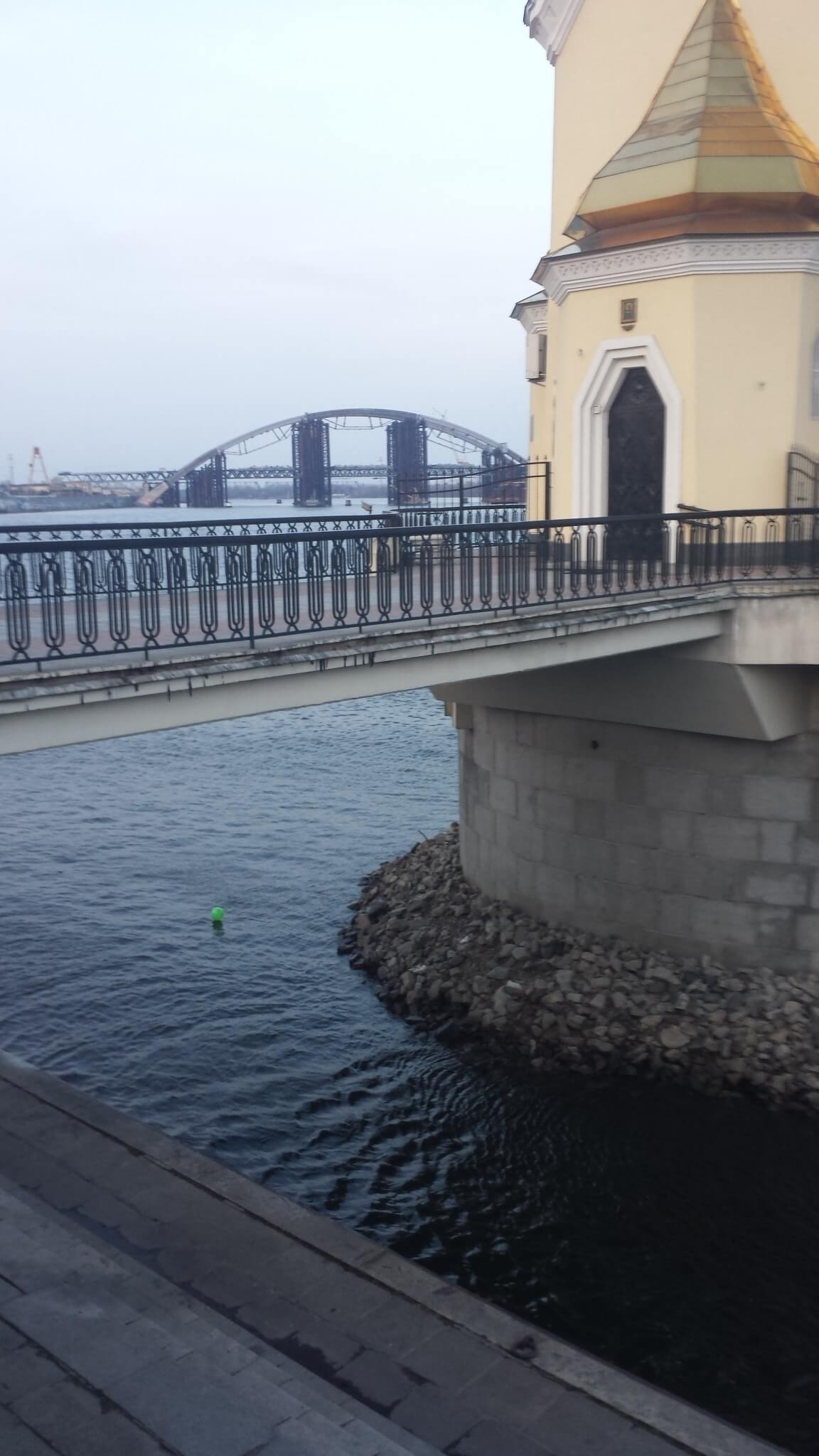

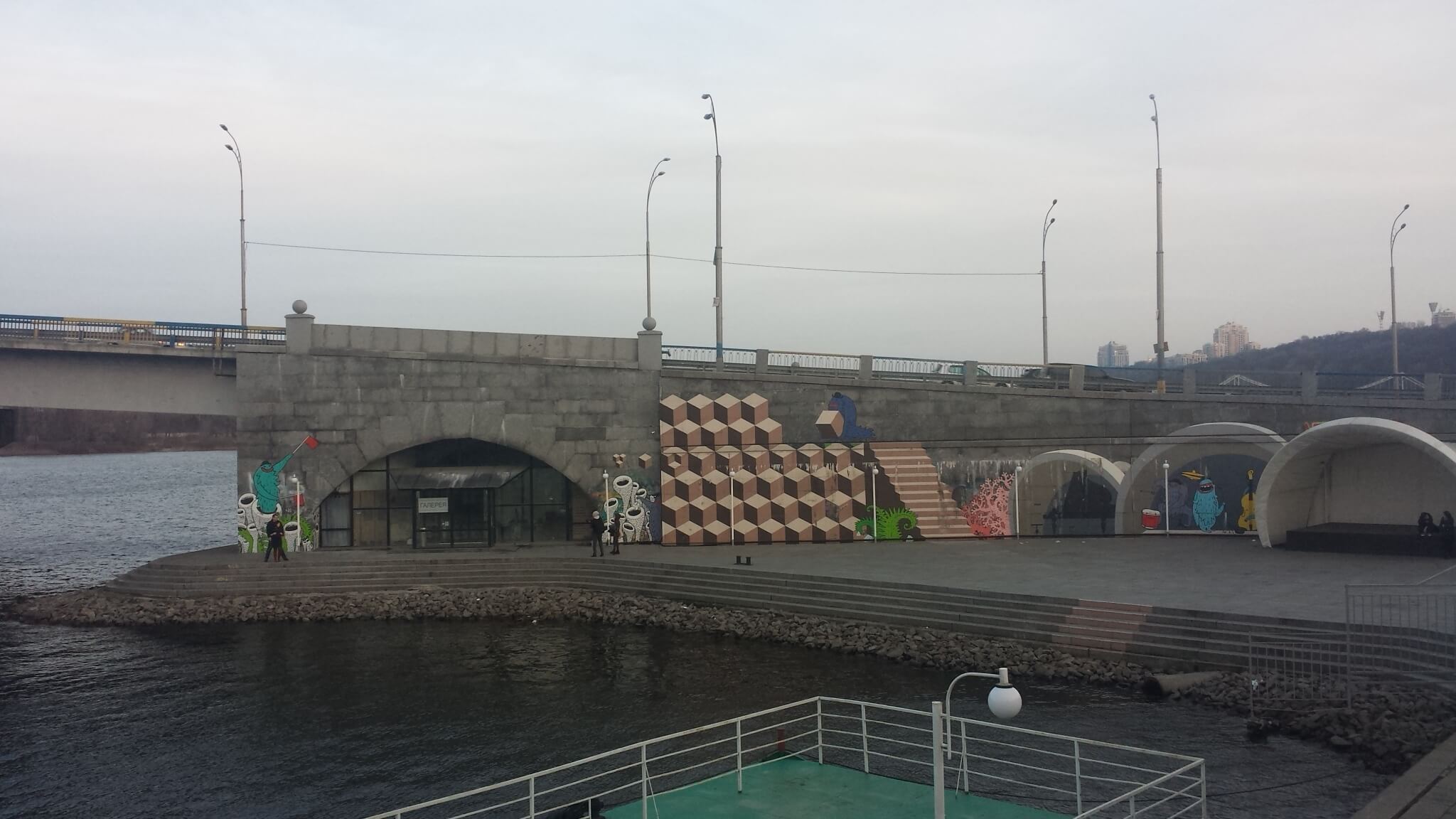
(click for larger image)
Ukraine is like a dream for Dutch farmers, says director of DIFCO International
“We (the Dutch farmers – ed.) have the knowledge in agriculture which we can apply here on a big territory. I am a son of a farmer, so for the Dutch farmers Ukraine is like a dream: you have so much very fertile lands, you can improve your production so much and you can really make big steps forward.” Ir. J. H. (René) Kremers says, Difco International director.
The company participated in an annual international exhibition of the innovative solutions in grain business “GrainTechExpo – 2016” which took place in Kyiv this February.
Vehicle title transfer in #Ukraine: 6 mind-numbing hours of bureaucracy and still counting.
Vehicle title transfer in #Ukraine: 6 mind-numbing hours of bureaucracy and still counting.
Women’s Chess Championship Concludes in L’viv
I hate to say it, but it seems L’viv did an embarrassingly poor job with this tournament. Just look at this:
Squeaky floor, clicking cameras, strange people milling about, some distracting nonsense about children making the opening moves, body scanning the players without privacy, no crowd control.
Amateurish.
FYI: Ukrainian defending champion Mariya Muzychuk lost to challenger (and former champion) Hou Yifan, 6 points to 3.
Ex-Putin aide Mikhail Lesin died of ‘blow to the head’ (in Washington DC!)
Ukrainian startups get a chance to join TechCrunch San Francisco
Ukrainian startups get a chance to join TechCrunch San Francisco with a booth at Ukrainian pavilion http://ain.ua/2016/03/11/637419 on Sep 12-14th
Strongly recommend for early stage startups that do have traction in US, and are looking to build up their business in US and eventually raise follow funding in US (not vice versa, you heard it – traction in US first, part of the team there and only then raise money in US)
Three ways Russia stalls Ukrainian reforms.
(Russia is terrified of the emergence of another successful state on its borders.)
First, there is the brutal fact of Russian military aggression. Moscow’s offensive in the country’s South and East has not only damaged Ukraine’s territorial integrity, but has also profoundly affected many other aspects of society, including its capacity for radical change. Thousands of Ukrainians — among them many selfless patriots — have been killed, mutilated, wounded, or traumatized by the fighting. The country lost two economically important territories, the Crimean peninsula and much of the Donets Basin (Donbas). Ukraine has had to redirect large portions of its already scarce financial, material, and human resources from civilian to military sectors as well to post-war restoration.
The war and various related challenges have had serious repercussions for Ukraine’s civil society and its diaspora in the West. Tens of thousands of activists mobilized by the revolution could no longer concentrate their efforts on transforming the country. Instead, they had to refocus on its very survival. . . .
The second major impediment to reform was the country’s economic crisis. Mainly but not exclusively as a result of the war, Ukraine’s GDP collapsed in 2014-15, taking the national currency with it. Real wages plummeted as well, by over 13 percent in 2014, and by another 10 percent in 2015.
Ukrainians have also faced sharp increases in energy costs — a condition imposed by the International Monetary Fund before it would agree to disburse its multi-billion standby loans. To be sure, these painful measures are long overdue. But this drastic macroeconomic adjustment during wartime further exacerbated the shock of the country’s already severe financial and social problems.
The resulting surge in utility costs and consumer goods prices have not only reduced private consumption, investment, and comfort. They have also reduced the living standards of civic activists, reduced popular support for the government’s Westernization agenda, and facilitated the rise of irresponsible political populism. . . .
Finally, Ukraine’s ability to reform has been seriously damaged by Russia’s general campaign of subversion. The more traditional aspects of Russia’s invasion of Ukraine have been accompanied by a wide gamut of unconventional “hybrid war” elements, including non-military economic, social, psychological, political, and other measures that are only partially visible to western policymakers and publics. These include trade sanctions, secret intelligence operations, international propaganda campaigns, cyber-attacks, diplomatic skirmishes, clustering of troops on the Russian-Ukrainian border, and so on.
The aim of the latter element — the staging of large-scale army exercises and movements of ground forces — is not only to train and prepare Russian soldiers for a possible future attack on Ukraine. Of more immediate concern is the anxiety the maneuvers create within Ukraine and among its partners. Like the enormous amounts of heavy weapons with which Moscow has armed its puppet regimes in the Donbas, the army drills near the border are designed to keep everyone guessing.
http://foreignpolicy.stfi.re/2016/02/26/how-moscow-is-subverting-ukraines-bid-for-freedom/?sf=oggdne
Kevin MacDonald: Alexander Dugin’s Fourth Political Theory is “an unrelenting attack on the very essence of Western civilization.”
Only a rare few in the alternative right knew Alexander Dugin before the publication and translation of his book, The Fourth Political Theory, in 2012. Suddenly, the contents of this book became the subject of lively discussion and he was hailed as “arguably the most prominent New Right thinker in the world.” . . .
Through the first pages, I was fairly impressed by Dugin’s laconic treatment of the way liberalism had created the normative conditions for a humanity predisposed toward a world government in its “glorification of total freedom and the independence of the individual from any kind of limits, including reason, identity (social, ethnic, or even gender), discipline, and so on” (18). With the “liberation” of man from any necessary, pre-ordained membership in any community or identity, and the universal morality of human rights widely accepted, few obstacles now stood in the way of a totalitarian global market. . . .
But it soon became apparent that Dugin’s FPT was more than a critique of American hegemony and Atlanticism; it was an unrelenting attack on the very essence of Western civilization. . . .
Dugin defends the Russian people and empire from the perspective of tradition while criticizing the West from the perspective of postmodernism and cultural Marxism. It has escaped the attention of commentators in the alternative right that Dugin relies almost entirely on cultural Marxists in his assessment of liberalism. I don’t think we should take it lightly that he celebrates Karl Marx’s ideas as “tremendously useful and applicable” (50), calls Franz Boas “the greatest American cultural anthropologist” (63), and believes that Levi-Strauss “convincingly showed” that primitive cultures in Africa were as complex and rich as European cultures (109). . . .
He is oblivious to the fact that without Peter the Great’s assimilation of European knowhow in industry, the Russian empire Dugin so admires, and aberrantly identifies with tradition per se, would have disintegrated in the modern era. . . .
He accepts Foucault’s condemnation of the Enlightenment as a carrier of “all the signs of intellectual racism, apartheid, and other totalitarian prejudices” (133). With statements like this Dugin would easily fit into a Western university environment. His depiction of all that is Western as racist and evil combined with his identification of non-Western traditional cultures as authentic, natural, and truthful are no different from the multiculturalist template enforced in academia. We are supposed to believe that the Chinese with their suppressed minorities and official discourse of racial hierarchies, the Russians with their history of breaking national heritages, and the Indians with their filthy caste system are not racist but possessors of healthy empires that should be supported by White nationalists in opposition to American hegemony. . . .
Dugin welcomes postmodernism and envisages its proponents as allies, not enemies, of a common front against Western modernity and liberalism. Postmodernists and cultural Marxists (“New Leftists”) are positively portrayed for their complex attack on the West . . . .
He rejects categorically the concept of nations with ethnic boundaries as a modern idea that works against traditionalism and empires. He envisages a role for White nationalists only within the context of a Europe thoroughly watered down by mass immigration and postmodern diversity where proud European ethnics will somehow find a niche alongside Africans, Asians, and Muslims against American universalism. . . .
The Fourth Political Theory is a theory for Russian geopolitical strategists, not for European ethno nationalists.

