Author Archives: RomanInUkraine

Russia’s navy is falling apart

Moreover, Ukraine is still the exclusive supplier for many of the heavy components, including engines and gears, for Russia’s warships — even the ones Russia builds in its northern shipyard. With the continuing tense stand-off, Kiev recently banned arms sales to Moscow.

Russia’s attempts to revitalize its domestic shipbuilding industry have not gone smoothly. In 2005, India inked a nearly $1-billion deal with Russia for a rebuilt Soviet-era small flattop. Russia’s work on Vikramaditya was so poor, however, that she suffered a near-total breakdown shortly after her purported completion in 2012.

India finally accepted Vikramaditya in 2014 — after the total cost of her refurbishment had nearly tripled to $2.3 billion. If Russia can’t even remodel an existing warship, imagine the difficulties it would face designing and building a big new ship from scratch.

Moscow knows its navy is in trouble. It seized on an extreme solution in 2011 — importing ships, technology and expertise from France. Russia signed a contract for two French Mistral-class helicopter carriers. Each ship costs more than $1 billion.

The plan was for Russian shipyards to help construct the vessels. “The purchase of Mistral shipbuilding technology will help Russia to grasp large-capacity shipbuilding,” Adm. Vladimir Vysotsky, chief of the navy at the time. “It is important for construction of ships like the future oceangoing class destroyer and later an aircraft carrier.”

Unsurprisingly, the Russian yards have proved incapable of handling intensive construction. In 2013, the Kremlin asked France to take over the bulk of the work. After Russia annexed Crimea, Paris suspended then ultimately canceled the ship deal.

But even if the deal had gone through, buying two ships from France would have done little to reform Russia’s shipbuilding industry, as Russian workers wouldn’t have been directly involved in building the vessels. Now deprived of the Ukrainian-made parts, Russia’s shipbuilding industry is in even worse shape than it was two years ago.

http://theweek.com/articles/572496/russias-navy-falling-apart
West encouraged Ukraine to give up Crimea without a fight – and it was a mistake.

The White House’s message to Kiev was advice, not an order, U.S. and Ukrainian officials have recently told us, and was based on a variety of factors. There was a lack of clarity about what Russia was really doing on the ground. The Ukrainian military was in no shape to confront the Russian Spetsnaz (special operations) forces that were swarming on the Crimean peninsula. Moreover, the Ukrainian government in Kiev was only an interim administration until the country would vote in elections a few months later. Ukrainian officials told us that other European governments sent Kiev a similar message.

But the main concern was Russian President Vladimir Putin.

As U.S. officials told us recently, the White House feared that if the Ukrainian military fought in Crimea, it would give Putin justification to launch greater military intervention in Ukraine, using similar logic to what Moscow employed in 2008 when Putin invaded large parts of Georgia in response to a pre-emptive attack by the Tbilisi government. Russian forces occupy two Georgian provinces to this day.

Looking back today, many experts and officials point to the decision not to stand and fight in Crimea as the beginning of a Ukraine policy based on the assumption that avoiding conflict with Moscow would temper Putin’s aggression. But that was a miscalculation. Almost two years later, Crimea is all but forgotten, Russian-backed separatist forces are in control of two large Ukrainian provinces, and the shaky cease-fire between the two sides is in danger of collapsing.

“Part of the pattern we see in Russian behavior is to test and probe when not faced with pushback or opposition,” said Damon Wilson, the vice president for programming at the Atlantic Council. “Russia’s ambitions grow when they are not initially challenged. The way Crimea played out, Putin had a policy of deniability, there could have been a chance for Russia to walk away.”

http://www.bloombergview.com/articles/2015-08-21/u-s-told-ukraine-to-stand-down-as-putin-invaded?cmpid=yhoo

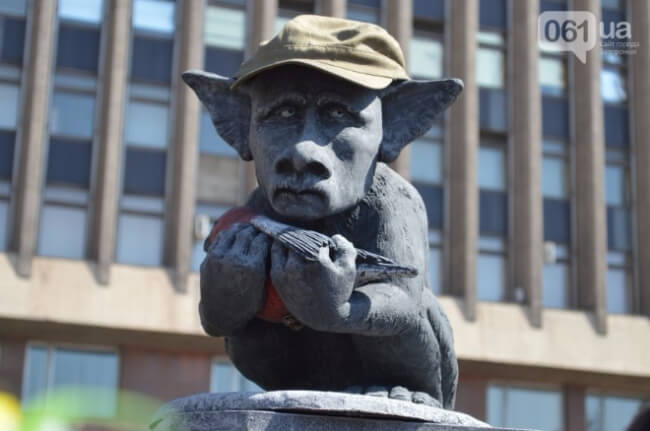
Monument to Russian Trolls Unveiled in Zaporizhia, Ukraine

It looks like Putin!

putlerfake

As reported previously, Russian media provided extensive coverage in December of the “perverted patriotism” in Ukraine where school children were being taught to kill the red-chested bullfinches because their coloring supposedly represents the imperial red colors of the USSR and its successor Russia.

However, posters in Ukrainian social media joked that the Russian propagandists had not done their homework since the real colors of the bullfinch are black and red — symbols, for example, of the Right Sector.

http://euromaidanpress.com/2015/08/25/monument-to-russian-media-fakes-unveiled-in-ukraine/

What I learned speaking to a truck driver who visits Crimea

1) Life is better for people with government jobs. Pensions and government salaries really did increase and the increase outstrips food prices.

2) Life is worse for entrepreneurs and people employed by private companies. Corruption and bureaucracy posed a problem, plus prices have radically increased.

3) All the police were fired. “We don’t need traitors,” they were told. The police were replaced with police from Moscow and other parts of Russia.

4) There’s a huge influx of immigrants from other parts of Russia who prefer getting their pensions in Crimea than in Siberia.

5) My friend was a proud Ukrainian and disrespectful to the border guards. He refused to speak or write in Russian and called Crimea occupied territory. He guard was infuriated, but the officer respected him for him.

A Ukrainian Border Town Once Fenced by Soviets Blossoms Into a Shopper’s Paradise

The “gate” is a small cluster of glass-and-metal buildings cut seven years ago through the tall fences that mark the border between Ukraine and Slovakia. One pedestrian path leads from the village Mali Selmentsi to its Slovakian counterpart, Velke Slemence, another leads out. Uniformed border guards calmly peruse the travel documents of the bag-wielding shoppers and the decaying remains of a Soviet watchtower pokes above the corrugated tree line.
Continue reading the main story

The saga of this small Ukrainian village (population 200) and its Slovakian twin (population 400), reads like a “Twilight Zone” episode joining the cruelty and absurdity of the 20th century with a most unlikely 21st-century denouement.

Part of the Austro-Hungarian Empire until its collapse at the end of World War I, the two medieval villages had long ago intertwined, sharing a church, community center and schools. In 1919, the combined area was given to Czechoslovakia. In 1938, it became part of the Kingdom of Hungary.

And then, after World War II, with Ukraine absorbed into a surging Soviet empire eager to claim as much territory as possible, a new international boundary was drawn smack through the center of town.

Overnight, families and friends a few blocks apart found themselves living in different countries, separated by surly border guards and, for 61 years, rarely allowed to visit one another. Even talking through the fence was forbidden.

http://www.nytimes.com/2015/08/11/world/europe/ukraine-slovakia-mali-selmentsi-velke-slemence.html