The Famous Yuri Bezmenov “Deception was my job” interview:
20:00 – importance of not being afraid
32:30 – disdain for the “useful idiots”
42:00 – reluctance of journalists to believe truth
46:00 – staged wedding for media purposes
49:30 – useful idiots
50:00 – KGB interest in Maharishi
53:00 – demoralization
54:30 – list of opinion makers
57:40 – Focus on Conservatives and crooks
1:01:00 – grass roots revolution
1:17:30 – ideological subversion / active measures
– changing reality 1. demoralization (a generation) 2. destabalization (2-5 years) 3. crisis (6 weeks) 4 .Normalization (indefinitely)
1:18:20 – stop supporting communism w grain deals, etc.
The very idea that the Soviet Union was defeated is disinformation in itself. The Soviet Union changed its name and dropped its façade of Marxism, but it remained the same samoderzhaviye, the historical Russian form of autocracy in which a tsar is running the country with the help of his political police.
During the Soviet Union, the KGB was a state within the state. Now the KGB is the state. Over 6,000 former KGB officers are running Russia’s federal and local governments. The Soviet Union had one KGB officer for every 428 citizens. In 2004, Russia had one FSB officer for every 297 citizens. . . . Russia today is the first intelligence dictatorship in history. It is a brand new form of totalitarianism, which we are not yet familiar with.
AGAIN, HOW TO ARUGE NON-INTERVENTION IN UKRAINE WITHOUT DECEPTION
When you portray Russia’s aggression vs their neighbor as defensive and just, you’re engaging in justification (ie deception).
If you want to make the case against American intervention (really ^continued non-intervention as the help Ukrainians have been pleading for has been minimal) then make it without deception. It should have everything to do with the cost of such a conflict and the need for Ukrainian self-reliance. I make the latter point here. The case should have nothing to do with Russia protecting Russian speakers, or their interests, or anything else because as far as their political system goes, it is immoral and has, for centuries, dragging surrounded civilizations into poverty and corruption.
I sympathize with your view, partly. As an American, I am also wary of endless militarism. I’ve written about this many times. But as I pointed out during my lecture at PFS 2011 – http://www.vimeo.com/user4741660 – there is a libertarian case for war in places where people want your protection. If my neighbor was being raped, I would not maintain a policy of non-intervention. Liberty and property rights have a cost. Who will bear that cost?
Libertarian ideology is grossly misguided where it assumes non-aggression is sufficient. A commons / social norms / legal norms exist and must be defended as one would defend property . . . . defended with violence.
AGGRESSION VS HARM VS COST (via +Curt Doolittle)
Sequence:
1 – I have no agreement with you, and therefore no constraint.
2 – I will not aggress against you.
3 – I will not cause you harm.
4 – I will not cause you to bear a cost.
5 – I will bear costs of reciprocal insurance.
Non-aggression alone leaves open unethical, immoral, and conspiratorial action. Harm leaves open the problem of relative costs — ie the costs of prohibiting criminal, unethical, immoral, and conspiratorial action of all kinds.
I think the jury is still out on the question of scale. Should we say that you bear the cost of reciprocal insurance for your neighbor, but not for your neighbor’s neighbor, or should the scope be universal. It’s a question of strategy, I suppose.
1. The state called – Muscovy was renamed to Russia by Tsar Peter 1 only in the 18th century, in 1721.
2. A tribe called the river flowing through the region Moskva, in the Moksha language this can be translated to mean “dirty water”. There is no other language in the world which can translate this word. The word – “kremlin” is a Tartar word which means “a fortification on a hill”.
3. In the Middle Ages all European cartographers worked and created their maps all the way to the borders of Rus’ (Rus’ – is the territory of contemporary Ukraine!) The Ulus (a turko-mongolian sociological term which delinates a particular group of people) of Moscovy, with its Finnish people, had always been designated as part of the Horde and Europe appropriately considered it to be part of Asia.
4. Moscovy (Russia) paid tribute to the Crimean Khan(!!!!!), its sovereign and their Host, who was a successor of the Golden Horde until 1700. The Tsar of Moscovy met with the Crimean ambassador on Poklannaya Hill who was on horseback, while the Tsar was on foot leading the horse by the bridle to the Kremlin, once inside he sat the ambassador on the throne and knelt before him.
5. In Moscovy in the year 1610, the dynasty of Genghis Khan came to an end Morza Gudun – better known to the world as Boris Gudunov, and then throned Alexey Koshka an ancestor of the Finnish Kobyla family, and in marrying him to the church they renamed him and gave him the surname Romanov, as if he had come from Rome to rule over Moscovy!
6. Catherine the Second, after the end of the rule of the Polish-Lithuanian Commonwealth in 1795, made a decree that all the Finno-Urgic tribes of Moscovy to be named socalled Great Russians while the Ruthenians or true Rus people to be called Little Russians!
7. No one ever saw the original agreement of Peryaslav of 1654 which was allgedly signed by Bohdan Khmelnytsky and the emissaries of Tsar Alexey of the created Romanovs!?
8. For many centuries, archaeologosts have tried to locate artifacts which would confirm the location of the Battle of Kulikovo, though searches have proven fruitless in proving that such a battle of Dmitri Dontsov being victorious over Mamai ever took place. To date it is but a myth created based on the finding of a few artifacts by a procurator of the Most Holy Synod, on Stepan Nechayev. Such a position allowed him to create any myth he chose. So until now this myth of the battle has been bellowed out, though there is little proof it ever took place!
9. The Pskov, Novgorod and Smolenks oblasts of Russia – were all former principalities Slavic- Rus Kingdom and had nothing to do with Finno-Urgic Moscovy, whilst they were respectively occupied by the Horde in 1462, 1478 and 1654. And Slavic tribes or peoples never lived in other areas of Moscovy, the present Russian Federation.
10. The Golden Horde and her daughter – Muscovy – were the only nations in the world that ever enslaved their own people. This explains the eternal backwardness of Moscovy which is so rich in natural resources as compared to European countries which are at a disadvantage when it comes to thse resources. Indeed, the efficiency of free people is much higher than that of slaves…
The latter claim [that Russian speakers are being ethnically cleansed in Ukraine] made repeatedly by Daniel McAdams of the Ron Paul Institute for Peace and Prosperity is especially egregious and hypocritical. Half the Ukrainian military is Russian speaking, and the leader of Ukraine’s “Donbas” volunteer battalion is ethnically Russian. It is deeply hypocritical because while Daniel McAdams is parroting Kremlin propaganda about ethnic cleansing by Ukrainians, the real thing is being carried out by Russians:
– Starting with the torture and murder of a Crimean Tartar activist Reshat Ametov by the invading Russians, the indigenous ethnic minority has faced homes and mosques being aggressively and repeatedly raided, the displacement and harassment by helicopter of their annual remembrance of the Soviet-era genocide, the banishment of their leader from the peninsula, and the dissolution of their political bodies and seizure of their meeting places. Seventeen other Tartars have gone missing.
– One of the first things the Russians did in Eastern Ukraine was kidnap and torture outspoke pro-Ukrainian politician Volodymyr Rybak (april 2014). They made sure his body was discovered. It was covered in wounds. They seem to lead with very public, very violent acts in order to scare everyone into submission.
– Catholic priests have been kidnapped and the Church described their plight as “total persecution.”
– Four deacons of the Transfiguration Evangelical Church were kidnapped and tortured to death in the parts of Donbass (eastern-most Ukraine) controlled by Russia.
– Though estimates vary greatly, it seems tens of thousands of Ukrainians have fled Crimea following harassment and threats against expressions of Ukrainian identity. The Ukrainian language has been removed from Crimean schools. Similar bans are underway in the Russian-controlled parts of Donbass.
– A Donbass miner was kidnapped and tortured because of his “glory to Ukraine” tattoo. A Ukrainian prisoner of war with a similar tatoo had his arm chopped off by his captors. He survived and was recently freed in a prisoner exchange.
There has been no analogous brutality directed at Russians by Ukrainians. That’s because Ukraine’s recent revolution was not anti-Russian but anti-corruption and anti-tyranny, and thus terrifying to the corrupt, tyrannical regime in Moscow which has done everything from lie about baby crucifixions to stage massacres to make Ukraine seem savagely anti-Russian.
Several Kyiv Patriarchate Orthodox priests have been forced to leave the Crimea and the majority have been summoned to the FSB for questioning.
Kyiv Patriarchate churches have been shut down in Sevastopol; Krasnoperekopsk; Kerch, as well as in the village of Perevalne, which was subjected to an armed attack in June. The prosecutor’s office has refused to initiate criminal proceedings over the attack.
Kyiv Patriarchate Archbishop Clement of Simferopol and Crimea constantly receives threats. His dacha was burned down and he fears that his church could also be targeted.
Members of the Moscow Patriarchate Orthodox Church have massively increased the rent in an attempt to force the Kyiv Patriarchate to relinquish its main church in Simferopol. . . .
FSB officers have turned up at church services and demonstrably observed worshippers. Already months ago veteran Crimean Tatar leader Mustafa Dzhemiliev reported that the FSB were openly watching believers in Crimean mosques.
In June Pastor Ruslan Zuyev from the Salvation Army left the Crimea after being the object of overt harassment by the Simferopol FSB. He says that they began phoning and then turned up at his office asking strange questions. His wife and daughter had also received threats.
Rabbi Misha Kapustin left Simferopol following threats over his opposition to Russia’s occupation of the Crimea. . . .
Father Piotr, the head of a Roman Catholic parish in Simferopol and a Polish national, was forced to leave the Crimea. . . .
. . . a number of UGCC priests have been driven out of the Crimea because of harassment by the ‘self-defence’ vigilantes.
– A side note about hypocrisy: In Russia there are no Ukrainian schools whatsoever – not even in the Kuban region where Ukrainians used to outnumber Russians. (There, Ukrainian identity has been pretty much destroyed.) In Moscow, in 2010, 50 Ukrainian language fiction books were seized from a library because of “ethnic radicalism.”
***
Ukrainian Churches are facing imminent ban in Crimea
(Bureaucratic Hooliganism)
The report cites the aggressive actions of the 4,000-man Russian Orthodox Army (ROA) as one of the most harmful actors in eastern Ukraine. According to credible reports, the group has destroyed church property, raided a Protestant orphanage, taken a Catholic priest as a hostage, and participated in other violence.
An insurgent group, the ROA is not part of Russia’s military force, but gains support from sources inside Russia. A Russian nationalist billionaire, Konstantin Malofeev, funds a charity that allegedly supports the ROA. The evidence against Malofeev is persuasive enough that the US government and the European Union have sanctioned him.
The rebel republic’s deputy PM, who describes himself as a “political scientist,” says he also worked in Ossetia, Abkhazia, and Crimea. “My employment history is no secret, I was awarded medals by the state in these countries, and I am proud of it,” he tells VICE News.
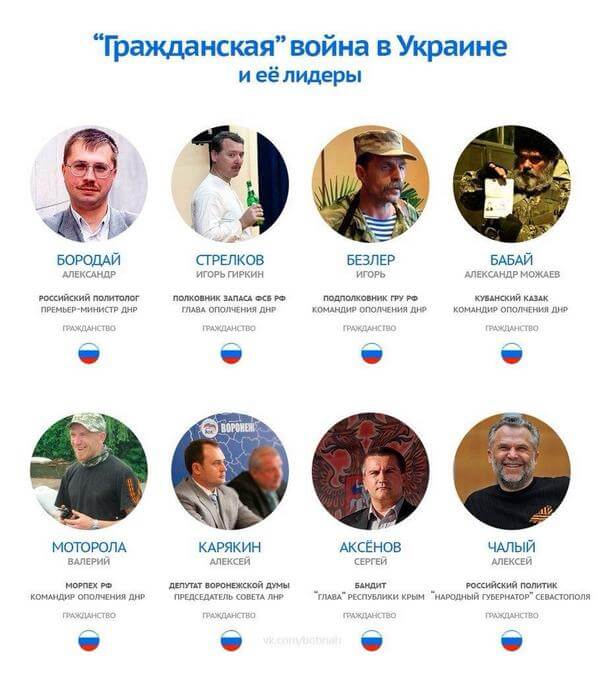
Siberian-born Antyfeyev is just the latest arrival from Moscow in war-torn eastern Ukraine. The key positions of defense minister and prime minister of the rebel People’s Republic — the political and administrative helm of the armed insurgency in the country’s east — are also held by Russian nationals: Igor Girkin and Alexander Borodai.
Girkin, better known by his nom-de-guerre “Strelkov” — meaning “Shooter” in Russian — arrived in the rebel republic in mid-April. A war re-enactment fanatic, with a fondness for playing the role of the White Guard general Mikhail Drozfovsky, who was killed in a battle with Bolsheviks in 1919, Girkin has openly admitted he was a Russian intelligence officer until one year ago.
Self-styled Prime Minister Borodai, a Muscovite like Antyufeyev, also worked in Transnistria and says he knows Strelkov from Crimea, Chechnia, and other “hotspots.” Both have written articles for the Russian nationalist newspaper Zaftra — a publication that has grown hugely in influence during Putin’s third term.
“This is the classic playbook of the Kremlin, to parachute in its own people to guide locals and augment existing resentments,” Brian Whitmore, Senior Eurasia Editor at Radio Free Europe, tells VICE News. “We have seen this strategy deployed many times before, in Transnistria, Abkhazia, and so on, but this time it is dialed up to 11, and these figures [Girkin, Borodai, and Antyufeyev] are the absolute personification of this strategy.”
After the February Revolution of Dignity in Kyiv, about two dozen officials and businessmen hastily left Ukraine. Many of them have been placed on the wanted list in Ukraine and Europe. Today, some of these internationally targeted Ukrainian fugitives can be seen in the elevators of elite skyscrapers in the Moscow-City business district. RosBuilding Consulting (RBC) has compiled a list of former Ukrainian officials, who have settled in Moscow and are building up their own business companies.
militants so-called “DNR” try using Russian media to cover up their crimes. This time we are talking about murder Representative “Red Cross” in Donetsk.