Funny that the same day I post “Getting Better at Life,” I notice a funny smell from my fridge. Then I notice water. Seems my fridge died quietly some days ago.
No worries. It’ll get replaced soon. :)

Funny that the same day I post “Getting Better at Life,” I notice a funny smell from my fridge. Then I notice water. Seems my fridge died quietly some days ago.
No worries. It’ll get replaced soon. :)
This is a rumor.
A friend of a friend was pregnant. She got repeatedly turned away from produce stand. They tell her quietly and politely to keep moving. Apparently, they have enough scruples to not sell radioactive tomatoes to pregnant women, but not so much that they wouldn’t sell them to people like me.
According to rumor, (Please, remember this is all hearsay.) she has since delivered a healthy boy, and now asks produce vendors whether their products are fresh. “Yes,” they say. Then she tells them she has a two year old child at home. “Are they really fresh?” And, often, they tell her to go somewhere else.
I’m hoping to glow in the dark when I return to the U.S.
My friend Rob who is visiting me from the U.S.: There are lots of beautiful women here.
Me: It’s nice to finally be in a place where everyone is as beautiful as I am.
Rob: Shut up, Roman.


Here is the first video I’ve ever attempted with my new Canon PowerShot SD 1300is. I ought to read the instructions. The original file was 45MB — there are probably lower quality video modes which I’m not yet aware of. I spent a couple days messing around with video converters, and various schemes for embedding videos, all of which ALMOST worked. I eventually decided to simply upload to Vimeo and post their embed code.
Anyway, this was last Sunday. I consider the shadow to be my Alfred Hitchcock-like cameo appearance.
On Saturday, I caught the last evening of Gogolfest. I gave myself a whirlwind tour of the complex which reminded me very much of an abandon barracks complex we briefly occupied in Afghanistan in 2002. Part industrial, part park. Mysterious shadows from the past around every corner.
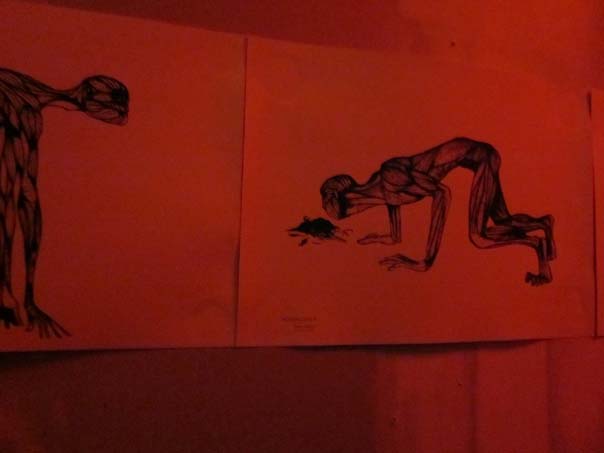
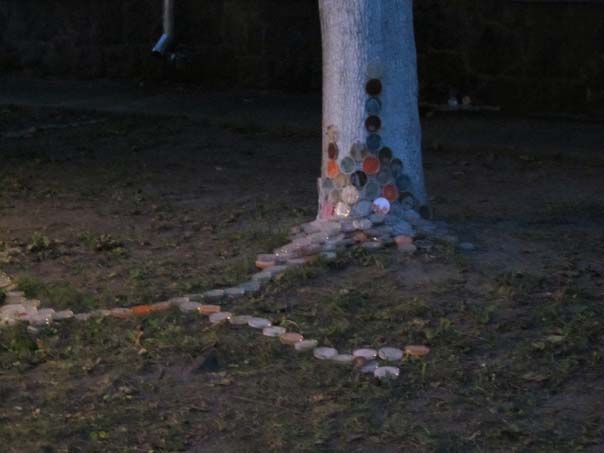
I looked at some installation art, watched part of a movie about Russian-speaking, Asiatic-looking people and their reindeer, listened to rock and roll and to strange trance music. I grew a little impatient with the people who seemed to be performing to the trance music. They were in a field below the surrounding sidewalks, and people crowded the railings looking down at them — women in flowing white robes, a man painted bronze. I grew impatient, because mostly, they just stood there.
Anyway, I loved the feel the place. Very experimental, which is completely appropriate for a festival named for the author of The Nose.






On Friday, I thought I was going to listen to music at a bar with an ex-pat friend I met through an acquaintance from a literary death match in NYC.
The bar turned out to be an intimate gathering in a small theater room in an Institute for Music. There were as many musicians as there were guests, and I was afraid of getting asked to perform something. I think the show was sort of an after-event for the ongoing Gogolfest.
A young Kazak man sat cross-legged on the floor and rocked out on a mouth harp. A Bandura, an accordion, and a Dombura played the bluegrass hit “Old Joe Clark.”
A group of three women and two men in traditional Ukrainian garb sang about a young woman saying goodbye to her Kozak lover, and a ballad which, if I understood correctly, was both about children saying goodbye to their mothers, and the homeland no longer being free.
The Debutante Hour sang about rejecting a lover, parking in NYC, and wanting to meet the devil.
All the music was fantastic. I felt moved and happy.
We went out after the show. Here’s a picture my friend took with me and 1/2 of 1/3rd of The Debutant Hour:

I like discovering foreign details of day-to-day life, different approaches to similar things. After two weeks, I’m already ceasing to notice them, perhaps a sign of my increasing comfort & assimilation into Kyiv life, so I thought I’d detail them before they’re entirely forgotten.
Peculiar:
1. Light switches are in strange places. It’s like a big Easter egg hunt, except the reward is being able to see.
2. There are many “Solon’s of Beauty,” which struck me as an adorable turn of language.
3. Groceries are usually marked with big signs that say “продукти” or “Products.”
4. Lots of women walk around on impossibly high heels, especially when scaling steep, cobblestone streets.
 5. There are lots and lots of Sushi restaurants, including at least two different franchises. Even some coffee shops serve sushi. When I visited Kyiv for the first time I stared, and stared at a sign that read “суші.” I sounded it out, “su-shi,” but could not believe it. It’s a word I never expected to see in Cyrillic letters. I crept closer, crossing a street and peering into the window, confirming it was, in fact, a sushi restaurant. As much as I like sushi, I told myself, you’d have to be crazy to consume raw fish in Ukraine. That was then.


6. In one products store, I only saw 15, 20 and 25% milk. (The box of 15% makes a cameo appearance in an earlier post.) I thought that was the standard, but I’ve since discovered bottles of 0%, 1%, 2%, and the like. So this really doesn’t count.
6-again (since the last one didn’t count). Ads very frequently appear on my cell phone. My phone doesn’t vibrate or ring, and the ads aren’t stored as text messages, though they look like them. The ads are in Russian, which I struggle with, but I can understand enough to know that some of them are for ring tones.
7. Metro tokens are plastic.

8. In many places, cars park diagonally on the sidewalk. Occasionally, where they can’t pull directly from the street onto the sidewalk, they drive amid pedestrians for a bit.
9. The cost of food is surprisingly high. I usually pay the equivalent of $4-$7 per meal for eating out when it’s nothing fancy, $15 for sushi. For a country whose average annual income is usually reported as between $4,000 and $7,000, this is very high. Several possibilities: Kyivian are a lot wealthier than other Ukrainians. Kyiv restaurants benefit from massive tourism. Statistics about income are artificially low because much of it goes unreported.
Regardless of the cause, there doesn’t seem to be as much of an eating out culture here. When, after yesterday’s music show (which I’ll write about soon), I asked a Ukrainian guy to recommend a place where a few of us U.S. expats to eat, he immediately joked: the best place to eat is home.
10. Ukrainians seem to love stamping thing. In the restaurant we ate at last night, all the pages of the menu were stamped and signed. On almost every street you see a “нотаріус” or notary.
11. Ukrainian, or, at least, Kyivans, also love fireworks. They’ve happened at least two or three times at week since I’ve been here. I usually startle, just a little, and for a split second wonder what is exploding.

12. You often have to go underground to cross big streets. The underground passages are usually filled with retail shops. Some are nicer than others. Around Maidan, the underground area sprawls beneath several complex intersections, and I can never get to the corner I want on the first try. I have to surface like a ground hog, reorient myself, and continue closing in my desired destination.


Surprisingly Familiar:
1. Break dancers, live mimes, and other street performers.
2. McDonalds.
3. People on the street in the city’s center handing out various coupons.
4. During my 2004, a restaurant named Domashna Kukhna (home kitchen) charged a nominal price for packets of salt and sugar, napkins, plastic ware, toothpicks, etc. I found this rather annoying and the market seems to have agreed. They no longer do this. (Side note: Domashna Kukhna is both the name of a franchise and the name used by many individually-owned restaurants. There doesn’t seem to be any problem distinguishing, though. Take THAT intellectual property advocates!)
EDIT: 5. Television commercials — for cat food, skin cream, movies, cell phone service, and a whole lot more.
Some people live to eat, others eat to live. I certainly love good food, and I’ll travel long distances and pay high prices for an especially good meal. Nevertheless, I probably belong in latter category — eat to live. When I’m distracted by the excitement of a new city, not to mention reading, writing, blogging, meeting people, I sometimes postpone meals, or take them quickly and conveniently. My belt now fastens around my waist one notch tighter than it used to. I’m not happy about that.
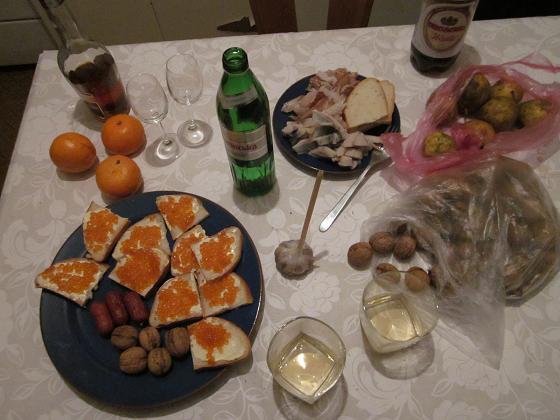
Here’s today’s breakfast:
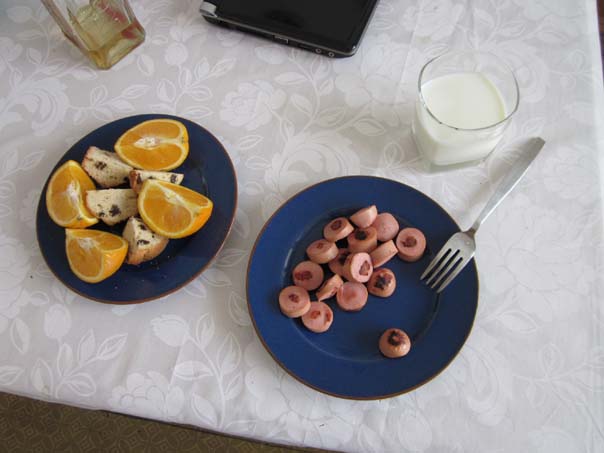
Edit: The pepper vodka in the corner of the photo was NOT part of breakfast. I swear.
Mostly.


As I had expected, very simple things were difficult, at least in the beginning. I set modest goals.
Day 1: Food. (This might be a surprising first priority to those of you who know me. Normally internet access comes ahead of food, but fortunately, the friend of the family from whom I’m renting this kvartyra leaves her internet running, and the lengthy password worked on the first try.)
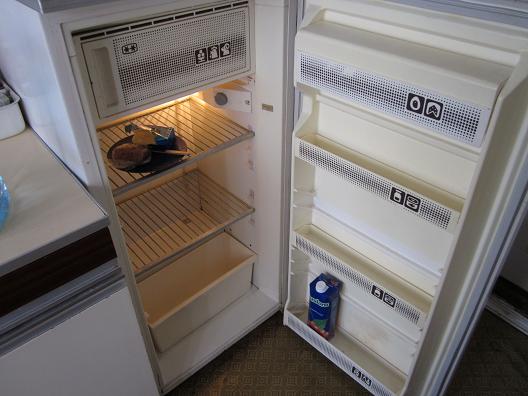
I went to the “Products” store, and after some impatience on the part of the checkout lady I stocked my tiny fridge chock-full of provisions: bread, butter, and delicious cherry juice.
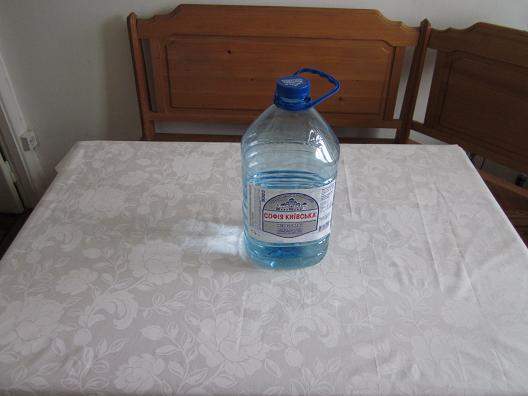
I also bought some water for drinking, following the advice of the nice lady who had let me into my apartment.
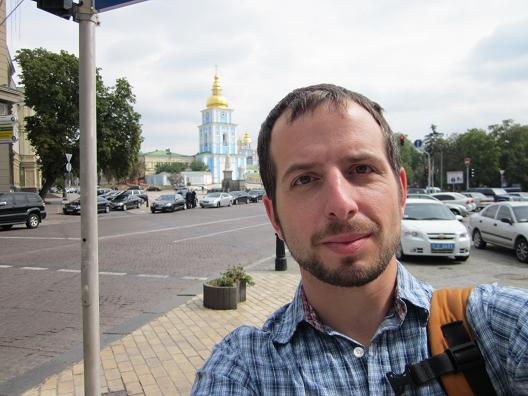
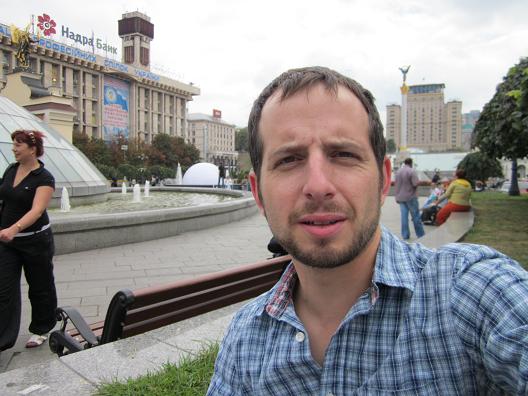
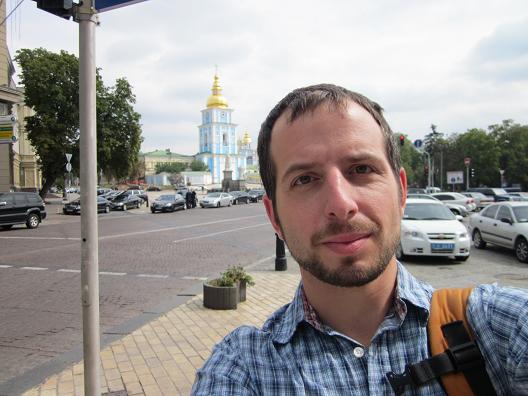
It was nice seeing a childhood friend of mine for a brief lunch. I called him from my kvartyra’s phone, not completely sure which of many digits I should enter. I guessed right on the second try. I gave myself plenty of time to make the walk to our meeting place – the McDonalds in the Maidan (square) of Independence. I followed the map carefully, passing Saint Michael’s Golden Domed Monastery where I photographed myself.
I arrived early and waited for 40 minutes, watching people and telling myself to look comfortable. McDonalds seemed to be a common meeting place. Most people looked very affluent.
The familiar face and familiar language put me at ease. We went to the dining area at the mall, at a franchise which serves traditional Ukrainian food. The girl smiled at my heavily accented Ukrainian. Sometimes they seem irritated, or only speak Russian. My friend works as a journalist, and we had a very vigorous discussion about politics and political philosophy. He returned to his work, and I wandered around a bit before heading home and unpacking.
Day 2: Communications.
After a breakfast of bread, butter and cherry juice, I followed the familiar route passed Saint Michael’s Cathedral to Maidan and to the same mall, but I couldn’t find the dining area. I ate at a different spot. The sausage smelled a little ripe. I ate one of the two and decided not to return. I felt myself digesting the one for the rest of the day.
I wanted to get Kyivstar for mobile service simply because I’d heard of it before, but the clerk at the mobile store insisted MTC (which is MTS in latin letters, since Cyrillic C = Latin S) was the best. I didn’t initially realize it was an MTC store. They were able to simply replace the sim card in my U.S. phone which had been unlocked.
Anyway, they were so excited for my patronage, that on the next day, MTC threw a dance party all over the Maidan:
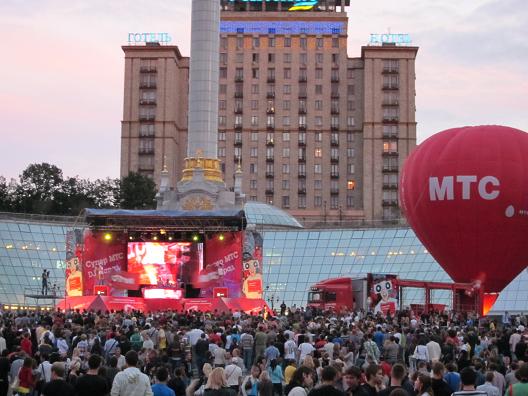

(I’m a pretty big deal.)
Before leaving the mall, I went to look at the gallery there. I had visited the same gallery during my 2004 visit to Ukraine, and was so impressed by some of the painting, that I journaled about them, then returned to look at them again to finish my description. I was stunned they only cost the equivalent of $200. Had I been better prepared, I would have bought a bunch.
On this trip to the gallery, I was particularly impressed with the landscapes of an artist named Vladimir Hrubnyk. I can not explain why they were so moving. Their cost ranged from $700 to $7000 for the larger ones. I guess this is good news. As is the fact that in 2004, that was the only mall in Ukraine, now, according to my friend, there are many.
I was feeling a little lonely after awkward interaction in coffee shops, and also a bit restless, as I often am on lonely Saturday nights.
I took a different route to the Maidan after studying the map, passing Saint Sophia’s Cathedral and the statue of Bohdan Khmelnytsky, leader of the 1648 uprising against the Polish Lithuanian Commonwealth which established a Kozak state.


 Boxing matched were underway in the Maidan. I had seen the posters before, but hadn’t taken the trouble of reading them. It was a big affair, and I couldn’t get very close.
The poster only depicted the Ukrainian in the main event. For his opponent they only listed a name. Perhaps they didn’t want to advertise him.
I walked several blocks to a common bar for ex-pats which I knew from my 2004 trip: Baraban (the drum). Sometimes you beat the drum, sometimes the drum beats you.
It’s in an alley and has no sign. Unfortunately, the bar looked to be undergoing renovation, so I went to another ex-pat bar, O’Briens. I actually knew about it from overhearing the heart surgeon – orphan savior who sat behind my on the plane. By chance, I had passed it earlier and recognized the name.
At the bar, I instantly met Mike from England on his last night in Ukraine. He’d just returned from a tour of Chernobyl. The video game S.T.A.L.K.E.R. inspired his short trip. S.T.A.L.K.E.R.: Shadow of Chernobyl is a popular Ukrainian-made video game, an alternate-reality first-person shooter modeled on actual Chernobyl and the nearby town of Prypiat.
Mike had a job and a passion, not unlike me, though I don’t do much of the former anymore. He’d just had a success with his passion, namely establishing himself as a record label for digital music.
He inquired about my work, and I told him about my program. I told him I wanted to survey political and economic philosophies in Ukraine. To illustrate, I said that poet and national Ivan Franko began as a Marxist, but later went on to say that Marxism is a philosophy based on hatred. Ivan Franko, by the way, is apparently the only man in history to be kicked out of a University which was later named after him. I also mentioned famous anarchist Nestor Makho, and his anarchist black army. I want to read everything he wrote too, find as coherent a philosophy as I can, and criticize it.
Mike asked about my own beliefs. I was happy to have made a friend for the evening, and didn’t want to get into politics, but we were already on good terms and he was genuinely curious. For the second time since arriving in Ukraine, I drew the chart from Jesus Huerta de Soto’s essay, Classical Liberalism versus Anarcho-capitalism, which, I think, offers a good overview and classification of political and economic thinking.
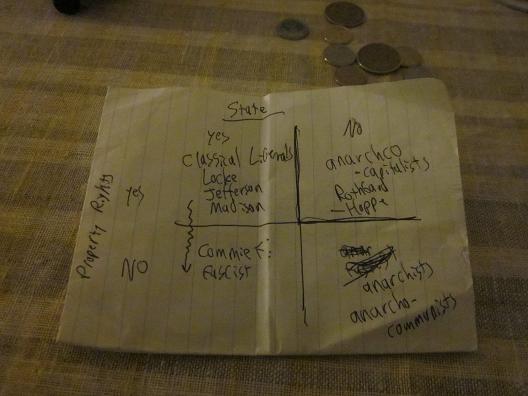
As I drew and explained, he objected to my putting communism beside fascism in the same box, the pro-state, anti-property rights box, because communism is beautiful, at least in theory. I conceded that many educated people have subscribed to its tenets, but I personally, don’t find it beautiful. It fails in practice, of course, he said, but in theory it is beautiful. I said it fails in theory too, because when you abolish prices, society is blind. I talked about all the information and coordination which happen through prices. They tell you from what materials you should build your home, what jobs to apply for, and what to study in school.
I also related to him Mises’ identification of German socialism as opposed to Soviet socialism, where on paper capital goods remain in private hands, but all important decisions are made by the state.
We went upstairs to listen to music, and kept talking. Five musicians played played a damn good rendition of AC/DC’s Highway to Hell. I couldn’t even hear an accent. Four had gray hair. The fifth had a mullet. They were fearless.
Mike asked how I would summarize it. I approached it from George Reisman’s, angle, the non-initiation of force. Force should only be used in defense or retaliation. We spoke about what this would mean for education.
They played Blue Suade Shoes, then Pink Floyd’s The Wall, as we listened in stunned silence. My heart leapt with joy and excitement every time they sang: Hey! Teacher! Leave them kids alone!
Mike kept listening to the music, and I became increasingly drawn to the television on the other side of the bar. The boxing matches from the Maidan were on, and I watched rounds 9 to 12 of the main event. The Ukrainian pressed the action for all the rounds, trying to get inside, but I though his lanky African opponent out pointed him, jabbing and circling away. They were close rounds, but by my reckoning, the Ukrainian lost each one. They embraced after the fight. The African fighter raise his hands. The decision seemed to take forever. It went to the Ukrainian.
Mike remained lost in the music. It really was quite good, as far as I knew. I watched a little Cricket, then bid him farewell.
I felt a little buzzed on the way back. Excuse me, Mr. Khmelnytsky, I imagined asking the statue, which way is my kvartyra? I want to lie down and sleep. The statue said nothing, stoicism being appropriate to his Kozak spirit, but he pointed with his scepter to exactly the correct street. Thank you, I imagined saying.
Days 3-5:
Build romaninukraine.com.
Continue eating, drinking.
Contact Kyiv Mohyla Academy about Ukrainian classes. They had me take a Ukrainian test – my first since I was 14 years old in Saturday school.
Contact the think tank which agreed to host me.
Iron my shirts and slacks.


 I left for Ukraine on Thursday August 26th, in the early evening. My mother drove me to the airport, and when she said goodbye, asked me to come home before the allotted 10 months.
I was just able to haul my two carry-ons, and two check bags without a cart. I had to transfer eight pounds from one check bag to the other to avoid a $150 fine. I was very early for the flight, and the check-in area wasn’t crowded. I transferred items without having to empty either bag, and without even opening them entirely. From deep within my memories echoed a sergeant yelling at all of us ranger students for living like a bunch of gypsies, and knowing nothing about fieldcraft.
At the Chilli’s in JFK airport, there were no prices listed by the beverages. I ordered a coke without asking and a meal. My salad and enchilada soup tasted awful, but I enjoyed looking at all the travelers and imagining their lives. The coke cost $3.79.
As we were being seated on the plane, missionaries loudly introduced themselves to one another. The man behind me, an older gentleman flirted with the stewardess, he was a heart surgeon, he said, and traveled to Ukraine to visit friends, and bring gifts of orphanage. The stewardess was very attractive. Later in the flight, she stood by his seat to make small talk, and eventually gave him her number. I decided that I didn’t care for heart surgeon who brought gifts to orphage.
The night is shorter when you fly east. I had two seats to myself, but couldn’t sleep. The sun came up, spilling orange and bronze over the softest, cleanest, most grandiose and unlikely landscape of clouds which stretched to every horizon. The photo doesn’t do it justice.
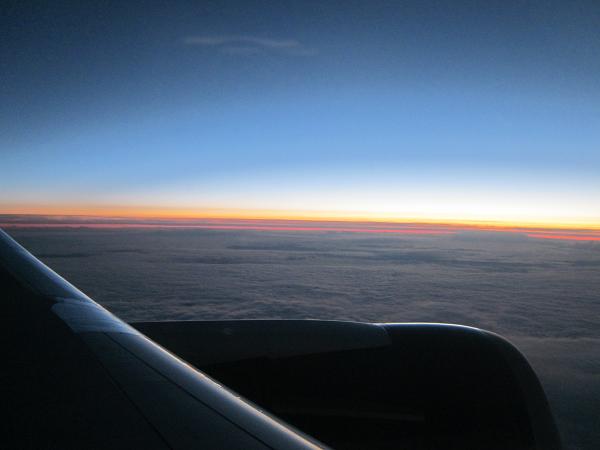
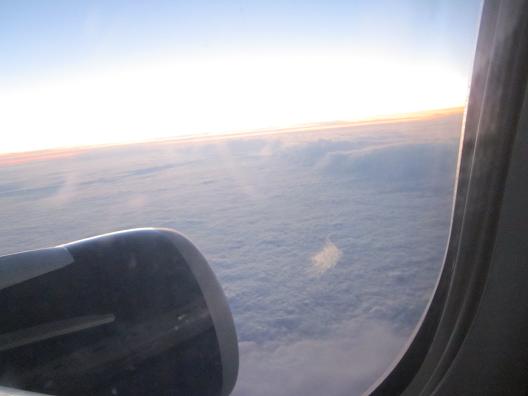
I imagined it to be the terrain souls might cross on their walk to heaven.
My checked bags were the second, and second-to-last bags to emerge onto the conveyor belt. Customs consisted of passing everything through an x-ray scanner.
Before crossing pushing my luggage cart through the doors which separated the customs to the public area, I prepared for battle. Valuables stowed securely. Wallet and passport in the least pickable pockets. Shoes double knotted. Baseball cap in my bag to look less foreign.
A cabby immediately approached me and spoke to me in Russian. I stammered a little and spoke in broken Ukrainian, not used to the language. Where am I going? To the center of Kyiv. Do I know the street? I pulled out my notepad, searched for the page, and read the street very slowly. One of my fingers was bleeding slightly from where a hangnail tore off handling my luggage, and I smeared the paper as I read. Very desperate looking, I thought to myself. I’ve messed this one up already. The only thing left was to ask the price for the sake of future comparison. Come with me, I’ll take you, he said in Russian. How much? 350 hryvna (UAH). Maybe later. Why? I started walking away. Because I’m not going yet. I walked off, trying to look like I knew where I was going.
The cabby followed me. What are you looking for? He asked in either Ukrainian or Russian – I couldn’t tell which. Nothing, I said. He watched me. You can change your money over here, he said. I’m going to eat, I said.
I walked among the restaurants until I thought I had lost him. It was crowded. I sat down and ripped the tags off my luggage to look less like a target. Perhaps I could be confused for a Ukrainian leaving the country.
I make things hard for myself. There are many websites which tell you the price of a taxi. Part of me enjoys the challenge of negotiation, but part of me finds it stressful. I can’t stop worrying about my personal security. I’m very alert, like being out on missions. My mind never stops speculating about the next blind corner, the next turn, fields of fire, weapons, communications, etc. I think I’m too tense for my own good. It probably shows in my expression. It’d really be easier to just reserve a cab.
I got on line to change my money and saw the cabby still had an eye on me. He looked like he was giving the scoop to one of his colleagues.
The line was very slow, and people crowded around the single window through which money was being changed. As I waited, I calculated the the conversion of $200 to hryvnas (UAH) to several decimal places to ensure I wasn’t going to get cheated. I also estimated the cab ride in dollars 350 UAH ~= $40. It didn’t seem unreasonable for a 45 minute trip. I also rewrote the address of my apartment (kvartyra) so I wouldn’t have to reveal the bloodied page again.
I had no privacy at the window. I did my best to keep my luggage cart near by, but out of everyone’s way. The old babushka lady in front of me had changed $10 to hryvna (UAH). I was changing $200, and it almost burned a hole in my pocket. I had worked out the sum she owned me, but the lady rejected one of the $20 bills without giving a reason, throwing off my calculation. It seemed close enough. I stuffed the cash in my pocket as discreetly as I could and turned around to find the cabby’s colleague.
300 hryvna to . . . he named my street. I was emboldened a little and walked past him with a dismissive wave of my hand, again trying to look like I knew where I was going. This time, I ended up at an exit. I paused, opened my notebook, and memorized the name of my street before exiting. I had to very carefully wheel my cart down a ramp, my luggage tipping back and forth.
Another cabby approached and put a hand on my luggage to help steady it. I did not appreciate that. Where are you going? He asked in Russian. He seemed a little more polite than the other two. I told him the street without stuttering, then looked him in the eye and said, how much? In Ukrainian.
He thought for a moment and said 250 UAH. I should have done what I’ve done before during other travels, and blindly undercut the stated price by at least 50%, but the Russian word “Davai” was on the tip of my tongue, and flew out.
It’s a good, bold word. It means “give,” or “let’s go,” or “giddy-up.” If you’ve ever watched Russian soccer hooligans go at it on Youtube you can usually hear someone screaming “Davai” as his bros let fly the fists and boots. This was the edge and credibility I strove for, and I jumped at the opportunity to say it, ruining any chance for negotiation.
I didn’t like that the more polite cabby put his hand on another’s shoulder, and told him 250 hryvas and the name of my street. He will take you, he said. I didn’t like that the new guy was young and stocky, nor the long walk to the far end of the parking lot, nor the miniature boxing glove dangling from his rear view mirror. I memorized the license plate as we loaded the trunk.
Nevertheless, I felt somewhat relieved, and after watching the outskirts of Kyiv passing my window for a while, I felt the adrenaline dump. Not the sort where the mission is over, and you can pull off your heavy armor, and sweat-soaked uniform, but the smaller kind when the most dangerous part of a mission is behind you, like when the helicopters would pick us up, and although I recognized I wasn’t out of danger, I knew I was past the point of having to make any decision, or when after putting behind us that awful knot of highways we called the Mixing Bowl as we returned to Forward Operating Base Saint Michael, or after a long day of winding up capillary valleys, and sitting with elders, anticipating trouble at every turn, when we’d return to the main valley and the hard ball road, and we’d see outposts Shilo and Bull Run smiling down at us.
I told myself that next time I’d arrange a car ahead of time. I noticed that I didn’t have exact change – a tactical mistake. I should have known what money I had before negotiating. I had two 500 hryvna notes, and two 200 notes, and I couldn’t make 50 UAHs with the smaller ones.
There was some confusion when we arrived about which door the street number referred it – my door turned out to be through an alley and behind the building. The cabby parked and did quite a bit of walking back and forth, trying to determine the address.
He didn’t have change. I offered a 200 note and a $10 bill, which would have been a surplus, and he initially accepted it, but then handed back the $10 because a corner was torn.
I changed one of the 220s at a small bank several doors down. The cabby looked at me and asked if we were finished. Finished, I said.
The door code I’d been given worked, and I dragged my four bags into the foyer, then waited outside. The alley smelled like piss, but there were very nice cars parked behind the building. After 15 or 20 minutes, a kindly, elderly lady arrived, identified me right away, and led me upstairs.
The building super joined us. We were all exceedingly polite. They tested lights and plumbing and the television and phone. She put some water on the stove, and found some tea.
The correct price for a taxi is about 140 UAH.