
Just shy of six months old, our son has broken his mother’s heart, probably for the first of many times. Today, he demonstrated an ability and willingness to fall asleep without her assistance.
Author Archives: RomanInUkraine
Ballot stuffing in Rostov, Russia.
Prisoner Released in prisoner exchange. Zhemchuhov was heavily wounded when he hit a tripwire.
I.Gerashchenko on how Volodymyr Zhemchuhov,Yuri Suprun were freed from RU-backed militants https://t.co/0dYS6RV3wR pic.twitter.com/yi6b3NSXP0
— Myroslava Petsa (@myroslavapetsa) September 17, 2016
#Russia lets a #Ukrainian prisoner free. He is blind and has no hands. He spent 2 yrs (!!!) in RU captivity. pic.twitter.com/XtRHJKAtow
— olexander scherba (@olex_scherba) September 17, 2016
Oleksandr Usyk easily outpoints Krzysztof Glowacki to win WBO cruiserweight title
Oleksandr Usyk easily outpoints Krzysztof Glowacki to win WBO cruiserweight title
New Stalin Monument (in Siberia) Gets Drenched in Red Paint a Day After Going Up
A monument to the Soviet dictator Josef Stalin recently erected in the Siberian town of Surgut has been vandalized the day after it was unveiled.
Protesters threw red paint on the statue to mimic the appearance of blood. The monument was originally installed by a local civic group, who bought the bust of Stalin in an antique shop in Yekaterinburg and raised 150,000 rubles ($2,300) to finance its installation.
https://themoscowtimes.com/news/new-stalin-monument-vandalized-day-after-unveiling-55375
Do you trust your country’s justice system?

Better Dead than Red

People detained in Moscow for reading the Russian Constitution in public
.@svabodka
People in Moscow were detained for the reading of Russian Constitution.
Madness….. pic.twitter.com/tJsLgIULL3— Viktoria (@Ukropo4kA) September 13, 2016
Ukraine replaces Russian UTD-20 engines for its military APCs with long-lasting powerful #German Deutz engines.
#Ukraine replaces Russian UTD-20 engines for its military APCs with long-lasting powerful #German Deutz engines.
200,000 muslims praying in the streets of Moscow
#Russia: about 200 000 muslims praying in the streets of #Moscow and celebrating Muslim holidays Eid al-Adha pic.twitter.com/76dnGmgRxL
— Tomasz Maciejczuk (@TomekMaciejczuk) September 12, 2016
Chorni kruky / Чорні круки
But in south Ukraine there is a small village where some people still speak an old version of Swedish.
Not everyone, even in Sweden, are aware of its existence. But in south Ukraine there is a small village where some people still speak an old version of Swedish. Gammalsvenskby (Old Swedish village) is its name. Stockholm News paid a visit to the village in late June this summer.

http://www.stockholmnews.com/more.aspx?NID=4219
Since sometime during the 14th century, a Swedish population had lived on the island Hiiumaa (sw: Dagö ) in present day’s Estonia. In 1781, the Russian empress Catherine the Great decided that they had to be moved. With a combination of threats and promises, she made the population walk the long way (more then 1000 km) to the village Zmejevka north of the Black Sea.
Around thousand people started the march. Only half of them reached their goal, the rest perished from hunger, cold or diseases. On the arrival they learnt that the empty houses they had been promised were not empty at all. One year after arrival only 135 where still alive, but during the coming decades, their number started to grow again.
Over the years, the Swedish population kept their Swedish identity and their Swedish language. Since they were isolated from a linguistic point of view, their version of Swedish did not develop as in Sweden. They still speak rather similar to 18th century Swedish. Gammalsvenskby is therefore a goldmine for linguists.
#Ukraine beat heavily favored #Russia at the Baku Chess Olympiad!!!
Woo hoo!! #Ukraine beat heavily favored #Russia at the Baku Chess Olympiad!!! #bakuchess http://chess-results.com/tnr232875.aspx?lan=1&art=3&rd=4&flag=30&wi=821
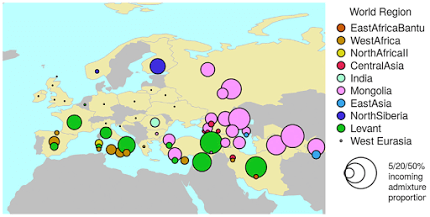
Recent admixture in West Eurasia (including Europe)
Below is Figure 4A from the paper, which shows the proportions of admixture from outside of Europe and West Asia among a wide variety of West Eurasian groups.
http://polishgenes.blogspot.com/2015/09/recent-admixture-in-west-eurasia.html
Ukraine says Russian agents posed as Poroshenko for fake interview with The New York Times
The Unsolved Mystery Behind the Act of Terror That Brought Putin to Power
All available evidence points to Putin’s complicity in the 1999 apartment-building bombings in Russia. Those who have tried to investigate have been killed off, one by one.
Russian human-rights defenders Sergei Yushenkov, Yuri Shchekochikhin, Anna Politkovskaya, and Alexander Litvinenko also worked to shed light on the apartment bombings. But all of them were murdered between 2003 and 2006. By 2007, when I testified before the House Foreign Affairs Committee about the bombings, I was the only person publicly accusing the regime of responsibility who had not been killed.
The bombings terrorized Russia. The Russian authorities blamed Chechen rebels and thereby galvanized popular support for a new war in Chechnya. President Boris Yeltsin and his entourage were thoroughly hated for their role in the pillaging of the country.
Putin, the head of the FSB, had just been named Yeltsin’s prime minister and achieved overnight popularity by vowing revenge against those who had murdered innocent civilians. He assumed direction of the war and, on the strength of initial successes, was elected president easily.
Almost from the start, however, there were doubts about the provenance of the bombings, which could not have been better calculated to rescue the fortunes of Yeltsin and his entourage. Suspicions deepened when a fifth bomb was discovered in the basement of a building in Ryazan, a city southeast of Moscow, and those who had placed it turned out to be not Chechen terrorists but agents of the FSB.
After these agents were arrested by local police, Nikolai Patrushev, the head of the FSB, said that the bomb had been a fake and that it had been planted in Ryazan as part of a training exercise.
The bomb, however, tested positive for hexogen, the explosive used in the four successful apartment bombings. An investigation of the Ryazan incident was published in the newspaper Novaya Gazeta, and the public’s misgivings grew so widespread that the FSB agreed to a televised meeting between its top officials and residents of the affected building.
The FSB in this way tried to demonstrate its openness, but the meeting was a disaster: It left the overwhelming impression that the incident in Ryazan was a failed political provocation.
Three days after the broadcast, Putin was elected. Attention to the Ryazan incident faded, and it began to appear that the bombings would become just the latest in the long list of Russia’s unsolved crimes.
Read more at: http://www.nationalreview.com/article/439060/vladimir-putin-1999-russian-apartment-house-bombings-was-putin-responsible
Ukraine Charts – economic and social trends since 1991. (Ukrainian language)
Number of Ukrainian generals to be cut from 194 to 95
“The proposed cuts: the State Border Guard Service (with about 42,000 people), including 74 generals, will have 14 people remaining; the National Guard (46,000 people), including 38 generals, will have 18 people remaining; the Emergency Service (73,000 people), including 27 generals, will keep 21 people; the National Police and the Ministry of Internal Affairs (175,000 people), including 57 generals, will have 42 people left,” he wrote on Facebook. Read also Avakov calls Trump “dangerous” following statement on occupied Crimea According to Avakov, under the proposal, in total, the posts and ranks of generals will be reduced from 194 to 95 among all paramilitary formations and law enforcement bodies which are part of the Ministry of Internal Affairs.
Read more on UNIAN: http://www.unian.info/society/1474054-avakov-announces-large-scale-cleansing-among-generals.html
Failure to report a crime is now a crime in Russia
Comparing Ukrainian and Russian histories
http://empr.media/culture/history/first-mentioned-ukraine-russia-not-exists/
What historical data will help to clarify Ukraine and Russia backgrounds.
Higher education institutions: the Russian Academy of Sciences was founded in 1724, Moscow University in 1755. Ostroh Academy was founded in 1576 in Ukraine, the Kyiv-Mohyla Academy was established in 1615 and Lviv University in 1661.
First printed ABC book in Ukraine was published in 1574 in Lviv, and in the Tsardom of Russia it happened 60 years later in 1634.
Religion: Kyiv Metropolia was founded in the year 988, and Moscow Patriarchate only in 1458. Kyiv Metropolia is 460 years older than Moscow ones.
Capitals: Kyiv is one among the oldest cities in Europe and was founded in 482, while Moscow was founded in 1147 by Yuriy Dolgoruky, the son of Volodymyr Monomakh. So, Kyiv is older than Moscow by 665 years.
The first monarch who was crowned in the Tsardom of Russia was Ivan the Terrible in 1547, and in Ukrainian lands it was the first king of Rus’ Daniel of Galicia in 1253.
Mongol yoke: Kyiv lost the Mongolian yoke in 1363 after the Battle of Blue Waters; Moscow lost yoke in 1480 after great standoff on the Ugra river, and Muscovy paid tribute to the Crimean khan till 1700, including the first years of Peter the Great reign.
Name: For the first time, the term ‘Ukraine’ was found in the chronicles in the year 1187. Term ‘Russia’ was found only during the reign of Ivan the Terrible 400 years later.
Last, but not the least, famous Ukrainian Pylyp Orlyk is the author of one of the first constitutions in the world. On April 5th, 1710 he was elected as a hetman. On the same day he announced a ‘Pacts and Constitutions of Rights and Freedoms of the Zaporizhian Host’. Worth mention, that the U.S. constitution was adopted in 1787. In France and Poland it was adopted in 1791.

