
There’s a well-known expression from Vynnychenko, that states, “Where the Ukrainian question begins, the Russian democrat disappears.”
Has no one ever wondered why this is so?
I came to an interesting conclusion on this after I had a conversation with a guy, who is a history major; he was coming back from the ATO on furlough to Kyiv, to his wife and small child. Returning from my lecture tour, I picked him up in Cherkasy and took him to Kyiv.
He told me an interesting story from a village in the Luhansk region. He used to buy milk from this very old woman who was well over 80 years. He went to her on purpose, precisely because she had a furious attitude toward Ukrainian soldiers, but nevertheless money came in handy for her, so she sold milk to those whom, in reality, she truly hated.
This old woman was herself from Russia. She was brought to this village when she was still very little by her parents, who were deliberately transported here by the Soviet regime. People were relocated to this village where over 90 percent of the villagers died of starvation during the Holodomor period. Russians were settled in those exact homes where Ukrainian peasants used to live, and where they died of starvation along with their entire families. And this old lady hated with passion everything Ukrainian, because she understood that at one time, her parents were given that which originally belonged to Ukrainians. They did what looters do; appropriated from those killed by them.
That’s why such a subconscious hatred developed in this old woman, of those who may be considered descendants of Ukrainian villagers who were victims. This hatred is based on fear of exposing the previously committed crimes.
We are seeing the same thing happening on a subconscious level to the vast majority of Russians. They understand that – by their own [Russian] grandfathers – at one time for Ukrainians their history was stolen from them, the name of their people, and all that is the foundation of the nation. And that’s why there is such hatred for everything Ukrainian–a denial of Ukrainian traditions, language, and cultural heritage.
Because if they admit that all of it was stolen, then it becomes clear that most of what Russians now call “historically Russian,” does not belong to them. It’s just something that they seized from other nations at some point in a very brutal and cunning manner. It’s the hatred of villains, who are afraid that one day the crime will be called a crime, and what was stolen, as stolen.
It’s no wonder that so often one can hear from totally intelligent Russians, this emotional thought that the question in general is not about Ukraine or Ukrainians, which on a subconscious level they have never recognized as a distinct nation. The question now lies in Russia itself. If they recognize Ukraine and Ukrainians, it will become inevitable to admit that they themselves are the descendants of those who once lived in Kyivan Rus–Ukraine. And then the whole concept of the “Russian world” will crumble to dust. That in reality, they have nothing of their own. Everything [they have] was at some point violently taken from others.
That’s why right now the fate of the Russian empire is really being decided. If Ukrainians preserve their sovereignty, then the final collapse of this prison of nations is only a matter of time. Moreover, I’m convinced that we are not talking decades. It’s a matter of several years.
Category Archives: History
How Stalin crushed the Euromaidan of 1930
December 12, 1933, American Communists attack a Ukrainian protest against Holodomor in Chicago


“Twenty people were taken to the hospitals after the riot, in which weapons of every sort were used including bricks which were hurled from an elevated station directly above the scene.”
Remembering Holodomor

Effects of Communism. Stunning comparison of East and West Germany
Hans Hoppe argued at the time of unification, that East Germany should become its own country and thereby avoid a dependent relationship.
A wedding in the Soviet Union

by Ihor Kolesnik
Greatest modern Japanese Sumo Wrestler was Half Ukrainian
Half-Ukrainian, Taiho Koki was the 48th yokozuna in the Japanese sumo wrestling & regarded as best sumo wrestler of the post-war period

In Photos: Prehistoric Temple Uncovered in Ukraine (Kirovohrad oblast)
Built before writing was invented, the temple is about 60 by 20 meters (197 by 66 feet) in size. It was a “two-story building made of wood and clay surrounded by a galleried courtyard,” the upper floor divided into five rooms, write archaeologists Nataliya Burdo and Mykhailo Videiko in a copy of a presentation they gave recently at the European Association of Archaeologists’ annual meeting in Istanbul, Turkey.
Inside the temple, archaeologists found the remains of eight clay platforms, which may have been used as altars, the finds suggested. A platform on the upper floor contains “numerous burnt bones of lamb, associated with sacrifice,” write Burdo and Videiko, of the Institute of Archaeology of the National Academy of Sciences of Ukraine. The floors and walls of all five rooms on the upper floor were “decorated by red paint, which created [a] ceremonial atmosphere.”
he ground floor contains seven additional platforms and a courtyard riddled with animal bones and pottery fragments, the researchers found.
Massive settlement
The temple, which was first detected in 2009, is located in a prehistoric settlement near modern-day Nebelivka. Recent research using geophysical survey indicates the prehistoric settlement is 238 hectares (588 acres), almost twice the size of the modern-day National Mall in Washington, D.C. It contained more than 1,200 buildings and nearly 50 streets.
A number of other prehistoric sites, of similar size, have been found in Ukraine and other parts of Eastern Europe. These sites are sometimes referred to as belonging to the “Trypillian” culture, a modern-day name. The name is derived from the village of Trypillia in Ukraine, where artifacts of this ancient culture were first discovered.
Archaeologists found that when this prehistoric settlement was abandoned, its structures, including the newly discovered temple, were burnt down, something that commonly occurred at other Trypillian culture sites.
http://www.livescience.com/48352-prehistoric-ukraine-temple-discovered.html
The Kremlin Is Trying To Erase Memories Of The Gulag
Wouldn’t be the first time Moscow rewrote its history.
http://www.newrepublic.com/article/118306/kremlin-trying-erase-memories-gulag
Shopping in Tallinn (now-Estonia) in 1990
American Quarterly on the Soviet Union
This is probably a goldmine for historians: http://www.unz.org/Pub/AmQSovietUnion
It seems to be mostly a propaganda journal, but one that presented scholarly views and official texts of government bodies.
I’ve just browsed briefly. The 1948 edition has an article about creating Jewish regions in Crimea and/or other parts of Ukraine.
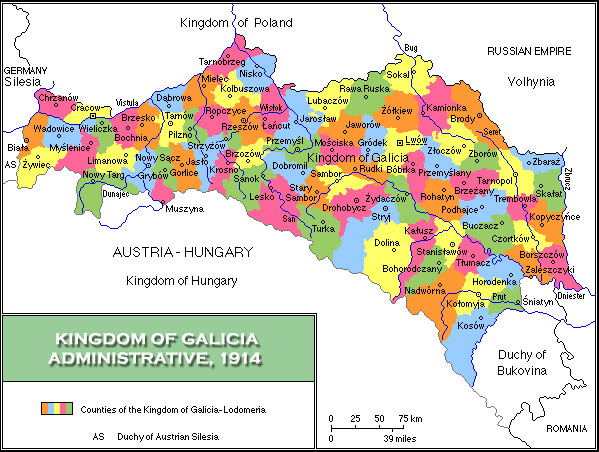
1914 Map of Galicia
Why Belarus is Lithuania?
And the territory of modern Lithuania was then called in another way: Samogitia or Zhmud. My ancestors called themselves Litvin, and their language – Lithuanian. Contemporary Belarus and Lithuania long time have been a unified country, our people share a common history. Even the Lithuanian capital Vilnius more than 600 years has been the Belarusian capital city of the Grand Duchy of Lithuania. Name of the city in those days was Vilna or Vilnia. Only in 1939 the Communists gave the city and the territory around to modern Lithuania. And if you ever read about ancient Lithuanian princes Mindovg, Vytautas, Gediminas, you must know: there are Belarusian princes too.
The name “Byelorussian” appeared only in the 19th century, when the land of my country went to the Russian Empire. Then Litvin was imposed on the new name of lands: Belorussia, and the people were called Belorussians. The name “Lithuania” departed to the northern part of the land. Now the modern state Lithuania located there.
And so people have become confused in terms of historical realities. This is understandable: Belarusians and Lithuanians are the neighboring peoples. We live together, Belarusians frequent Vilyunyus, go back to university, go shopping. Lithuanians are also frequent visitors to Belarus. For many centuries we have lived together in a single state whose name was the Grand Duchy of Lithuania.
http://mynativebelarus.blogspot.de/2012/06/why-belarus-is-lithuania.html
The Russian Origins of the First World War (a criticism of a book promoting this theory)
Sean McMeekin. The Russian Origins of the First World War
n his third book in four years, Sean McMeekin, an assistant professor of international relations at Bilkent University (Ankara, Turkey), rekindles interest in Russia’s responsibility for unleashing the great catastrophe of 1914. Based on Russian, Turkish, French, German, Austrian, and British documentary repositories, including the Archive of Imperial Russian Foreign Policy (AVPRI) and the Russian State Military History Archive (RGVIA), the study forwards a courageous interpretation that stimulates interest in Russia’s path to war. Focusing on political designs and military events in the eastern theater, the book argues that the constellation of circumstances in July 1914 triggered Russian plans to overthrow and expel the Turks from Constantinople, extend dominion into eastern Anatolia and Persian Azerbaijan, and secure predominance in the Black Sea. While not entirely new, the thesis is told with vigor and boldness, based on fresh AVPRI findings. Russian Foreign Minister Sergei Sazonov appears center stage as the astute and charming, yet shallow and deceitful mastermind behind an intricate manipulation of British and French foreign policymakers to secure Russia’s bid for world power. . . .
In evaluating the reasons that Russia opted for war, McMeekin diminishes the symbolic interest of the Bosnian Crisis of 1908. He dismisses its memory “in the minds” of Russian statesmen. He pays scant attention to Russia’s fragile domestic morale and the influence of the popular press. Yet after Russia’s ignominious bow to Austrian and German threats in 1909, Russia’s political and military elite believed that Russia could not sustain yet another humiliation on that scale.
The absence of discussion about the archduke’s assassination in a handful of diplomatic papers does not conceal the deep-seated concern for Balkan affairs. The matter in Serbia was not “some silly Balkan bagatelle” or “phantom issue” to the Russian Foreign Ministry (pp. 101, 232). If Russia remained passive in the face of the destruction of Serbia, it would be humiliated and its long-held prestige among the Slavic peoples of southeastern Europe would dwindle into insignificance. The Russian ministers feared that the domestic results of such a fiasco would be incalculable. Action entailing major sacrifices would be better than skulking away in shame. McMeekin’s inspection of the July record rests on ample speculation over a few consular reports, incomplete diaries, and self-proclaimed insights into the “actors’” minds. Absent from the war plans and consular papers employed are the enormous, astoundingly complex details behind a descent on the Turkish capital and its effect on millions of people.
An emphasis on the drama of the Russian Revolution has diminished historians’ appreciation for events directly connected to the eastern theater of the war. Building on the work of Norman Stone, the central chapters of The Russian Origins of the First World War provide a brief narrative of Russian military action in the eastern front, including the southern Caucasus, Anatolia, and Persian Azerbaijan. In the opening month of the war, Russia’s infantry-divisional advantage coupled with Austria’s botched mobilization enabled tsarist forces to score major victories in the Southwest. . . .
There is a tiny kernel of truth in McMeekin’s analysis; since Sazonov’s time, the Russian General Staff had maintained that mobilization was the equivalent of war. General mobilization was consequently a bellicose act directed at both German states. Yet time was a prized commodity and the Russian leadership had no reason to postpone the inevitable. Austria’s declaration of hostilities against Serbia indicated that war was at hand. Most Russian leaders believed the war would be short, and key figures among the military and civilian elite were acutely aware of Russia’s unpreparedness. Russia’s strategies for war were dependent on incomplete, hastily conceived plans and tense cabinet meetings chaired by all too human actors, not a cohesive strategy for the Ottoman inheritance.
Crimea is Not Historically ‘Ours,’ Russian Historian Says in ‘Vedomosti’
Zubov, who was a professor at Moscow State Institute for International Relations (MGIMO) until he lost his position there because of his pro-Ukrainian positions, uses this article to lay out for Russian readers just how tendentious and wrong are the Kremlin’s arguments at a time when few in that country or elsewhere are willing to challenge them.
Great article on Russia’s long battle with Ukrainian history
(thanks, Elmer)
http://www.sofmag.com/russia%E2%80%99s-war-ukraine
On the periphery of most peoples’ awareness, Ukraine is the largest country in Europe by territory, located in the geographic center of the European subcontinent. It is the land, wrote English historian Norman Davies, through which most peoples passed on their way to settle the rest of Europe, and to become the nations and countries that we know today.
In the Middle Ages, the Kyivan Rus’ (not Kyivan “Russia”—more below) Imperial Dynasty was the largest political entity in Europe. Following Kyiv’s adoption of Christianity from Byzantium, the precursor of modern Ukraine became a powerhouse of intellectual discourse, religion, and cultural life. In its size, grandeur and advancement of education (mandatory for women), in its equal rights for women, in the arts and the sciences, Kyiv eclipsed other European cities such as Paris and London. European kings and the English monarchy married into the Kyivan Dynasty. Among them, King Henry I of France married Princess Anna of Kyiv; she signed her name to the marriage document, he used an “X.” The Gospel she brought from Kyiv was used in the coronation of French kings for centuries. The French historian Levesques wrote about the marriage, quoting Bishop Gautier Saveraux who was King Henry’s envoy to Kyiv: “This land is more unified, happier, stronger and more civilized than France itself.” The trident was the official state insignia of Kyivan Rus,’ stamped on its coins, and continued as the national symbol of modern Ukraine through the intervening 1,000 years (the significance of this appears below).
“Russia” at that time did not exist, and had as its antecedents Finno-Ugric tribes that separately evolved into scattered principalities in the north that rejected Kyiv’s dominion. Most telling was their sacking and rejection of Kyiv in 1169 that was not matched until the city’s destruction by the Mongol Horde a hundred years later. The Kyivan Rus’ Empire collapsed with the latter onslaught, but in the process shielded the rest of Europe from the same fate. . . .
On May 31, 1933, Gradenigo, the Italian consul in the Ukrainian city of Kharkiv during the height of the man-made famine, reported to the Royal Italian Embassy in Moscow his discussion with a senior OGPU secret police officer who advised that 10-15 million starvation murders were required to tame, in the OGPU’s words, Ukraine’s “ethnographic material.” Not a nation. Not people. Not human beings. Just “ethnographic material.” Hitler’s term was untermenchen.
Reporting further, Gradenigo said the government strived to ensure that “Russians would constitute the majority of the population” in certain regions of Ukraine, and thus assure that potential political difficulties would be removed. The Italian consul concluded: “However monstrous and incredible such a plan might appear, it should nevertheless be regarded as authentic and well underway…The current disaster will bring about a predominantly Russian colonization of Ukraine. It will transform its ethnographic character. In a future time, perhaps very soon, one will no longer be able to speak of a Ukraine, or a Ukrainian people, and thus not even of a Ukrainian problem, because Ukraine will become a de facto Russian region.” It is the offal of that tectonic ethnic cleansing that underlies the “split” in Ukraine, mouthed with such obliviousness as to its cause. . . .
Moscow was ecstatic: “We have annihilated the nationalist counter-revolution during the past year we have exposed and destroyed nationalist deviationalism…1933 was the year of the overthrow of the Ukrainian nationalist counterrevolution.” More: “Acknowledging the great amount of work put…into the fight against Ukrainian nationalist and other counter-revolutionary elements, work which has not ceased and which shall not cease, we must say that of course we gave the nationalists a beating, a good one, as the saying goes, we hit the spot.” Is this the “common history” between the Kremlin and Kyiv that today the media and others put forth as underpinning Russia’s claims to Ukraine?
. . . .
A Ukrainian in the Jamestown colony (?)
Wikipedia claims it: The first Ukrainian immigrant to America, Ivan Bohdan, sailed with John Smith to the Jamestown colony in 1607. Bohdan met captain Smith during the time when the latter had fought the Turks, was captured, and escaped captivity by fleeing through Ukraine, Romania, Hungary, and other countries.
But his name doesn’t seem to appear on the lists of original settlers:
http://apva.org/rediscovery/page.php?page_id=30
http://www.nps.gov/jame/historyculture/the-first-residents-of-jamestown.htm
But:
Bohdan arrived in 1608, a year after the founding of Jamestown. He and several other men, noted as Poles and Germans, were recruited by Capt. Christopher Newport at the behest of Capt. John Smith, then president of the Jamestown colony, because they possessed a variety of practical skills lacking among the English settlers who were struggling to survive. Bohdan, for example, was described as an expert in making pitch and tar necessary in the building and repair of wooden boats back then. Others were talented in making glassware, an important industry in the colonies.
Smith may have learned first-hand about the industrious Poles and Germans – and Ukrainians – in yet another possible connection with Ukraine. Serving as a mercenary, Smith fought in wars against the Ottoman Turks but was wounded, captured and sold as a slave. His escape route may have taken him through parts of what is now Ukraine, including Crimea, and then through the Polish-Lithuanian Commonwealth.
While I could not find much more information about Ivan Bohdan via the Internet, I wondered if he was part of the contingent of Polish workers who staged America’s first labor strike in 1619, a colonial example of democracy in action. The Virginia colony was about to hold its first election, but the English political leaders denied voting privileges to the Poles and other non-British settlers – despite their important contributions.
The Poles, however, decided to strike and took up the slogan, “No vote. No work.” The tactic worked, and English soon changed their stance on who could vote in America’s first legislative election.
http://uk.wikipedia.org/wiki/%D0%91%D0%BE%D0%B3%D0%B4%D0%B0%D0%BD_%D0%86%D0%B2%D0%B0%D0%BD
The Slavery of Russians and Christianity (?)
Dissident 19th-century nobleman philosopher Pyotr Chaadayev called serfdom “a terrible ulcer” and asked: “Why … did the Russian people fall into slavery only after having become Christian? … Can [the Orthodox Church] explain why it did not raise its motherly voice against the repulsive violence committed by one part of the nation against the other?”
My answer: because, Christianity destroyed old tribal power structures in just a couple generations. (See Francis Fukuyama)
***
The rest of the article is a pretty damning look at Russian history:
In the late 18th century, nobleman Aleksandr Radishchev was exiled to Siberia for publishing his critique of serfdom. At one point in the book, Radishchev’s stance seems at odds with Zorkin’s that it was the abolition of serfdom that produced revolutionary unrest in Russia. It was serfdom itself.
“Tremble, cruel-hearted landlord! On the brow of each of your peasants, I see your condemnation written,” Radishchev wrote.
In 1847, literary critic Vissarion Belinsky penned his famous letter to Nikolai Gogol, in which he wrote that Russia “presents the dire spectacle of a country where men traffic in men without even having the excuse so insidiously exploited by the American plantation owners who claim that the Negro is not a man.”
Russia is “a country where there are not only no guarantees for individuality, honor, and property, but even no police order, and where there is nothing but vast corporations of official thieves and robbers of various descriptions,” Belinsky wrote.
http://www.rferl.org/content/russia-judge-praises-serfdom/26616056.html
Muskovy lies about #History and the invented “Russian” people
Let the Russians refute these 10 facts:
1. The state called – Muscovy was renamed to Russia by Tsar Peter 1 only in the 18th century, in 1721.
2. A tribe called the river flowing through the region Moskva, in the Moksha language this can be translated to mean “dirty water”. There is no other language in the world which can translate this word. The word – “kremlin” is a Tartar word which means “a fortification on a hill”.
3. In the Middle Ages all European cartographers worked and created their maps all the way to the borders of Rus’ (Rus’ – is the territory of contemporary Ukraine!) The Ulus (a turko-mongolian sociological term which delinates a particular group of people) of Moscovy, with its Finnish people, had always been designated as part of the Horde and Europe appropriately considered it to be part of Asia.
4. Moscovy (Russia) paid tribute to the Crimean Khan(!!!!!), its sovereign and their Host, who was a successor of the Golden Horde until 1700. The Tsar of Moscovy met with the Crimean ambassador on Poklannaya Hill who was on horseback, while the Tsar was on foot leading the horse by the bridle to the Kremlin, once inside he sat the ambassador on the throne and knelt before him.
5. In Moscovy in the year 1610, the dynasty of Genghis Khan came to an end Morza Gudun – better known to the world as Boris Gudunov, and then throned Alexey Koshka an ancestor of the Finnish Kobyla family, and in marrying him to the church they renamed him and gave him the surname Romanov, as if he had come from Rome to rule over Moscovy!
6. Catherine the Second, after the end of the rule of the Polish-Lithuanian Commonwealth in 1795, made a decree that all the Finno-Urgic tribes of Moscovy to be named socalled Great Russians while the Ruthenians or true Rus people to be called Little Russians!
7. No one ever saw the original agreement of Peryaslav of 1654 which was allgedly signed by Bohdan Khmelnytsky and the emissaries of Tsar Alexey of the created Romanovs!?
8. For many centuries, archaeologosts have tried to locate artifacts which would confirm the location of the Battle of Kulikovo, though searches have proven fruitless in proving that such a battle of Dmitri Dontsov being victorious over Mamai ever took place. To date it is but a myth created based on the finding of a few artifacts by a procurator of the Most Holy Synod, on Stepan Nechayev. Such a position allowed him to create any myth he chose. So until now this myth of the battle has been bellowed out, though there is little proof it ever took place!
9. The Pskov, Novgorod and Smolenks oblasts of Russia – were all former principalities Slavic- Rus Kingdom and had nothing to do with Finno-Urgic Moscovy, whilst they were respectively occupied by the Horde in 1462, 1478 and 1654. And Slavic tribes or peoples never lived in other areas of Moscovy, the present Russian Federation.
10. The Golden Horde and her daughter – Muscovy – were the only nations in the world that ever enslaved their own people. This explains the eternal backwardness of Moscovy which is so rich in natural resources as compared to European countries which are at a disadvantage when it comes to thse resources. Indeed, the efficiency of free people is much higher than that of slaves…
http://wpawlowsky.com/2014/06/08/liars-moscovy-myths-debunked/
***
See also:
Mongolian-establish-Muskovy adopted Christianity in 1613 to legitimize their rule, quell the masses
Moscow appeared as a princedom in 1277 at the decree of the Tatar-Mongol Khan Mengu-Timur and it was an ordinary ‘ulus’ (subdivision) of the Golden Horde. The first Moscow prince was Daniel (1277-1303), younger son of Alexander, so-called ‘Nevsky’. The Riurykovich dynasty of Moscow princes starts from him. In 1319 Khan Uzbek (as stated in the afore-mentioned work by Bilinsky) named his brother Kulkhan the virtual Prince of Moscow, and in 1328 the Great Prince of Moscow. Khan Uzbek (named in Russian history as Kalita), after he converted to Islam, destroyed almost all the Riurykovich princes. In 1319-1328 the Riurykovich dynasty was replaced by the Genghis dynasty in the Moscow ‘ulus’ of the Golden Horde. In 1598 this Genghis dynasty in Moscow which began with Prince Ivan Kalita (Kulkhan) was finally broken. Thus for over 270 years, Moscow was ruled solely by the Khans of Genghis.
Still, the new dynasty of the Romanovs (Kobyla) promised to follow former traditions and solemnly swore allegiance to the age-old dynasty of Genghis.
In 1613 the Moscow Orthodox Church became the stabilizing force to safeguard the sustainment of Tatar-Mongol government in Moscow, offering Masses for the Khan, and issuing anathemas on anyone who opposed this servitude.
Based on these facts, it becomes clear that Moscow is the direct inheritor of the Golden Horde Empire of Genghis and that actually the Tatar-Mongols were the ‘godfathers’ of Moscow statehood. The Moscow princedom (and tsardom from 1547) up until the XVI century had no ties or relationships with the princedoms of the lands of Kyivan Rus.
http://euromaidanpress.com/2014/05/14/how-moscow-hijacked-the-history-of-kyivan-rus/

