
Roman on Hromadska Dumka, Lviv, Ukraine, April 2011 from Roman in Ukraine on Vimeo.
Author Archives: RomanInUkraine
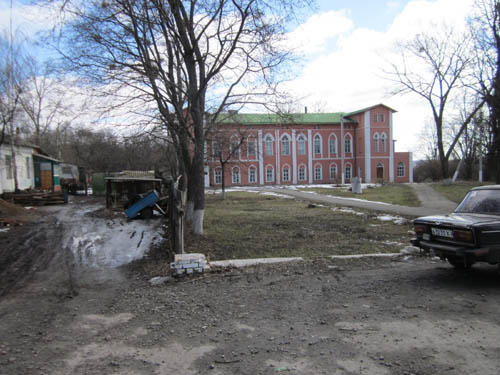
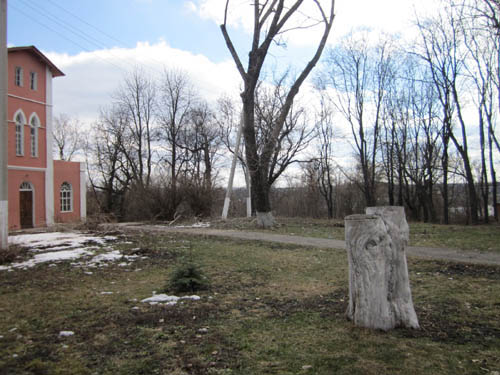
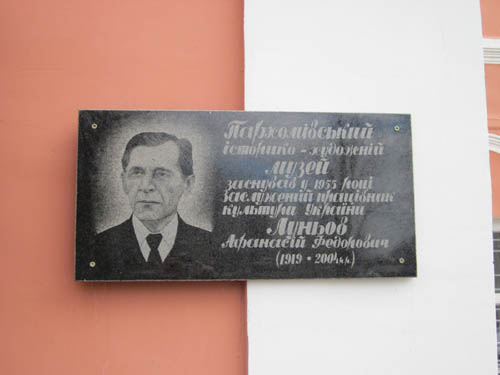
Parkhomivka Art Museum
I thought I should finally follow up on the post about my visit to Kharkiv and describe the unlikeliest art museum in the world.
From my Lonely Planet guide:
“Possibly Ukraine’s best collectino of Western art isn’t in Kyiv, Kharkiv or Odesa. Rather, it lies deep in rural Kharkivska oblast near the obscure town of Krasnokutsk. We say ‘possibly’ because it has not been verified that all of the works at the Parkhomivka History & Arts Museum belong to the names they are ascribed to — names like Van Gogh, Gauguin, Manet, Rembrandt, Picasso and Renoir. But if you think we’ve fallen for a classic Ukrainian scam, think again. Many of the works by big-name artists have been verified….
How did such a rich collection land here? The man responsible is one Afansy Lunyov, a teacher and master networker who ran an art school here in the heart of the Khrushchev and Brezhnev years. He used to take his students on field trips to art museums across the Soviet Union, in the process becoming close with artists, collectors and curators.”
***
I stayed with my friend Mike-the-historian in Kharkiv. On the first evening, he needed to schedule some interviews before we left for dinner. He and Olga, his multi-lingual assistant (Ukrainian, Russian, English, German, Spanish), made calls, and I flipped through my Lonely Planet guide to kill time.
That’s how I discovered the museum. We asked Olga to try the two phone numbers in the guidebook to confirm their hours. One number was disconnected. The other turned out to be the head curator’s personal mobile phone. I have no idea how it got into my Lonely Planet guide.
The next day, our taxi driver asked directions through his window, first around major intersections to find the village, then in the village to find the museum. Eventually, we pulled down a dirt and gravel lane toward a building with a pink exterior which stood out from the surrounding small village homes. A shabby dog paced in the adjacent lot, lazily dragging this chain back and forth. The two teenage security guards snuffed out their cigarettes and stood from the stoop. They glanced at us, avoiding eye contact, as we gathered our things from the cab.
Three old babushkas worked the coat check. Neither I nor my friend Mike checked our coats, so the three of them supervised Olga’s. We were the only visitors. Two other ladies made an elaborate show of taking our money and ripping each of us a ticket from a booklet, using the straight edge of a ruler.
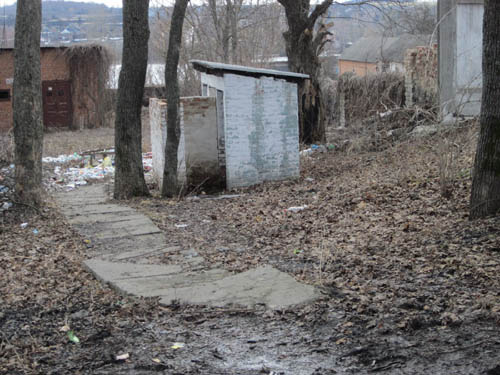
It seemed none of the two dozen employees had a plumbing background, because the toilet was broken. I resorted to their outhouse.
There were two floors, and a cadre of grumpy old women who flipped the lights on and off as we came and went and watched us as if any moment, through some miraculous slight-of-hand, one of us would whisk a painting off the wall and into our pants.
They seemed unbearably stressed when the three of us drifted toward different parts of a room, not knowing who was the thief, and who the decoys. Sometimes their colleagues from adjacent rooms came to assist. Fortunately, we were the only visitors.
The first room had 18th century portraits donated from the Hermitage.
In the second, I saw sketches of mermaids by Mikieshyn (1835-96). One was entitled “Prince Among Mermaids.” (Мікєшин — “Лицар Серед Русалок”)
These were swamp mermaids. They had legs, emerged from the fog and were ugly and menacing. Olga told me they were illustrations of a folk story which transliterates as Vij.
A painting by Kovalevs’kyi called Stsena Silskoho Jytia (Stage of Village Life) depicted a boy riding bareback shepherding a couple of cows through a gate. This was one of my favorites. (
Ковалевський — “Сцена Сільського Життя”)
I’m please at my ability, so far, to remember the paintings from their titles which I jotted down in my notepad. The boy had a red shirt and a stick.
There were breathtaking sketches of trees and woods by Shyshkyn (1832-1898) which reminded me very much of the obsessive detail of the great Ukrainian diaspora artist Jacques Hnizdovsky.
One of my favorites was by Kryjytskiy, Zumoviy Peizaj (Winter Landscape), 1903. It shows a small row of Ukrainian village houses blanketed by snow beneath a startling yellow sky. Do you know that bright, fresh morning sunlight that only comes in winter? This was the painting. (Крижицький — “Зимовий Пейзаж”)
Another one of my favorites was Landscape with Hunter, 1882, by Volkov (1844-1920). It showed an enormous, impenetrable forest — the kind that no doubt inspired Mikieshyn’s swamp mermaids — and, almost unnoticed beside the immensity of the trees, a hunter finding his footing on the bank of a small creek. (Волков — Пейзаж з Мисливцем)
The first artist whose name I recognized was Pissaro. Olga later chided me for not having known Shyshkyn — I do now. Pissaro’s “Spring,” 1891, hung in the third or fourth room. It showed the beauty of the spring from an unlikely angle. Where a sidewalk and lawn meets a building, shadows of some elaborate trees cast colorful shadows.
Four Picassos were in the same room:
Decorative Vase,
Dove with Olive Branch (Is Blue Dove the correct name???),
Portraint of G. Curi (F.J. Curie???),
and Decorative Place with Divers.
I guessed the divers were a man on horseback and one laying prone before sounding out the Ukrainian-language title and seeing the divers.
I don’t know the value of these works, but I suspect it is a lot, especially for such a little village and two bashful teenage security guards. I wondered about various possibilities of fakes being on display to foil thieves, or else already replaced with the originals which went to one of Ukraine’s ubiquitous oligarch.
Some of the most exciting paintings were by unknown artists:
– A small, badly damaged which I think was from the 17th century showed a vigorous fight between a hunting party and a big, round pig with tusks. I don’t know enough about art to name the style or exact era, but the painting was flat — the objects in the distant landscape were smaller but in the same perfect focus as the foreground. I enjoyed looking at the action.
– Blue palms which filled most of the painting and were summarized with distinct, recurring shapes, like Grant Woods Iowa landscapes.
– Glassy roses beside a window. Everything dancing with colors.
– A painting entitled “Bronze Snakes” seemed to show a biblical scene with a line of tents and people agonizing as snakes rain down from the sky. A prophet-like figure preaches amid the suffering.
There were a couple of 17th Century Dutch harbor-scapes with astounding, majestic detail.
In my notebook, I also wrote “Unexpected Meeting” and “Bruno,” but my memory fails me.
A corridor at the end of our second floor tour showed Soviet era industrial portraits. One depicted a forest of power lines, which was cool and surprising. I didn’t care for the others.
The first floor had more recent work, such as those of Bolshevik poet and artists Maiakovski (Маяковский). His cartoonish, “Who Will Lift the Soviet Flag,” showed a bending laborer, who, strangely, looked like an African-American character in black-face, lifting the Soviet flag from the mud.
His other work, the pair, “Seven Pairs of Dirty” and “Seven Pairs of Clean,” each showed fourteen characters. The dirty were laborers, the clean were Marx’s supposedly exploitative classes — priests, aristocrats, entrepreneurs, a fat military general. It was pointed out to me that the “exploiters” were in disarray, while the laborers were in relative conformity, all facing the same direction.
It was painted very unusually, shapes and lines invoking caricature and movement. I recognized it, vaguely, from some art book.
The most ridiculous work in the collection was the 1968 embroidery by Ivanova A. A. entitled “V. I. Lenin speaks with Hutsul Villagers. It depicted Lenin in his suit and determined expression preaching the gospel of Marx to fascinated Hutsuls. Of course, the part of Ukraine inhabited by Hutsuls didn’t fall under the Soviet Union until 1944.
The painting I found most moving, and consider my favorite, was Portrait Kolhospnytsi (Portrait of a Collective Farm Worker) by Rotnytski, born 1915. (Ротницкій — Портрет Колгоспниці)
She was a middle aged peasant women with a scarf and white embroidered shirt resting her chin in her hand. I felt overwhelmed by the sadness in her eyes. They spoke volumes, as did the wrinkles on her face, and her swollen hands.
I returned many times to look at her, much to the distress of the grumpy old woman who practically ran after me to flick on the light and make sure I didn’t find a way to tuck the large portrait into my sleeve.





Here’s an embroidery for you, mom. :)

(click for high resolution)
It’s from a Museum in Berejany.
Cafe Cafe during a storm
A violent thunderstorm blew into L’viv with buckets of water falling from the sky, blue flashes of lightning, and instant, ear-splitting thunder.
I was in the center, returning from a purchase of train tickets. The lines were long and I had been thinking angry thoughts about gross inefficiency and the life-times Ukrainians spend waiting in lines or getting things stamped — the country’s two main pastimes.
The restaurants in the center all filled instantly with Ukrainians and tourists. A small crowd did remain outside under their umbrellas watching musicians set up on a stage in Rynok square.
People waited under awnings and in doorways for the rain to pass. The rain was so fierce, that even people eating under the large canopies many restaurants set up in the streets opened their umbrellas against the splash and wind.
After darting between various cafes, I feel fortunate to have gotten the last table at one of my favorite places, Cafe Cafe, which probably has the best casual combination of good service and reliable wifi in L’viv.
Show tunes are playing. I was served instantly and ordered pasta and tea. My jeans and shirt are drying. The rain seems to be subsiding already, and the thunder more distant.
The People’s Cube!

Brilliant anti-socialist website by a former professional propaganda artist from Soviet Ukraine. Check it out: http://thepeoplescube.com/ |
***
Here’s one of Oleg Atbashian’s lectures:
[youtube]G_aNNT7cFuQ[/youtube]

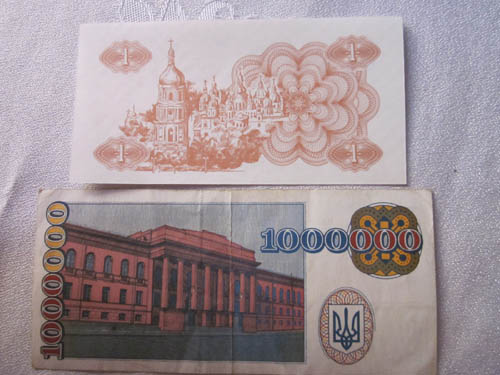
Ukraine’s Hyper-Inflation — Kupony / Karbovantsi

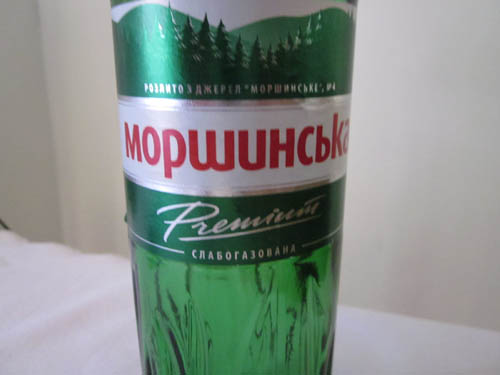
Various Water Carbonations




God. Bless. Capitalism.
My Friend Kateryna’s Blog
Odesa
Just returned from the Fulbright conference in Odesa. I think I won the prize for most *interesting* presentation: “Property Rights and Ukrainian Identity”
Stay tuned for audio, pictures.
Economic Outlook
This was publish in Media Star’s newspaper and elsewhere.
В українській мові: here.
***
It is difficult to contemplate the enormous extent to which the world changed when the Soviet Union collapsed. The more economists and historians study the Soviet Union, the more apparent it becomes that it existed as a house of card built upon economic fallacies and that its collapse was inevitable.
We should remember, however, that the economic fraud of Soviet central planning is not only known historically, in retrospect. It was predicted before it happened. Based strictly on a theoretical understanding of human action, in other words, of economics, the eventual collapse of the Soviet Union was apparent to L’viv-born, Austrian School Economist, Ludwig Von Mises.
In 1921, before Lenin was even forced to restored partial property rights through his New Economic Policy (Новая экономическая политика, НЭП, Novaya Ekonomicheskaya Politika ), Mises criticized central planning in a book entitled “Socialism.” He predicted not only that the Soviet Union’s collapse, but that it would eventually have many factories and empty stores. His reasoning was simple: without market prices, society is blind to its true desires.
We are now facing a second collapse which may alter the world as much as the collapse of the Soviet Union did — the collapse of the dollar. Using a similar theoretical understanding of human action, economists of the Austrian School unanimously predict the dollar’s collapse. The reason is also simple and should be self-evident: the United States government cannot stop printing money.
The intellectual work of the Austrian School is largely devoted to unmasking the many euphemisms the government and its apologists use to conceal this fact: economic stimulus, quantitative easing, liquidity traps.
The exact date of the dollar’s collapse is not only unknown, but unknowable. As Mises noted, an objective way of determining the date of a significant economic event cannot exist because the knowledge itself would change the date of the event.
For example, if we could determine that the dollar was going to lose half its purchasing power on Friday, this would cause people to spend dollars as quickly as possible on Thursday, changing the date of the collapse. Theoretically, however, it is clear that the United States government will be forced to chose between destroying the dollar and defaulting on its debt, and default appears out of the question.
It is very likely that the hryvnia will collapse along with the dollar. The price increases plaguing Ukraine are at least partially (perhaps totally) attributable to the country’s monetary policy. By keeping a fixed exchange rate between hryvnias and dollars, Ukraine’s central bank imports inflation from the United States.
There are probably two reasons for this monetary policy. First, Ukraine’s government is dependent upon IMF loans to avoid it’s own long-overdue default. The IMF promotes dollar-friendly policies. The more inflation gets exported to other countries, the longer the collapse of the dollar can be delayed, and the further the gravy-train of printed money can carry the vast bureaucracies of government. (In the United States, one of out six people works for government.) It is likely that the IMF pressures Ukrainian monetary policy.
Secondly, large industries which export their products benefit in the short term from a devalued currency, and many of Ukraine’s most influential people are industrialists who rely on exports. They may also be pressuring the Central Bank of Ukraine to import inflation from the United States. It is important to remember, however, that they only benefit in the short term. In the long term, all of society suffers under the skyrocketing prices and the chaos they create.
The question remains, what to do about this?
For individuals, both dollars and hryvnias should be treated like the hot potato in the similarly named children’s game. Do not get caught holding a large amount of dollars or hryvnias when the music stops. People who have worked hard and lived modestly and want to preserve the value of their savings for the distant future should find ways of doing so that do not involve keeping large quantities of currency.
For society, we should distinguish between what Austrian School economist F.A. Hayek called the voluntary, private-sector economy and the coercive, public sector economy. He called the public sector economy coercive because it runs on taxes which are collected by force.
After the collapse of the dollar, the voluntary sector of the economy will go through a difficult time as it finds a new medium of exchange. Where currencies have collapsed, cigarettes, cows, flour, and bottled water have served as temporary mediums of exchange. Gold have silver almost always emerge as the voluntary choice when a society isn’t forced to use its government’s currency.
The private sector will recover naturally and peacefully because people will still want all the goods and services it produces — food, clothing, entertainment, books, technology, travel. Those businesses who fail to produce goods and service which others want at prices they are willing to pay will go bankrupt, and their land, labor and capital goods will eventually be incorporated into more productive enterprises.
By contrast, the coercive sector of the economy will recover neither naturally nor peacefully because it doesn’t produce goods and services which people voluntarily consume. They run on money which is collected by force or printed. Look for the vast bureaucracies of governments all over the world to suddenly find themselves starved for money, and look for all manner of demagoguery as they attempt to justify their existence and reimpose another system of wealth extraction upon the private sector of the economy.
The recent protests in Greece and in the U.S. state of Wisconsin were protests by government workers and their economically misguided allies against fiscal responsibility. They are a premonition of what is to come on a much larger scale.
Preserving bloated, unnecessary, inefficient government bureaucracies, will make everybody, including those protesting, poorer. Forcing these people to enter the voluntary sector of the economy and to produce goods and services which you and I will voluntarily pay for will make everyone richer. Those who contend that there is a limited number of jobs in the world over which we must all compete are wrong. The only limit to the number of jobs in the world is the number of needs and desires felt by humanity. In other words, none whatsoever.
Perhaps the most important question of our time is what comes after the dollar’s collapse. The rather obscure question of whether people will be free to choose their own medium of exchange, or if another printable, government currency is imposed on society by the brute force of law is a question between freedom and slavery. It is too late to save the dollar. I hope it is not too late to educate society about the nature of money.
***

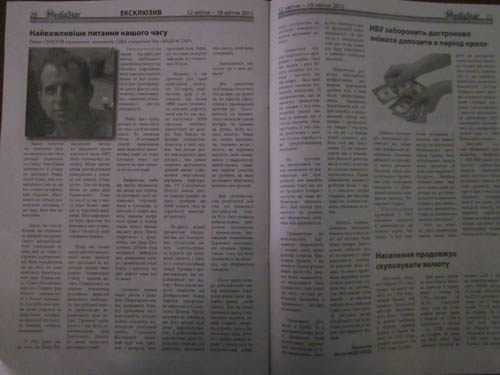
Chernobyl Cleanup Survivor’s Message for Japan: ‘Run Away as Quickly as Possible’
(more)
Red Caviar Flavored Lays
:)

Holy Mary Statue
I pass this statue several times a day. More of then not, there are people praying there.


Relatives Skyping w/ Mom

Relatives visited me a few Sundays ago. Here’s a picture of some of us Skyping with my mother in NYC.
I’m proud myself for hosting so many people, though I think I may have committed a faux pas by serving a meat other than fish (kobasa and salami) on a Sunday during lent.
One of the most culturally interesting moments came when I was gathering dishes. Two of my nieces ages 10 and 12 not only insisted on clearing the table themselves, but washed them all despite my telling them not to. Later, after some coffee and desert, my third niece, perhaps feeling jealous of the thanks I offered her sister and cousin, did it herself, then asked me where I kept the broom.
“I’ve lived here five months and I haven’t seen a broom,” I told her. She found one anyway and swept the kitchen.
Holy moly!
Morning Reading
Ukrainian Weekly, March 27
Putin threatens Kyiv over EU
KYIV – If Ukraine sets up a free trade
area with the European Union and enters
the Russian market with its products,
Russia will have to “build a border” in trade
with Ukraine, Russian Prime Minister
Vladimir Putin said, according to March 16
news reports. It would be much more bene-
ficial to both Russia and Ukraine to negoti-
ate with the EU as Customs Union mem-
bers, Mr. Putin said at a press conference
following a meeting of the Eurasian
Economic Community (EurAsEC) inter-
state council in Minsk, Belarus. “If Ukraine
sets up a free trade area with the EU and
has to give in on many positions sensitive to
the Ukrainian economy, it will certainly
expect these products to go to the Russian
market. But we won’t be able to afford
this,” Mr. Putin said. “We will have to start
building a border, for otherwise they will
dump their goods on us,” he added.
“Holding negotiations with the EU in the
format of a common economic area or the
Customs Union is quite a different thing.
And the positions are much more advanta-geous,” said the Russian prime minister.
(Interfax-Ukraine
***
Lviv City Council OKs UCU’s exemption from rental fees
LVIV – The Lviv City Council, led by
the Svoboda nationalist party, voted at its
March 10 session to grant the Ukrainian
Catholic University (UCU) its long-
awaited exemption from rental payments,
after refusing to do so in previous ses-
sions.
***
Tax code hurts entrepreneurs
KYIV – Following the adoption of the
new Tax Code of Ukraine, the number of
those wishing to register as entrepreneurs
declined by 50 to 60 percent. This was
reported by a senior lawyer of MTS-
Consulting, Oleksandr Minin, in early
February. The number of applicants for
registration of businesses has also
decreased.
***
Ukrainian Weekly, April 3
Melnychenko tapes arouse questions
KYIV – Alan Dershowitz, a professor
of the Harvard Law School who has
become a special legal advisor to former
Ukrainian President Leonid Kuchma, has
started examining the details of the crim-
inal case opened in relation to the murder
of journalist Heorhii Gongadze, it was
reported on March 30. The website of
Mr. Kuchma’s charitable fund Ukraina
says that the professor, who is studying
the details of the case, has the greatest
doubts about the use as evidence from
what is known as the Melnychenko
recordings because for 10 years their
authenticity has been either denied or
doubted.
Word of the Day

Photo by Aleks.
Some Headlines — the Market and the State
Ukraine’s government to oblige grain traders to finance grain production
How to make money under the radar of the oligarchs
American wins $9.5 million claim in dispute that started in 1996 A World Bank arbitration tribunal ordered Ukraine to pay $9.5 million in damages to an American businessman, marking a rare victory for foreign investors who have long received shabby treatment.
World Bank criticizing grain export quota system in Ukraine
Consumer confidence slips as Ukrainian pessimism deepens
Investment Opportunities Experts agree that deregulation, decreasing the number of licenses and permits and the appearance of political stability are considered positive signs for attracting much-needed foreign investment into the country. It is all the more bizarre that the government would at the same time bar major foreign telecommunication giants from taking part in privatizing the state fixed-line telephone monopoly Ukrtelecom, or continuously pressure foreign players on the grain market, proposing a draft law nearly imposing a state monopoly on grain exports.
Ukraine designates Rodovid as ‘bad asset bank’ Ukraine will move bad assets from three nationalised banks into one of them, Rodovid, to revive others, the Finance Ministry said on Friday, a move towards making good on its commitments under an IMF bailout. Ukraine has pledged to sort out problems in the banking sector under the $15 billion programme that it agreed with the International Monetary Fund last July. The Fund has delayed the next $1.6 billion disbursement under the programme after Ukraine missed a deadline on implementing a pension reform and sought to soften a planned energy price hike for consumers.
Dnipropetrovsk entrepreneurs to send ‘diet social package’ to Azarov
Corporate Raiding & Svoboda
Corporate Raiding is an epidemic in Ukraine. Politically connected people harness the violence of government to seize property from others. Kind of like the Kelo Case back in the land of the free, but in Ukraine, it’s done even more crudely.
Here are the websites of two anti-raiding organizations:
http://www.antiraider.ua/
http://obsheedelo.org.ua/
I distrust all politicians and political parties. Here is a video from the nationalistic Svoboda Party, which, strangely, is believed to by financed by Russians. It combines their nationalistic message with anti-raiding.
[youtube]0actjED5iow[/youtube]
@ 3:30 the video shows a group of guys, students apparently, beating away another group. Very dramatic (political).
I hope the victors were really on the side of property rights for all — not just for their friends. The chants of “Ukraine belongs to Ukrainians” isn’t encouraging. Their dialogue seems to dress this up as an ethnic battle. Property rights must be applied to everybody. On the other hand, a journalist friend of mine claims that the raids are most often conducted by non-Ukrainians.
I am mindful of the historic precedent of nationalism ultimately undermining property rights.
As I’ve often told self-proclaimed conservatives back in the United States: people who want to socialize in the name of national greatness are still socialists, even though they consider themselves ideologically opposite.
Ukraine Watch
River Cruises along the Dnieper River
Here’s the flier for a trip I’m interested in taking. Perhaps in June:
Favorite Sights Along the Dnieper River
The Dnieper River offers an abundance of wonderful sights, many of which have enamored
tourists for hundreds of years. The area along the river is rich in history that can spark your
imagination with images of times long passed. The combination of its historical significance
and its natural beauty make the Dnieper River one of the most exciting trips that you can take in
Europe. When you visit, make sure that you set aside time to see some of the favorite spots along
the river.
Sights of Kiev From the Dnieper River
Kiev’s origins stretch all the way back to 482 CE, making it one of the oldest cities in Europe.
Over hundreds of years, the city has grown into a thriving metropolis with more than 2,000,000
residents.
While floating down the Dnieper River, you can enjoy some special views of Kiev’s historic
landmarks. The illuminated bridges connecting the river’s coasts are a relaxing sight that evokes
the tranquility of Ukraine’s peaceful times (the Nicholas Chain Bridge is particularly delightful).
Kiev, however, has been maintained through struggle against numerous opposition forces. The
Mother Motherland Statue honors those lost in the German-Soviet War. Its statue’s figure stands
above the city with a shield and sword lifted to the sky. Even those without Ukrainian roots may
feel inspired by this statue.
View the Countryside from the Dnieper River
Travelers floating down the Dnieper River will pass several important cities, including Kaniv,
Nikopol, and Kherson. All of these cities offer their own unique views. Some of the most
wonderful sights, however, come from the countryside that stretches between these cities.
The Ukraine has a reputation for its stark, industrial cities. The rural areas, however, are the
exact opposite. Spring is a wonderful time to visit. On your trip down the river, you can view
fields of wildflowers and trees in bloom. During summer, you will feel honored by the river’s
lush greenery that shields the water from outside forces. The fall, of course, offers its own
beauties as the tree’s leaves start to turn.
It is difficult for many cruise ships to navigate the Dnieper River during winter. The frozen
ice makes certain areas troublesome. As the ice begins to thaw in spring, though, travelers are
treated to a miraculous site.
Consider reading several reviews of Viking River Cruises to help you determine what season you would like to explore the Dnieper River. Having more information about specific cruise options will help you choose the one that fits your particular interests.
Traveling on the Dnieper River
Regardless of whether you are interested in spotting remarkable pieces of art, magnificent
buildings, or stunning views of nature, the Dnieper River can give you a vacation that will
encourage you to return time and time again. To truly experience the area, you might consider
booking a cruise that allows you to visit notable cities along the journey. That way, you can stop
to visit the historic sites and museums in person. Seeing them from afar and up close is the best
way to truly appreciate the beauty of this region.

