In celebration of spring, here’s a gorgeous video of Ukraine’s sunflower fields.
[youtube]nvDon8kyTJI[/youtube]

In celebration of spring, here’s a gorgeous video of Ukraine’s sunflower fields.
[youtube]nvDon8kyTJI[/youtube]
I have a few months left in Ukraine. I am working furiously on writing, though it seems I still have impossibly much to do. I’ve been invited to a number of conferences, and I hope to attend all of them, as they’ll take me to Odessa and Donetsk, and give me an opportunity to see more of Ukraine.
Spring has fully arrived. Instead of cold rain and snow, there has been sun for several days now, and also a dusty wind which causes you to squint and breathe through your nose.
A diaspora friend from my childhood recently stayed with me for a few days. He’s lived in Kyiv for six years. It was nice empathizing with a fellow American. Aside from history, politics and economics, the topic which dominated yesterday’s dinner conversation was customer service in Ukraine. It sucks.
I’ve been ignored in mostly empty restaurants for a good 5-10 minutes before being handed a menu. Waitresses are rude. They don’t look at you when they pass.
You can get service, of course, but you need to act tough and rude. You need to TELL the staff what to do — give me a menu, come here, take my order, bring the drinks right way, bring all the dishes out at the same time (or else you might get them as they are prepared, sometimes with a 20 minute gap between your meal and your friend’s). You can get all the service you want, but you need to bring the authority. You can’t relax and expect to be taken care of. I prefer to relax.
Sometimes I bring the authority. Sometimes I get up and leave. I also have a growing shit-list of restaurants I no longer patronize, including MVF (a cute name which shares the Ukrainian acronym for International Monetary Fund, but substitutes the word “Varenyky” — dumplings — for “monetary”) where, despite being the only patron in the restaurant, the three girls ignored me for twenty minutes after handing me the menu. In their defense, it sounded like their conversation was *extremely* interesting. That was the first time I left a restaurant.
I now understand my mistake. You can’t show any fear. You must be like an animal trainer. For example, when you walk into a restaurant, there will likely be a three or four young staff members chatting amongst themselves. Their conversation will stop and they will look up at you without smiling. Several things may go through your head at this point: Am I interrupting? Is the restaurant open? Do I seat myself? Is this the hostess who sill seat me?
This is a very common moment in Ukraine, and I’ve discovered the most important thing is to show no fear. If you hesitate, meekly inquire about their status, beg permission to sit, feel embarrassed by your broken Ukrainian, they will smell your fear and consider you powerless and unimportant. On other hand, if you walk in like you own the place and tell them what to do — take me to a free table, give me a menu — they will often spring to life and serve you as if their well being depends upon it.
It is sad and pathetic, but unfortunately that’s the way things are for the moment.
I tend to cut my fellow Ukrainians a lot of slack. Outside the black market, capitalism has only existed here for two decades. The free market can solve the customer service problem, though it will take much longer in a market as mutilated as the Ukrainian one, where success is determined more by political and criminal connections than by one’s ability to serve customers.
The most notable exception to the characteristically poor customer service is McDonalds, where the cheerful call of “vilna kasa” (free register) from smiling employees are as uplifting to me as the springtime flowering of Crocuses.
A couple weeks ago, I was so excited by the good customer service at a restaurant called “Pol’iana” (Prairie) in Kyiv’s largest shopping mall, Dream Town, that I left a 50 hryvnia tip on a 60 hryvnia meal.
Another exception was the restaurant at which my diaspora friend and I had our conversation. A wonderful L’viv restaurant called “Miaso i pyvo” (Meat and beer). They knew to hand us English menus even though I gave the polite, attentive hostess my best “dobri vecher” (good evening) upon entering.
The duck tasted wonderful, but next time I’ll try one of their many steaks.
EDIT: I recently spoke about this with a Ukrainian girl who once lived in the U.S. for a year and half. She’d worked in the U.S. as a waitress, but said doing so here would be degrading, because customers are more rude here. She says the culture of service is much less developed.
EDIT 2: Tip — the smoking sections are always the cool place to sit.
I recently had the opportunity to visit the eastern city of Kharkiv, once the capital of Soviet Ukraine. My friend, an American historian studying there, provided a wonderful tour.
I found the city’s Soviet legacy a little creepy — there are monuments of Lenin and a neighborhood named after Felix Dzerzhinsky.
I liked the exotic feel of the city. There are certainly many foreigners there — mostly students at their many universities — but they are Arabs, Asians and Africans. There are few westerners, which was strangely exciting.
The presence of the oligarchs / mafia felt greater in Kharkiv — it was the first thing several of the people I met talked about. Also, we passed a store which had been burned few months ago. I also encountered stories like: “My mother sold her home in the 90s for $1500. The guy never paid her, but my mother didn’t do anything because he’s connected.” There’s also the specific bad reputation of some prominent local politicians, $600 Metro benches and more.
On the other hand, some people tell me L’viv is more corrupt. I’m not going to do a careful analysis, nor will I dissect the meaning of the word “corrupt” right now.
Pictures of Kharkiv. Look through them to read the many captions.


The owner of an apartment gave me permission to photograph it. He said it’s typical late 80’s Soviet upper “class” decor. Class bears quotation marks, because the Soviet Union was officially a classless society. This is the type of apartment enjoyed by higher level government workers — military officers, KGB, etc.
Soviet Kitsch:


I’m planning to make a separate post about the Parkhomivka Art Museum which we managed to visit during this trip. It’s probably the unlikeliest art museum in the world.
 A warning to travelers. If you phone Kyiv’s Arena Dance Club and ask them the cover price, then show up to enter, you’ll discover that you’ve been lied you, by those dirty lying liars. In Ukraine, you have to tolerate a lot of abuse (and staggering indifference) from businesses. Not that big a deal, but I’m getting tired of it. My contribution toward better business practices in Ukraine is publicizing the injustice here.
The place turned out to be rather dead, even though it was Saturday night, though the music was pretty good, and the fact of it being empty made it easier to get drinks — always a challenge in Ukraine.
The river-walk in the Obolon neighborhood was beautiful.


For me, the turning of seasons fills me with urgency rather than revival. Here are a few pictures I took:


Recently looked at works by Picasso, Shyshkyn, Pissaro & other famous artists in a village called Parkhomivka near Kharkiv. The bathroom was out of order, so I used their out house. Stay tuned for more.
 In the two small examples I am about to present, I see yet another rebuttal to the Hobbesian notion that without a supreme authority, the natural state of man is a war of all against all.
By U.S. standards, one might say there is a shortage of traffic lights in Ukrainian cities. Instead, there are designated cross-walks. The dynamics of them are interesting. The exact behaviors they cause aren’t perfect, but are much closer to ideal than the brute legal force of traffic lights.
A lone pedestrian, unless he or she is in a big hurry, will usually wait until several others accumulate to form a critical mass before they cross. But the pedestrians won’t go if there are just a few more cars. In that case, they’ll wait until there is room. These spontaneous behaviors all seems to be astonishingly mature.
They are also consistent with the experiences of a British town which saw a several-fold improvement in commute times after they shut off all their traffic lights. That’s right. They shut off all their traffic lights. There was no decrease in safety either.
[youtube]vi0meiActlU[/youtube]
The second example of spontaneous cooperate is a compliment to Ukrainians and a counter-example to this country’s ubiquitous corruption.
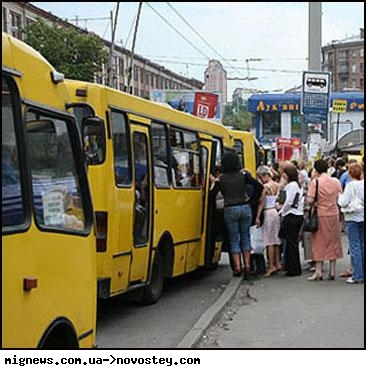
The marshutky (semi-private busses) in the city of L’viv are the most crowded public transportation I’ve ever encountered — as a child of the NYC subways, I do not make this claim idly. Imagine the impossibly crowded buses. How does everyone have room to pay the driver?
They don’t.
People pass money back and forth. You’ll be standing awkwardly, barely reaching the overhead railing for balance, and someone will pass you a 10 hryvnia note. “For two,” he’ll say. (The price is usually 1.5 to 2.5 hryvnias, i.e. 12 to 20 cents, depending on the route.)
Money gets passed forward, and change is passed back. Astonishing. Sometimes I spend the better part of my trip passing money back and forth, but this isn’t even the most impressive part.
There are no automatic machines like in NYC busses. The driver is responsible for all the financial transactions, making change, etc. How does he do it?
He doesn’t.
Once, it was I who found myself closest to the driver — I tried to avoid the spot, but couldn’t overcome the movements of the crowd. I was handed a 5 hryvnia note. “For one,” said the lady with the gigantic fur hat.
There was no one else between me and the panel beside the driver — no one to whom I could pass the money and responsibility. I looked above the windshield. A note read “1.75 hryvnias.”
I dropped the five onto a panel beside the driver which had money and change all over it. I gathered 3.25 hryvnias and put it back in the lady’s waiting hand. More money came my way, and still more. I dusted off my arithmetic and spend most of the trip making change. Money flew all over the place. A couple times, the driver reached over and organized some of the bills. I was too busy providing quick, accurate change.
I am reminded of anarchist Peter Kropotkin’s late-in-life observation about cooperation: “I failed to find,” he wrote, “although I was eagerly looking for it — that bitter struggle for the means of existence, among animals belonging to the same species, which was considered by most Darwinists (though not always by Darwin himself) as the dominant characteristic of struggle for life and the main factor of evolution.” What he saw instead was “Mutual Aid and Mutual Support carried on to an extent which made me suspect in it a feature of the greatest importance for the maintenance of life, the preservation of each species, and its further evolution.”
He concluded that
life in societies enables the feeblest animals, the feeblest birds, and the feeblest mammals to resist, or to protect themselves from the most terrible birds and beasts of prey; it permits longevity; it enables the species to rear its progeny with the least waste of energy and to maintain its numbers albeit a very slow birth-rate; it enables the gregarious animals to migrate in search of new abodes. Therefore, while fully admitting that force, swiftness, protective colors, cunningness, and endurance to hunger and cold, which are mentioned by Darwin and Wallace, are so many qualities making the individual or the species the fittest under certain circumstances, we maintain that under any circumstances sociability is the greatest advantage in the struggle for life. Those species which willingly abandon it are doomed to decay; while those animals which know best how to combine have the greatest chance of survival and of further evolution, although they may be inferior to others in each of the faculties enumerated by Darwin and Wallace, except the intellectual faculty.
Kyiv Post, February 25, 2011
London Judge Dismisses Firtash Lawsuit Against Kyiv Post A London judge on Feb. 24 dismissed a libel lawsuit filed by Ukrainian billionaire Dmytro Firtash against the Kyiv Post, saying that the link to English jurisdiction was “tenuous in the extreme.”
~**-=Democracy’s=-**~ deterioration discouraging, but not irreversible [flair added]
New tax code opens dangerous doors; fines could be very high Some of the causes for complaint include vague laws and a somewhat aggressive attitude toward those businesses that are willing to open their books to the tax authorities. In addition, the severe penalties set out in the new tax code for non-compliance scare away those businesses that are willing to come out of the shadows. . . .
More: http://www.kyivpost.com/news/business/business-sense/detail/98259/
ArcelorMittal [Ukraine’s largest foreign investor] becomes target after complaining about taxes To put it mildly, last year was not the easiest one in Ukraine for ArcelorMittal, the global steel-production leader and biggest of investors in Ukraine.
First, the Prosecutor General’s Office started looking into whether the company, which in 2005 bought Ukraine’s largest steel mill for $4.8 billion, fulfilled its investment commitments. ArcelorMittal feared the process could go as far as the government re-taking ownership of the steel mill.
Some think that only the interference of French President Nicolas Sarkozy duriing viktor Yanukovych’s visit to France and the Ukrainian president’s subsequent three-hour long meeting with ArcelorMittal’s owner, billionaire Lakshmi Mittal, halted such a scenario.
But such high-ranking interference didn’t solve the company’s day-to-day problems in Ukraine. In September, the State Customs Administration accused the plant of being a coal smuggler, as it claimed that ArcelorMittal failed to pay Hr 200 million ($25 million) worth of customs duties on its imported coal, arresting nearly 67,000 tons of coal in question at ports. This case was dropped last December, only to give way to headaches.
Recently, tax authorities accused ArcelorMittal’s plant in Ukraine of more than $50 million in tax violations. But Russian-native Rinat Starkov, appointed ArcelorMittal’s general director in Ukraine, says his biggest headache is the state tax administration’s inability to refund value added tax on time and in full. . . .
Kyiv Post: [how where the last 6 months?]
Rinat Starkov: You have to be involved in many things outside improving the operational efficiency of the company, which I wish I had more time to work on. But instead, I find myself dealing with the prosecutor’s office, various courts. . . .
KP: Last week you announced that the total VAT refunds owed to ArcelorMittal’s steel mill in Kryvy Rih totaled Hr 2.3 billion ($290 million) as of Dec 31. Has there been any response from the government, or tax officials?
RS: No, these people don’t work like this (he laughs). They are well informed about this amount. But in December-January we got no refunds from them whatsoever. No interview would lead to this money being returned.
KP: But last week, a top tax official promised in a Kyiv Post interview that he would refund around Hr 17 million of the VAT owed to one Finnish company. It was around half of what they were owed.
RS: I hope that company receives it. But I am not a fan of such personalized solutions. There needs to be a system of automatic refunds. We need to stop wasting each other’s time.
KP: Have you applied for automatic refunds? Has it been approved?
RS: No, we haven’t. At the moment, we are not able to establish even normal day-to-day communication with tax authorities. May I remind you that we had to pay profit tax in advance? This happened because tax authorities demanded that we immediately return 50 percent of whatever VAT refunds we got as the profit tax. So, overall, the state owes us Hr 3.5 billion.
KP: How do tax officials explain this?
RS: They are basically forcing us to import everything we need for our work, first of all, coal, our biggest purchased commodity. Tax officials claim that our Ukrainian suppliers of coal or scrap metal often wouldn’t pay the VAT they received from us to the budget, as it “evaporates somewhere along the chain of intermediaries.”
We tried to explain that we paid the VAT to suppliers, and it’s not our job to monitor what happens to it afterwards. But all we hear is that since this money didn’t make it to the budget, they won’t refund it. That’s their approach. It is a little strange to me.
During our last meeting, we said that we are switching entirely to imports, as in this case we pay VAT directly to the budget, and that we hope they won’t again say it “evaporates.”
In our view, this VAT is simply impossible to dispute. We hope that in the future what we pay for imported commodities, as well as for gas, and electricity inside the country will be returned to us unconditionally.
This is about half of what we are owed every month. Probably, such a switch to imports will be very bad for Ukraine’s economy, but we are forced to do this.
Currently, whenever we try to talk to them and find out what’s going on, they tell us that they found new violations related, for example, to scrap metal purchases, and that they are opening a criminal case.
KP: Have you set up the special department to work with the relentless inspections?
RS: I think it’s necessary, as currently working with inspectors requires efforts of many departments. We try to have the legal department coordinate all this, but when you have two-to-three inspections each day, it’s really difficult.
KP: Are they searching for something specific?
RS: Well, you know how it is. When there is an inspection, they cannot leave empty-handed. Sometimes, it’s something small, sometimes, bigger issues arise. Last time, they took a whole truckload of documents related to scrap metal purchases. I kind of understand them, as they know we are the only ones who have all the necessary documents on scrap metal in order.
So, they took a truckload of them, in turn paralyzing the work of two departments which needed to arrange all these documents for them. We offered giving them an electronic version on a disk, but they said it wasn’t enough. . . .
KP: Could someone be trying to force ArcelorMittal to sell its mill?
RS: No, such minor mosquito bites won’t lead even to the thought of selling it. . . . .
Nobody understands why such methods are used against one of the world’s largest companies, one which controls 10 percent of the global steel market.
But, it’s important to understand that in the ArcelorMittal empire, the Ukrainian company accounts for only 3 percent of the whole company. To say that the whole corporation cannot live or breathe without it would be a huge exaggeration.
Read more: http://www.kyivpost.com/news/business/bus_general/detail/98262/#ixzz1G7P9ykJ9
Azarov fails to impress business leaders But speaking with the Kyiv Post after discussions with Azarov, EBA executive director Anna Derevyanko said companies surveyed by the 807-member business association say they are fed up with promises and want results. Timely refunds of value added tax to exporters are at the top of many lists.
Read more: http://www.kyivpost.com/news/business/bus_general/detail/98267/#ixzz1G7QR7Z5y
Klymenko: Grain rules could trigger international scandal
Ukraine’s grain traders have long complained about state interference in a lucrative sector frequently seen as key to the country’s economic future.
When export quotas were introduced last year, some top international firms were shut out while a disproportionate share of quotas have gone to a company owned by the state and unknown individuals.
On Feb. 2, lawmakers from several parties made a move to increase state control further with a proposal to create a monopoly that allows only state companies and farmers to export grain.
The Kyiv office of the influential Grain and Feed Trade Association wrote to the speaker of parliament, Volodymyr Lytvyn, saying the draft law “contradicts all known standards of free trade and the market.”
One of the most vocal critics has been Volodymyr Klymenko, president of the Ukrainian Grain Association, an organization that brings together 80 percent of Ukrainian traders.
The Kyiv Post sat down with him to talk about the draft law and corruption in the agriculture sector.
Kyiv Post: Why have you been so critical of this draft law? What’s so bad about it?
Volodymyr Klymenko: Competition has become the key to success of Ukraine’s agrarian sector in last 15 years, and this draft law could lead to the demise of the country’s entire grain sector. It aims only to squeeze private firms from grain export. Private grain traders have invested in Ukraine’s agrarian sector for 20 years.
They brought investment, built or modernized grain silos, constructed facilities for loading grain, cultivated soil – and now they are all told to get out of the market.
The members of our association alone own 250 silos, while there are about 700 private grain silos all over Ukraine. All of them could be closed as the silos used only for storage of the grain without subsequent export would be unprofitable.
If the grain storages and the grain loading facilities become useless, their value will decrease dramatically.
So, perhaps the aim of this draft law is to make grain market participants sell out their granaries for pennies?
I can assure you that the grain trading companies, some of which have a budget bigger than the state budget of Ukraine, will never give up their silos for nothing.
All state attempts to displace them from the market could lead to an international scandal.
KP: Are chances high that this law will be passed, as it was sent for revisions by parliament’ agriculture committee?
VK: I think this draft law was written with the aim to monopolize grain exports, to enable one company to run all export operations and to dictate its own prices and working conditions to the market.
KP: Are you hinting that corruption could be at play as a result of monopolizing of the export?
VK: Sure. We know that Hr 7 billion, including grain, disappeared from the State Committee of Material Reserves. We know that it is risky to store grain in the silos of the state company Khlib Ukrainy, as more than once grain completely disappeared from there.
Several months ago, the agriculture minister said about 300,000 metric tons of grain had disappeared from the state-owned Agrarian Fund.
Now we hear about plans to create a fourth state body that will run grain export, and I have serious doubts that this new institution will not have the problems of mystery losses.
I can compare grain trade with a casino game as both things are equally risky. In Russia, the state-run United Grain Company failed to become a big grain trader.
Two years of its work as a monopolist led to huge losses. Now we are trying to repeat Russia’s unsuccessful experience.
Read more: http://www.kyivpost.com/news/business/bus_general/detail/98274/#ixzz1G7XGRKlr
Taxes around the world
Country/# of payments a year/Hours per year spent complying/Total tax rate
top 5:
Maldives/3/0/9.3%
Quatar/3/36/11.3%
Hong Kong/3/80/24.1%
Singapore/5/84/25.4%
UAE/14/12/14.1%
bottom 5:
Chad/54/732/65.4%
Rep. of Congo/61/606/65.5%
Ukraine/135/657/55.5%
Central African Republic/54/504/203.8%
Belarus/82/798/80.4%
also:
U.S.A./11/187/46.8%
(this is from a PWC study)
Kyiv Post, March 4, 2011
Desperate Lives
CHISINAU, Moldova – Konstantin is desperate. His daughter is sick and needs an operation abroad costing thousands of dollars.
The 30-year-old father sees one option left – to sell part of his body.
“I am willing to sell my kidney, in the worst case bone marrow,” he writes in an advertisement on a Ukrainian website, naming his price as 25,000 euros.
“Please help!” he signs off.
Konstantin is part of a growing trend in Ukraine and its neighboring former Soviet countries to sell organs for cash. Some donors are tempted by the chance to make a quick buck. Others are tricked into the illegal organ trade, recruited by intermediaries who then sell their body parts at a huge profit.
“Medicine is business, and it always will be,” said Ruslan Salyutin, who is in charge of coordinating organ transplants at Ukraine’s Health Ministry.
A search on the Internet shows there is no shortage of people openly hawking body parts.
“I am urgently selling my kidney, a part of my liver or spinal marrow. 25 years old. I don’t drink or have any sexually transmitted diseases. The price is $45,000,” reads one post on a Ukrainian website.
Offers another: “I am selling the liver of a 16-year-old boy. He is healthy, he doesn’t drink. The price is 60,000 hryvnias ($7,500). Mirgorod, Poltava region.”
The donors are primarily from Ukraine, Russia, Moldova and other former Soviet countries, where poverty makes the allure of a large paycheck much brighter.
According to human rights activists, intermediaries buy kidneys for anything from a few hundred dollars to $10,000, before selling them on at five to 10 times the price.
The donors are often volunteers, desperate for cash by any means. Others are trafficked abroad by recruiters who trick or force them into leaving Ukraine and going to countries where donating organs to non-relatives is legal.
Nicolae Brdan is one such victim. He left his impoverished Moldovan village in 2000 having been promised a job in Turkey.
Arriving there in a group of people from Moldova, Ukraine’s western neighbor and Europe’s poorest country, his passport was seized from him by the people who had recruited him.
They offered him only one way home – by selling one of his kidneys. “I hesitated for a month,” whispered Brdan, 35, through yellow teeth. “But I had no choice. You can’t come back without your documents.”
He had been tricked into going to Turkey by a woman in the neighboring village.
“Few come back,” said Marina Yevsyukova, director of the legal department of the human rights center La Strada Ukraine. She says the operations are often done unprofessionally, causing injury and even death to the victim: “Sometimes, they even cut out the victims’ hearts and both kidneys.”
Yevsyukova described a call to one of the center’s psychologists from a man who travelled to Israel to work as a nurse in a private clinic. One day, he found himself lying in a medical ward after an operation. Upon returning to Ukraine he went for a medical checkup and learned that he was missing a kidney.
Read more: http://www.kyivpost.com/news/nation/detail/98927/#ixzz1GTUAoYiO
Cherniavskiy: High tax unjustified in nation
While Ukrainian businessmen are frantically trying to understand the realities of the new tax code, those who provide accounting and tax consulting services are capitalizing on the uncertainties of doing business in a nation with one of the most complicated and burdensome tax systems.
Such is the case with Dmitry Cherniavskiy, a partner with London-based firm Tax Consulting U.K., and former interim general director of Olympic Stadium, the main venue for the Euro 2012 soccer championship.
Cherniavskiy’s firm specializes in business accounting, financial reporting and tax optimization.
Last fall, the Kyiv Post visited one of the seminars, co-organized by Tax Consulting U.K., where business representatives were taught how to avoid problems with tax authorities and customs by moving most of the income earned to the offshore jurisdictions with “no taxes and no reports.”
Cherniavskiy has no warm sentiments about the new Ukrainian tax system.
He said that the Ukrainian government simply does not provide enough public services – such as transparent judiciary, quality healthcare, and good education – to justify the high tax rates and fiscal pressures that it imposes on its businesses and citizens. . . .
Last year, the Security Service of Ukraine [SBU] and prosecutor general opened a criminal case on suspicion that Cherniavskiy gave out consulting contracts worth nearly Hr 428,000 ($53,500) for already completed construction work and services while he oversaw Olympic Stadium. Charges against him were allegedly dropped several months later.
Prior to that, the parliamentary commission investigating reconstruction of the Olympic stadium found that during currency exchange operations under Cherniavskiy’s management, the state incurred losses totaling Hr 4.3 million ($543,000). . . .
In Ukraine we have a different situation. The authorities try to collect taxes wherever they can, basically on the basis of “tax whoever you can catch.” This is not to mention the political regime we have. We all understand that there are “untouchable” people and there are people who are even more “untouchable.”
And in such a de facto absence of clear rules, it’s natural that there are people who don’t pay taxes at all, or pay fewer taxes, or pay them according to some other criteria. . . .
KP: But fiscal pressure from tax authorities could be explained by the budget deficit, which, in part, results from the widespread use of offshore and tax-minimization schemes by big business?
. . . .
Do we have independent courts in Ukraine? No. They weren’t independent during the previous government either, but today there is not even an illusion of moving towards establishing independent judiciary.
People often call offshore countries “banana republics.” But most of these so-called banana republics have the judiciary system established by the British, the Dutch, or the Germans, who used to have a protectorate over these countries. . . . You cannot buy a decision there, like in Ukrainian courts. . . .
Therefore, is it surprising that big Ukrainian businesses you have asked about have offshore subsidiaries in such “banana republics”? They do provide much better protection for business than in your home country.
Read more: http://www.kyivpost.com/news/business/bus_focus/detail/98892/#ixzz1GTWKvQDG
Yanukovych’s assault on Ukrainian history
Alexa Chopivsky writes: Russia negates Ukraine’s historical identity.
“One Ukraine, One History” – reads the text of billboards splashed across downtown Kyiv.
But just what does that history encompass? More than a year into office, the government of President Viktor Yanukovych revised fifth-grade history textbooks to delete certain key events from Ukrainian history, including the 2004-05 Orange Revolution.
The selective teaching of Ukraine’s history and the government’s moves to curb university autonomy are reinforcing concern that the country is moving away from the West and becoming more synchronized with Russia, and in some cases, even endorsing Moscow’s take on Ukrainian history.
The fifth-grade textbook under the previous administration referred to the Orange Revolution as the “Orange miracle,” according to Vakhtang Kipiani, the editor-in-chief of “Istorichna Pravda.” It was an interpretation he says that lacked objectivity, “but simply to throw out the Orange Revolution, that’s not right,” Kipiani said.
A lawmaker with the ruling Party of Regions and a member of the Parliamentary Committee on Education and Science, Maksym Lutsky, defended the change: “The Orange Revolution needs to be burned out of history because of what its instigators did to the country.”
No reference to Kruty . . . Deleting ‘man-made’ from famine . . . ‘Umbilical cord’ to Russia
“Minister [of Education, Science, Sport, and Youth Dmytro] Tabachnyk and the leaders of the ministry are anti-Orange, anti-democratic, anti-West people,” Kipiani said. “That’s why correspondingly at their level, as much as they can, they are trying to clean out the heritage of the Orange Revolution.
Some in the current leadership are connected by an umbilical cord to Russia; some in financial ways and some morally.”
Last year, Tabachnyk and his Russian counterpart, Andrei Fursenko, announced their intention to create a Ukrainian-Russian working group for the purpose of creating a joint textbook guide for history teachers in the two countries.
Tabachnyk also cancelled the 12th year of secondary school, bringing it into line with Russia’s 11-year system and making it more difficult, according to critics, for Ukrainian students to qualify to study at Western institutions, which typically are premised on 12 grades of schooling.
Read more: http://www.kyivpost.com/news/opinion/op_ed/detail/98915/#ixzz1GTXad6mZ
Formidable Firtash in flurry of chemical acquisitions (more)
In protectionist bid, nation may hike fuel import taxes (more)
Kyiv Post, other dates
Fact-checking Yanukovych
1. Soon after becoming president, Yanukovych promised to ink a visa-free regime with the European Union. . . .
2. Yanukovych assured the Wall Street Journal that Ukraine had no intention of banning grain exports. . . .
3. In dealing with Russia, Ukraine will protect its national interests, Yanukovych told France’s Le Figaro newspaper. . . .
4. Yanukovych told a group of German media that billionaire businessman Valeriy Khoroshkovsky is the right person to serve as head of Ukraine’s SBU security services. . . .
5. Yanukovych downplayed probes centering on former Economy Minister Bohdan Danylyshyn, a close ally of former Prime Minister Yulia Tymoshenko, saying the investigation was not political because Danylyshyn himself was not involved in politics. . . .
6. In the same Washington Post interview, Yanukovych called on his main rival in the presidential election campaign, ex-Prime Minister Yulia Tymoshenko, to prove that corruption charges against her were baseless. . . .
7. In the same Washington Post interview, Yanukovych claimed that a major anti-corruption campaign was under way in Ukraine under his leadership. . . .
8. Yanukovych insists he fairly won the 2004 presidential election, where his allegedly fraud marred victory was overturned by the Orange Revolution. . . .
9. Yanukovych says he doesn’t fear anything. . . .
Read more: http://www.kyivpost.com/news/nation/detail/99515/#ixzz1GTaA56L2
Ukrainians buy $1.3 billion more currency than they sell in February 2011
Ukrainians in February 2011 bought $1.305 billion more foreign currency than they sold, whereas the difference in January was $864 million.
As the National Bank of Ukraine reported on its Web site, Ukrainians bought $2.613 billion from banks and sold back $1.308 billion over the period.
Read more: http://www.kyivpost.com/news/business/bus_general/detail/99328/#ixzz1GTaxyYYI
U.S. experts: Ukraine 6th among countries most likely to default (more)
[I wonder where the U.S. itself was on that list.]
Just listened to an economist from the Kyiv School of Economics tell a large classroom the following (with a straight face):
– The U.S. stimulus was too small.
– Irrational behavior, what Keynes referred to as ‘animal spirits,’ was responsible for the recent economic crash. Bad mortgages are an example of such irrational behavior.
– Financial stability is a public good. [I’m not sure if this was a reference to bank bailouts.]
– The U.S. economy is under regulated.
– Classical capitalism is not capable of dealing with current challenges.
– Government needs to supervise the private sector to prevent excessive behavior and bubbles.
– U.S. needs to overcome culture of non-intervention and introduce new regulatory instruments. The Fed bailing out private companies is one such instruction.

Ukraine Naftogaz to get USD 630 million in capital from state: http://www.steelguru.com/russian_news/Ukraine_Naftogaz_to_get_USD_630_million_in_capital_from_state/183975.html
The law with overly broad protections of personal data came into force on Jan. 1, Ukrainska Pravda news site reports: http://www.kyivpost.com/news/nation/detail/94030/#ixzz19yj98L2j
Germany, France ambassadors on democracy, freedom of speech and anti-corruption campaign in Ukraine: http://zik.com.ua/en/news/2011/01/03/264928
Nobody is suggesting that previous regimes were not guilty of using selective prosecutions and the use of enforcement, regulatory and judicial bodies for political ends. Recent developments, however, create serious concern due to their scale and, in many cases, overt disregard for constitutional norms. http://www.kyivpost.com/news/opinion/op_ed/detail/94026/#ixzz19yhm34b5
This next article is a little too in love with its own writing, but it contains wonderful anecdotes about business and justice, including IKEA’s experience in Russia. Note that Ikea abandoned its Ukraine business for similar reasons. http://www.opendemocracy.net/od-russia/andrei-loshak/kafka%E2%80%99s-castle-is-collapsing?utm_source=feedblitz&utm_medium=FeedBlitzEmail&utm_content=201210&utm_campaign=Nightly_2010-12-26%2005%3a30
Ukrainian officials say nine members of a nationalist organization have been arrested in western Ukraine, RFE/RL’s Ukrainian Service reports. Interior Ministry officials in the Ivano-Frankivsk region has said the Trizub (Trident) members arrested on January 10 came to the region from other parts of the country and were armed. Police say they confiscated an AK-47 assault rifle, three pistols, ammunition, nine walkie-talkies, knives, two grenades, two sniper rifles, and a pump-action rifle from the activists. http://www.rferl.org/content/ukraine_nationalists_detained_arms_cache/2273347.html
Yanukovych vetoes ban on leasing health establishments for other uses. http://www.kyivpost.com/news/nation/detail/94615/
Azarov blames supermarkets for raising prices of buckwheat. http://www.kyivpost.com/news/nation/detail/94995/
Government creates Institute of National Memory. http://www.kyivpost.com/news/nation/detail/94986/
Two bombs exploded simultaneously in the eastern Ukrainian town of Makiyivka on Thursday and a threat was made of more attacks later in the day, police said. http://www.kyivpost.com/news/nation/detail/95232/
Unity Day celebration. http://www.kyivpost.com/news/nation/detail/95402/
Maidan walled off, possibly for fear of protests. Attendees of a pro-Party of Regions rally get paid 100 hryvnias each to attend: http://translate.google.com/translate?langpair=auto|en&u=http%3A%2F%2Fwww.bbc.co.uk%2Fukrainian%2Fmultimedia%2F2011%2F02%2F110223_yanukovych_bbc_ak_it.shtml
The IMF mission and Ukraine’s government have not reached a staff-level agreement by the end of the mission visit, and the Fund will continue discussions with the government before deciding on the disbursement of the next SDR 1bn ($1.6bn) loan tranche from the $15.6bn Stand-By program. http://www.kyivpost.com/news/business/bus_general/detail/97225/
Ukraine, IMF reach compromise on further credit program. http://www.kyivpost.com/news/business/bus_general/detail/97329/#ixzz1FCMERKTn
Tymoshenko slams IMF for legitimizing corruption in Ukraine. http://www.kyivpost.com/news/business/bus_general/detail/98252/
ArcelorMittal, one of Ukraine’s largest foreign investors, which runs Ukraine’s largest steel mill, is considering establishing a separate department to respond to twice-daily inspections by state bodies. http://www.kyivpost.com/news/business/bus_general/detail/97448/#ixzz1FCMn0NTB
Ever wonder why most Ukrainians live so poorly although the nation is one of the world’s leading exporters of steel, chemicals, weapons and food? Experts blame ubiquitous corruption and insider dealing that cost the nation billions of dollars each year. Future generations will pay for today’s graft as the nation sinks more heavily into debt. Ukraine’s reliance on foreign loans has raised its public debt to $54 billion, even as the government still hopes to tap up to $12.1 billion more in loans from the International Monetary Fund. http://www.kyivpost.com/news/nation/detail/97465/
The Kyiv Post stopped serving web pages to British IP addresses because of a liable suit brought against them by one of Ukraine’s oligarchs. Since then, a UK judge dismisses the Firtash libel lawsuit against the Kyiv Post. http://www.kyivpost.com/news/nation/detail/98219/#ixzz1FCTZlaWR
Kyiv Post Jan 14:
Prized Kyiv monopolies target of insider wars
” With Kyiv’s eccentric and controversial Mayor Leonid Chernovetsky now serving a mainly ceremonial role, the lid is being lifted on some of the deals that happened under his rule — and what’s beneath is proving very murky.
The new city administration — led by pro-presidential appointee Oleksandr Popov — is battling to reclaim through courts prized city assets after it emerged that one company, Novy Region, had acquired large stakes in several leading municipal companies that were never officially, or at least transparently, privatized by the city.
But concerns have been raised that shares in the lucrative and prized city-owned companies, including utilities with monopolistic positions on the market, could be resold to insiders close to President Viktor Yanukovych’s team at below-market prices, as happened when he was prime minister in 2006.
Experts said municipal companies that provide everything from electricity, heat, water and sewage services desperately need investment and could benefit from private ownership. But they warn that stocks sold in shady deals to well-connected businessmen could bilk a chash-starved city budget, while generating big profits for the new owners without improvement in services.”
Coal smuggling case ends in favor of ArcelorMittal
“A court in Ukraine has dismissed charges of coal smuggling against the local unit of ArcelorMittal, the company said on Dec. 7. . . . In September . . . customs service seized 100,000 metric tons of coking coal imported by ArcelorMittal’s smelter in the city of Kryvy Rih.”
Azarov: Time to lift ban on agriculture land sales
“Ukrainian Prime Minister Mykola Azarov threw his weight behind the privatization of farmland, including sale to foreign investors.”
Corruption probes look like political reprisals to many
Numerous investigations target Yanukovych’s foes
What interested me most about my recent visit to Bukovel, Ukraine’s only major ski resort, was the rapid, uneven development of the resort and the region. Bukovel is located 240 km from L’viv, where I lived during my 2010-2011 Fulbright Scholarship.
Before dawn on Saturday, we went to the statue of Mykhailo Hrushevski where a private bus picked up all the skiers. Many L’viv residents make day trips, leaving at 4am and returning at 10 in the evening.
At about 8:30, we passed our hotel near Bukovel and asked the bus driver to drop us off. Four and a half hours is a long time to travel 240 km, and a testament to the state of Ukaine’s roads. For much of the trip, the bus weaved from the adjacent shoulder, across the lane of oncoming traffic and into the opposite shoulder to avoid potholes. The gross corruption and incompetence of the Ukrainian government is universally blamed for the pathetic condition of the roads (among many other things). Ukrainians are all holding their breaths for Euro Cup 2012, some with fear of national humiliation, others with childlike anticipation of calamity.


The word bum, in English, is an Americanism and a shortening from the word bummer. Strangely, the Ukrainian word is бомж or bomj, which sounds the same (plus an additional letter), means the same thing (though I don’t think it’s derogatory), but happens to be an acronym.
БОМЖ = Без Определённого Места Жительства = Without a Permanent Place of Residence
L’viv is a city of about 750,000 and I see fewer homeless people than in my native Iowa City. One can speculate as to why: perhaps family ties are stronger here. Nevertheless, I’ve been hearing one lately.
My kvartyra (apartment) is on the highest floor. The stairs go up farther though and there’s a small landing with a perpetually locked metal door. When the weather is cold, a bomj sleeps there and snores so loudly that I can hear him inside in apartment. This is the case right now. :)
My friend Khrystyna invited me to speak to her economics class. They’re focused on international marketing. She asked me to do a brief cultural comparison between Ukraine and the U.S. Since culture is a broad term, I asked for specifics, and she suggested I compare whatever interests me.
I’m really glad she talked me into lecturing. It was invigorating. There was a lively discussion afterward and I made many points which are close to my heart — the actual “social contribution” of entrepreneurs, Sweden’s welfare state, a true free trade agreement can be written on a napkin, high prices as a market signal.


Here is my presentation. As it says on the about page, my views are my own and not those of any other person or organization.
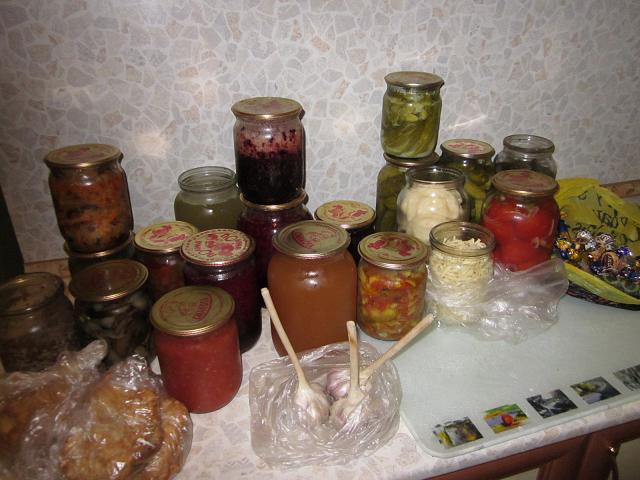
Some of food that relatives give me. Mostly home grown.
Episode on the station website can be found here.
@ 5:45 — the moderator asks whether the government is for the people or against the people, then we see several citizens talking about how difficult it is to live on a government pension.
@ 8:20 — the guy says the pension is fine, but the stores shouldn’t be raising prices.
@ 13:15 — the lady expresses a lot of ideas about government-enforced “fairness” in the pension system.
@ 16:30 — the guy points out that soon there will be more pensioners than tax payers. [FYI: Ukraine’s population is declining sharply]
@ 20:00 — Dr. Soskin names several big robberies of the Ukrainian population by their politicians, and about election fraud.
@ 32:10 — List of pensions. Who gets what.
. . . a long discussion about how (not if) the pension system should work.
@ 41:00 — Dr. Soskin shocks the host by noting a conversation with an American friend who suggested the right to bear arms for all Ukrainians.
During my recent visit to Kyiv, I veered off the touristy Andriivs’kyi Descent, and walked down Desyatynna Street, hoping to find the Bandurist I had once seen playing there. Desyatynna is a very unspectacular street. The sounds of the merchants at their tourist shops on Andriivs’kyi fades as you walk. It is residential. From an apartment of one building hung a sign protesting the construction of additional units on the roof. The street gets more interesting when it dead-ends into the parking lot of the imposing, Soviet-style Ministry of Foreign Affairs, not far from St. Michael’s Golden-Domed Monastery, but I only walked to where I had once seen the ancient Kobzar. As on my previous four or five attempts, there was no sign of him.
I’d seen him only once, and now wonder if he wasn’t a ghost. There are many more ghosts wandering over Ukraine’s black earth than over the U.S. I don’t know how to describe it to my American friends. Perhaps it can be understood by Southerners and Indians, by the losers of wars. Those ghosts, half in the wind, half in your blood, press you with that lonely urgency. You sense some critical knowledge which nobody’s telling you, as if you missed a day of school and are now condemned to stumble on in confusion.
It is a rare thing when one of them speaks to you.
I saw him in November. Small, sharp drops of cold rain had just begun falling through the wind. I actually walked past him, coming within several steps without noticing him. Then I heard a tinkling in the wind, bells you might associate with angels or the souls of babies. I turned and saw the ancient man.
His sun-baked cheeks were sunken, and eyes half shut. He looked so emaciated, my first thought concerned whether or not I should seek medical attention for him. The grey ends of his mustache curled off his face, and blew in the wind beneath his chin as I wondered what to do. His fingers were gnarled like roots, with thick, brown finger nails. They seemed to barely move over the strings of his bandura, perhaps having learning efficiency over several lifetimes of practice. I saw all this before I heard him, as he played very quietly.
The street was empty except for us. I would have liked a second opinion, a verification of sorts. Some magic in the sounds he produced held me frozen in place.
The wood of his instrument was blackened where his fingers gripped it, and the strings too were black with grime except for where he plucked them. There, the strings shone as brightly as the domes of St. Michael’s Monastery. He wore a great wool hat, and an over-sized coat. I felt so absorbed by this strange apparition that it was his ragged velcro sneakers which seemed anachronistic, rather than the man himself. A melodic groan blew from his skinny neck, and I stepped still closer.
Between breaths he opened his eyes slightly and seemed to take me in without giving anything back, never interrupting his ancient song. I leaned even closer, tilting my good ear toward him. It seemed he sung of a young girl whose lover will not return from war, children begging for bread, and a solemn line of horsemen and the grasses of the endless steppe opening then closing behind them like water. The sounds unwinding from his strings contained the rocking of slave ships on the Black Sea, devastated cities, and a mother whose children are condemned to work foreign lands. There were Scythian Mounds, torn open graves, betrayal and forgotten glory. There were people hiding in their gardens with the wagon cars outside, and the ashes of a library.
If I could only have listened longer, taken a seat at his torn, velcro sneakers and listened, I might have learned that missing bit of knowledge for which I’ve been so hungry, that elusive clarity. The movements of his long-practiced fingers to retell the stories and glories consumed by fire, reignite the lights vanished by darkness. It was all there, but I woke up. I startled awake, as if from a dream.
The ghost had vanished in the wind. I stood over the withered Kobzar. He played on, but my usual reality crept back into my thoughts, crowding him away. Some important obligation — I don’t remember what — compelled me to move on. I made a mental note to return to that spot, thinking, idiotically, that I could capture all the loneliness and history with my digital camera and post it on this blog.
Regardless of how futile it would be, I’ve returned five or six time now with no luck. If I do come across the ghost again, I hope I’ll find the courage to sit at his feet and listen.
My credit card was blocked. When I called, the fraud department told me it was because of a charge of over $1000 to an online store which sells Plus Size Women’s Clothing, Lingerie, Accessories, and wide width shoes.
Wasn’t me, I swear!
My world was turned upside down recently when someone told me the word грубий (hrubi) meant crude. For all my childhood, the word meant fat. Online translators confirmed my error.
Was the entire Ukrainian diaspora using the word incorrectly?
I seems we diaspora Ukrainians are not alone. Our habits came from somewhere. I took great comfort in this reference to the arcane definition which seemed popular in my American Ukrainian community as a child:
Те саме можна сказати й про слова грубий — товстий. Мені більше подобається «груба книжка», а не товста. Чому? А тому, що так казали мої баби в Ромні й Недригайлові (цебто на Лівобережжі), та ще й досі так кажуть у народі навіть діти
Other diaspora peculiarities (I’ll use transliterations):
“koshykivka” instead of “basketball”
“kanapka” instead of “sandvich”
the arcane “lyshcheta” for skies instead of “lyji”
See also:
(my original post about the Ukrainian language)
(Ukrainian words from my diaspora childhood which haven’t quite worked in Ukraine)


