Author Archives: RomanInUkraine

Finding the Birthplace of Ludwig von Mises

by Mykola Bunyk and Roman Skaskiw

The problem of determining the house in which the famous economist and liberal thinker was born acquired urgency several months ago with an initiative by Ukraine’s small Austrolibertarian community to unveil a memorial plaque this September for the 130th anniversary of Ludwig von Mises’s birth.

The initial relevant information about the Mises family concerned Ludwig’s great-grandfather Ludwig Mayer Rachmiel Mises. According to the website of the Center for Urban History of East Central Europe in Lviv, Ludwig’s great grandfather Mayer Rachmiel owned buildings on Market Square 18 and Old Jewish Street 7 (Rynok Square 18 and Starojevreis’ka 7), two prominent addresses in the center of Lviv connected by a courtyard.

(Read more from mises.org)

My Garage in Iowa

August 12, 2010, morning:

Roman's Garage Ukraine Trip

Roman's Garage Ukraine Trip

August 5, 2011, 8pm:

Roman's Garage Ukraine Trip

Roman's Garage Ukraine Trip

On Thursday night, I rented a car, loaded it to eye level with my three enormous pieces of luggage from Ukraine plus some of the boxes of my old thing which my other had, then, too restless to sleep, decided to drive right away.

I napped twice during the trip for thirty minutes each — once at six am in a McDonalds parking lot where I put sneakers over the parking break and seat belt buckle to soften them, and second time on the should of a highway off ramp where I pulled in front of a big rig whose driver, I imagine, did the same as me. There, I slept seated and I woke when the car became hot at about 10:30am.

I detoured to visit a friend at Notre Dame University. We had lunch instead of dinner because I made great time and would get a discount for returning my rental car within 24 hours. He gave me a tour and a Time Magazine with an article entitled Five Myths About the Economy. One of the myths was “the free market can fix it,” another “entrepreneurs drive the economy.”

I got snagged in horrible Chicago traffic, where I wondered about the innovative and courageous bureaucrats tasked with managing the transportation system.

Hard, intermittent rains fell for the last hour of my trip in Iowa, as the glow of the sun shown behind clouds before me. I arrived at my condo in the cool, damp evening and remembered the combination to my garage door. It opened on my first attempt, as if I had been there just yesterday. All my belongs looked clean and intact and the only smell was that of mothballs. A small, year-long worry vanished.

There were three racoons in the dumpster. I left the lid open.

I unpacked my car and hurried to the Cedar Rapids Airport, dropped off the car, $398 instead of $582 since it was just a single day. I have no idea why the cost of one-way rentals has skyrocketed. Then, excited by the turns of my life unfolding before me and feeling awake and alert, waited for my friend Regina to pick me up.

I think this will be a big year for me.

Debit Card Fraud

I review my finances monthly. At the end of July, I noticed an ATM withdrawal on the 15th of that month for $178.63 from an ATM in St. Petersburg Russia (ATM W/D 0317, 00888519 LENTA ST).

I’ve never been to Russia. I’d been back in the U.S. for three weeks when the suspect withdrawal happened. Either they knew my balance, or guessed really well, because my account only had about $200.

My bank, Hills Bank, was really nice about it. I filled out a form and they sent it to their investigator who contacted me. There’d been another withdrawal from another St. Petersburg ATM in May (ATM W/D 0338, 00069616 RBA ATM 19881). That one for $354.33 when my account had just a little over $400.

Clever patient criminals.

She said ATM fraud is rare, because they need to either counterfeiter the card or do something else I didn’t quite understand. The day of that May fraud was the day I gave three lectures at Donetsk University of Economics and Law, so I’m certain I didn’t make any ATM withdrawals, and certainly not in Russia.

In any case, Hills Bank is taking care of me.

I think I did good following the Fulbright office’s advice, though when I heard it, I thought it excessively cautions. I sheltered my main banking account by opening a checking account at a separate bank and used it for month-to-month expenses and ATM withdrawals.

Anyway, this is the second financial fraud I experienced from my trip.

The first was stopped before the transaction went through. The criminals did get some money from this one, but I was reimbursed without too much difficulty.

The biggest losers are Ukrainians (not to mention Russians), because this type of stuff keeps investors away from their desperately under-developed economies.

Bert Kreischer — A visit to Russia

A story about crime in Russia.

[youtube]8PAtFsJY5q0[/youtube]

A lot of problems in both Russia and Ukraine could be solved if everybody owned a gun. I hate that in a society where everybody is helpless, it is the criminals who become the capable citizens — rich, hip, cool.

Think about how this story would turn out if when Igor and Big Igor started robbing people, one of their victims shot one of them in face. Suddenly Igor, Big Igor and Sasha wouldn’t be so awesome anymore.

Let the good guys be the cool people. Legalize self defense. Let them own guns.

Two headed albino snake in Ukraine zoo

[youtube]FGHzI2apBBM[/youtube]

From arbroath.blogspot.com: Zoo officials say the Albino California Kingsnake has two heads that think, react and eat separately, though one is more passive than the other.

The head of the zoo said that the two heads sometimes compete with each other for food.

Because of that, zoo workers have to put a barrier between the heads when feeding the snake. The zoo said two-headed snakes are extremely rare, appearing once in every 50 years.

Farming by hand

I suspect one of the images of Ukraine I’ll remember will be the view through a train window of huge, finely checkered fields with a single individual farming by hand. I’d see a lone babushka bent over in an enormous field planting on the little square which I assume was hers. I’ve seen a man pulling a hand plow, stepping and pushing hard to drag it over the loose earth. It looked like a giant comb with widely spaced teeth.

On one hand, growing your own food, self reliance, being in touch with the source of your nutrition is beautiful. On the other hand, farming by hand is grossly inefficient. Specialization and trade leads to prosperity.

A friend of mine told me he wanted to eventually move to his wife’s village and farm. I suggest it was good if one enjoys farming in itself and also self-reliance and nature, but that it’d be a mistake for him, who has no experience, to do it for financial reasons. I referred him to this funny story about a businessman turned farmer, turned farming-resort-manger.

Of course, there is also increasing investment in large-scale farming:

Lectures @ Donetsk University of Economics & Law

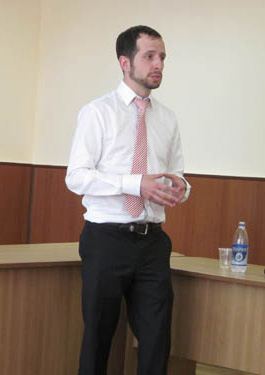
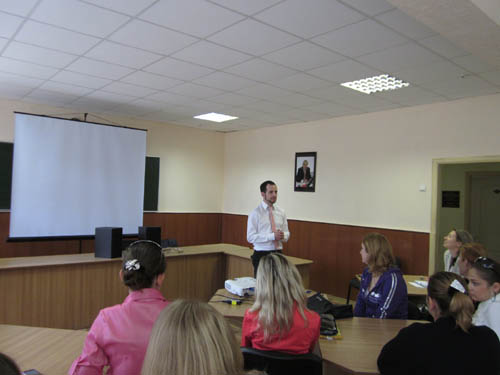
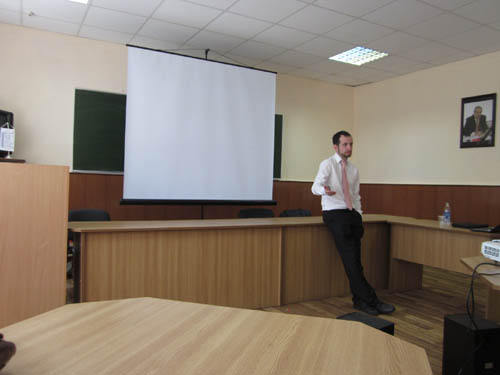
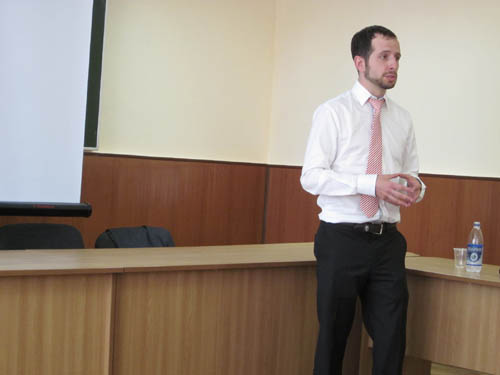
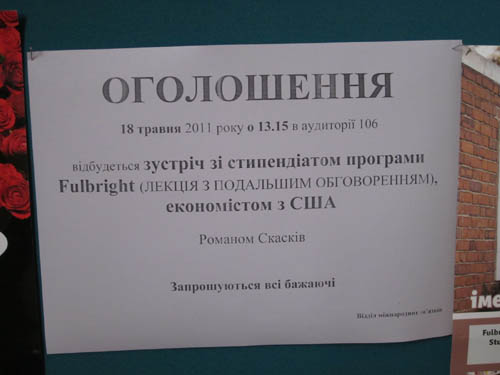
I gave lectures to economics, finance and law students at Donetsk University of Economics and Law.

Lecturing at Donetsk University of Economics & Law

Lecture to Finance Students — The Nature of Money & Economic Disinformation:

http://romaninukraine.com/Stuff/Donetsk_Finance_Lecture.mp3

For the second half of this lecture, I improvised with slides from two different Power Point presentations:
Economic Disinformation
US – Ukraine Liberty Comparison

***

Lecture to Law Students — Property, Government & Democracy.

My favorite lecture was the most radical one which I gave to law students. For them, I thought it would be most appropriate to discuss the libertarian theory of property ownership, the idea of government being a monopoly on justice and violence, and to introduce Hoppe’s arguments against Democracy.

I had good questions from the students and a vigorous discussion ensued. Pity I didn’t catch it on tape.

Here is my Power Point presentation. There was no projector, so I used the slides as notes, and wrote some things on the blackboard, including the chart (a modification of the chart in this essay by Professor Huerta de Sotto).

Donetsk University of Economics & Law

Donetsk Visit

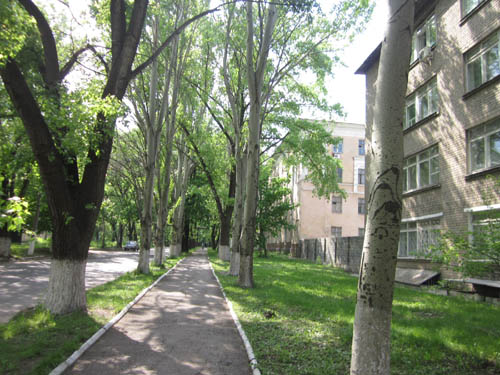
I expected Donetsk to be a gray, industrial place. This wasn’t the case at all. There is an extraordinary number of trees. I was told the city was recognize by UNESCO in 1970 as one of the greenest industrial cities in the world.

They are known for steel production, coal mining and roses.

I was struck by how the public areas — parks, roads, sidewalks — are so much better maintained in Donetsk than in other parts of Ukraine. Feel free to speculate as to why.

I gave five lectures in two days and will post the two that I recorded soon.

Two law students and I went out for coffee. They talked about the impossibility of starting a business in Donetsk without the right connections.

There were foreigners in the streets, but Arabs, Chinese and Africans — few westerners, just like in Kharkiv.

My hosts were very gracious. They offered me a wonderful tour of the city and worried like two mothers when I told them that I’d walk around a bit on my own in the evening. One made repeated calls to my mobile to make sure I was okay.

One lady I spoke with said “there isn’t much here, but we like our city.” Many Ukrainians seem to think the worst. I feel like Donetsk has quite a bit to offer. She also said “we speak mostly Russian here, but we are Ukrainian too,” and she seconded her Ukrainian credentials by telling me her husband is descendent from one of Bohdan Khmelnytski’s Atamans (generals).

One law school student asked me about national socialism in L’viv. I told them it is mostly the politicians, and that the people I speak with who have a national socialist inclination are mostly just scared about losing their language and culture. I said that commerce can make anybody peaceful. It forces people to cooperate.

I also spoke with one entrepreneur who endured a grueling two-year fight against corporate raiders and, amazingly, prevailed. “If I hadn’t generated so much publicity,” he said, “they would have killed me for sure.”

Shakhtar, Champion! Shakhtar, Champion! Shakhtar, Champion!

Do I miss Ukraine?

I miss walking around and imagining history, including the specific history of my ancestors during the insanity of the previous century. It’s a burden, that weight of history, but I miss it now that it’s gone. It’s also a tether to help me understand who I am. I also miss the coffee culture, my uniqueness as a Ukrainian-speaking American, and the endless interesting places to visit.

I miss being in a place that is not politically correct, the universal cynicism about government, and the excitement of a market economy that hasn’t even reached its 21st birthday.

Back in the USA — reflection and a list of observations

As of a few days ago, I’m back in the United States, western North Carolina to be more precise.

America’s wealth is immediately apparent: the wide, smooth roads, big houses, even for poor people, store after store after store selling cheap, high quality goods.

I made a few trips in my mother’s car to buy a coax cable, brackets and other supplies for some minor repairs in her new house. I was struck by the monumental investment in commerce. Huge tracts of land dedicated to making my patronage as convenient as possible. I imagined all the people hoping I’d stop at their store to buy home furnishings, groceries, lunch, tax advice, mobile phone service, paintings, building materials, pet supplies, discount clothing, electronics.

I paid $2.40 for twenty five feet of RG 6 coax cable. How do these places stay in business with such low prices? I had to explain what I wanted and wait for a while as they made it. At Lowes, the same cables was available for $10, ready made and hanging abundantly on their shelf. A higher price for more convenience? I love choices.

For a while everything seemed possible. Everything seemed to be at my finger tips. For my every desire, it seemed some merchant was desperately trying to provide at a price I could afford. I tried imagining my second cousin’s visit to Toronto in 1990. She was startled by the question “what type of tea would you like?” never before realizing more than one type existed.

I was reminded of the power and ingenuity of the human spirit as it once existed in the United States, unhindered by populist claims of social responsibility by which everybody puts their fingers in everybody else’s pocket. As William Faulkner expressed it:

that man’s inalienable right [to pursue happiness] was the peace and freedom in which, by his own efforts and sweat, he could gain dignity and independence, owing nothing to any man.

OWING NOTHING TO ANY MAN! Do you hear that, leftists??? I want my country back!

Faulkner went on:

the enemy of our freedom now has changed his shirt, his coat, his face.

He no longer threatens us from across an international boundary, let alone across an ocean. He faces us now from beneath the eagle-perched domes of our capitals and from behind the alphabetical splatters on the doors of welfare and other bureaus of economic or industrial regimentation. . . .

His artillery is a debased and respectless currency which has emasculated the initiative for independence by robbing initiative of the only mutual scale it knew to measure independence by. . . .

to believe this, that man’s crime against his freedom is that there are too many of him, is to believe that man’s sufferance on the face of the earth is threatened, not by his environment, but by himself: that he cannot hope to cope with his environment and its evils, because he cannot even cope with his own mass. . . .

Which is exactly what those who misuse and betray the mass of him for their own aggrandizement and power and tenure of office, believe: that man is incapable of responsibility and freedom, of fidelity and endurance and courage, that he not only cannot choose good from evil, he cannot even distinguish it, let alone practice the choice. And to believe that, you have already written off the hope of man, as they who have reft him of his inalienable right to be responsible have done, and you might as well quit now and let man stew on in peace in his own recordless and oblivious juice, to his deserved and ungrieved doom. . . .

What we need is not fewer people, but more room between them, where those who would stand on their own feet, could, and those who won’t, might have to. Then the welfare, the relief, the compensation, instead of being nationally sponsored cash prizes for idleness and ineptitude, could go where the old independent uncompromising fathers themselves would have intended it and blessed it.

Let’s hope that after the collapse of the dollar, America regains its lost liberty, and more importantly, its lost spirit of self reliance and responsibility.

I made of list of impressions as they came to me, writing them on a notepad on my pocket:

* Wealth. The amount of wealth accumulated in the United States is mind boggling.

* Polite customer service — this excludes TSA workers.

* Obese people.

* The stewardess is required to teach Americans how to put on their seat belts. Home of the brave, baby!

* People dress much more casually.

* At stores, I get accurate change every time and without question. (In Ukraine, they’ll bother you for exact change, or other small bills and coins to reduce the volume of change.)

* Standing in lines is much more ruly. There’s no consuming fear of losing one’s spot. Perhaps this is because the United States has known famine and mass shortages (except during FDR’s New Deal).

* Money looks different.

* Lawns instead of gardens. My first thought concerned all the wasted fertility, all the vegetables and chickens which might be raised, but then I thought: No! Division of labor. Specialization.

* No more adapters for my laptop power cords.

* Much more processed food.

Stay tuned. I will blog about Donetsk next and post my lectures.

Moving On

Young couples laugh, an old woman sells raspberries, startlingly beautiful women pull peoples glances after their swaying hips, men fit cobble stones into a reconstructed sidewalk, a crowd listens to their tour guide who points to Jesus sitting atop one of L’viv’s churches, Father Ivan sits with a colleague at an outdoor table beside a coffee shop and calls to me — “In a few hours,” I tell him. “Go with God,” he says, gently shaking my hand with both of his — restless commuters wait for marshutky, friends drink beer from plastic bottles, sun shines, wind blows, summer blooms, people walk the streets in every direction, each carrying a universe of purpose, history, feeling.

My time has come. It always seems like ends are a time to make some grand concluding remarks, some revelation. As is usually the case with me, however, my pen does not keep up with my life.

I will fly home very soon, but I will continue writing about Ukraine, and continue blogging, so please stay tuned. I’m at least a month and half behind. I’ll soon post two of the lectures I gave at Donetsk University of Economics and Law, photos from the Carpathians, restaurant reviews, and more.

Please stay tuned.

Roman on the trail to Robert's Bunker

Zbroya Gun Day

I went to Zbroya Gun Day on May 14th with a libertarian friend of mine from Kyiv.

Zbroya is Ukraine’s only association of gun owners. It formed in October 2009 after a long bureaucratic process during which the founder, George Uchaikyn, obtained permission from the first deputies of Ukraine’s Army, Police and Justice Department. (more info here)

My friend Vlad and I walked through a park to reach the lodge, unsure of what to expect. We found tables and food and live rock music. The event was very well organized.

All those participating in the shooting portion were broken into three groups which rotated between pistol, shotgun and rifle ranges. A lady followed each group and recorded scores. I wish I’d realized from the beginning that I was being graded.

As is the case with similar events I’ve attended in the U.S. the staff emphasized safety. Each rotation began with a block of instruction geared toward beginners. At the pistol range, we didn’t even load the weapon. We only fired it.

I expected to do best at the rifle range. Even though they were Mosin bolt-action rifles, I thought my experience with M16s and M4s would translate. However my best rotation was the trap range. I hit six out of ten.

After the shooting portion of the event, everyone made a determined move to the food. The staff tallied the scores and Gregory, the founder of Zbroya, thanked sponsors and participants, and announced the winner. The highest post total was a hundred sixty something. Third place was a hundred forty something. Mine was a hundred fourteen. Maybe next time.

The participants I spoke sound very similar to their American counterparts. After getting to know you, they express frustration at the legal difficulties of gun ownership, and of common people’s fear and bias against guns. They say what I’ve heard many time before, “if only people would come to our events and try it for themselves.”

From what people told me at the event, it seems no definitive gun ownership laws exist in Ukraine, at least not for normal guns. Certain types of people (journalists, politicians, hunters) are explicitly allowed pneumatic (compressed-air-powered) guns.

The confusion about laws is consistent with my experience. Over the course of my ten month stay in Ukraine, I’ve gotten completely different and diametrically opposed answers about gun laws.

I’m very happy people like George exist, who are willing to jump the considerable bureaucratic hurdles and create a organization for gun owners in Ukraine.

For any gun ownership skeptics who may be reading my blog, I would say that the idea of a well armed society might, at first glace, seem violent, but experience tells the opposite story.

Gun laws only disarm law-abiding people. The most dangerous society is one in which only criminals and government are able to exercise lethal force.

“Fighting for Freedom” in the Middle East — the military mentality and unintended consequences

This lecture was given at the 2011 Property and Freedom Society Conference.

My powerpoint presentation here.

Essays based on this lecture:
The Military Mentality
Bureaucratic Management and Unintended Consequences

Very flattering review of the conference and my lecture here. I agree with Jame’s sentiment. The PFS conference is a rare visit to the outside of the asylum.

Roman Skaskiw at 2011 Property and Freedom Society Conference

Sauna Conversation

After initially scoffing at my gym’s (Eurosport) absurdly named “Zone Relax,” and not even bothering to visit it for my first several months, I’ve become quite the addict. They have a Finnish sauna, a Russian sauna (which smells like burnt wood), a Roman steam room, a freezing cold pool, and a jacuzzi which isn’t hot but gives a great massage.

The gym is full of expensive-looking women and important-looking men. Many speak Russian which is not typical in L’viv, though certainly not unknown especially for business men.

So today, two guys started talking to me in Russian in the sauna. They were intrigued that I spoke Ukrainian, but wasn’t born here. I told them about my work and some entrepreneurial ideas I may pursue on a future visit.

One spoke about the unfairness of cheap labor and the other, the older, more important-looking one, lectured him about why this isn’t so.

I was so interested in their conversation that I stayed in the sauna until I felt dizzy and light headed. I excused myself, stumbled to the frozen pool for a dip. Then I returned for more.