Author Archives: RomanInUkraine

“Hot Topic” in Ukraine

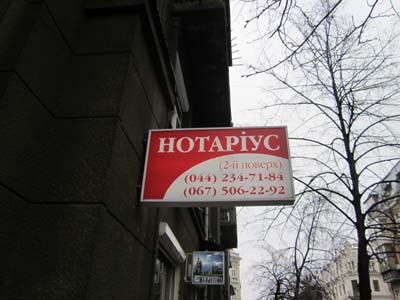
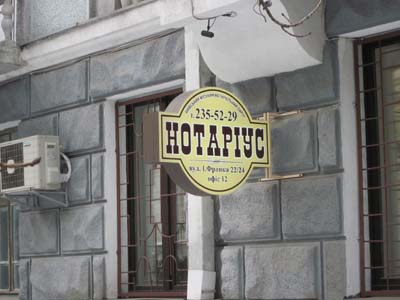
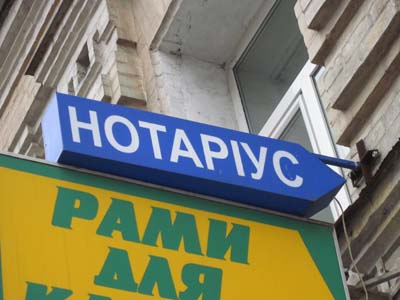
New visitors to Ukraine may be surprised by the ubiquitousness of Hot Topic stores (more so in Kyiv than L’viv it seems to me). With at least one, sometimes several, on every street, novice travelers might easily conclude the American retail chain specializing in music and punk/rock culture-related clothing and accessories has a strangle hold on the Ukrainian market.

But wait! Upon closer inspection, travelers semi-competent with Cyrillic letters may realize the signs are actually “Нотаріус” (No-ta-ree-us) which is Ukrainian for notary. Sorry, novelty T-shirt lovers. The abundance of notaries speaks to one of the most popular, activities of Ukrainians: getting things stamped.

Notary Sign in Ukraine - Notarius

Notary Sign in Ukraine - Notarius

Notary Sign in Ukraine - Notarius

Notary Sign in Ukraine - Notarius

Notary Sign in Ukraine - Notarius

Notary Sign in Ukraine - Notarius

Ukrainian Money

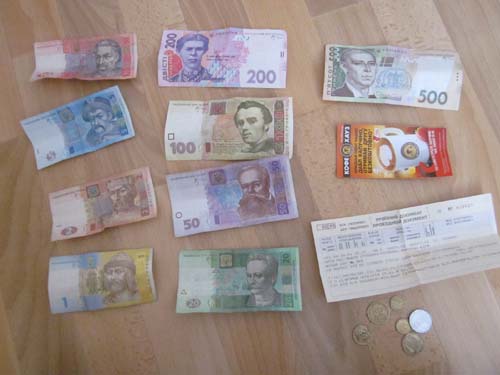
A few days ago, I found myself with every type of Ukrainian central bank note in my wallet, also a coffee coupon and my train ticket to L’viv:

Ukrainian Money

At the time of this blog post, the exchange rate is about 7.95 hryvnias to 1 dollar. The Ukrainian central bank pegs their currency to the dollar.

Ukraine Tourism

My neighbor from Iowa came to visit me. Took the opportunity to be a tourist. Here are pics from the L’viv Opera, a late 19th Century Mansion is disrepair (the guard dog’s ferocity didn’t live up to the warning sign), a place called Stilsko where there existed a city in the 10th century — descended of present day Croatians according to our guide, and a nearby ski area called Slavs’ke. We took the chair lift up into the cold. There’s a surprising little commercial area on top of the mountain. We ate verenyky and kabobs to warm up from the cold chairlift ride.

From Kyiv with Love

Missed my train to L’viv. Afer a brief search for the proper platform, I arrived just as my trai departed.

Partial refund on the ticket. Next train at 1:20am.

I’m now sitting in McDonalds browsing via Kinde.

When I get back, I plan to write and work like my life depends on it.

I haven’t vanished

Apologies for the delay. There’s much to do here, and my pen doesn’t keep up with my life. I plan to soon blog about:

family history
all the food relatives give me
my Iowa City neighbor Andy’s visit
spontaneous cooperation in transportation here
newspaper clippings
Hot Topic in Ukraine
the money in my wallet

Legalize Land Ownership

A Column appeared in the Kyiv Post a while back arguing the criminalization of selling agricultural land to non-Ukrainians should remain in place. My response was going to appear as an op-ed, but it seems they decided for this one instead, so I’ll post it here.

You can read the original column “Business Sense: Nation should not be in rush to lift moratorium on sale of farmland” by Michael Lee here. I also saved a copy here.

My reply:

***

I was disappointed to read Michael Lee’s column last month in support of the national moratorium on the sale of farmland. I am always saddened and amazed to see that even analysts who readily reject central economic planning quite happily centrally plan once they seize the reins of government or a journalistic platform.

We should remember that there is no law without punishment. Every law, statute, regulation is backed, ultimately, by force or threat of force. The use of force to restrict peaceful, voluntary activity, like the sale of land by an “owner,” should always be viewed with extreme suspicion. “Owner” bears quotation marks, because one doesn’t truly own something whose usage is severely restricted by the state.

Throughout history, restrictions on peaceful, voluntary activity have been justified in various ways. Mr. Lee echoes one of the most popular — security for the incompetent. Because he believes some land owners will squander the money they receive, any land owner who sells his property must be considered a criminal.

His column bears the same pretense of knowledge assumed by history’s many glorious central planners. He knows, for example, that the current practice of landlords receiving “their annual rental income in cash or in a combination of cash, seeds and straw” is superior to the lump-sum profit from a sale of land because of its reliability, and that land value as well as rents and the landlords’ income will increase as the global population increases. I’m not sure how he’d reconcile this argument with Ukraine’s crashing population (which I’m certain has nothing to do with the countless, arbitrary restrictions over the lives of Ukrainians) and even if it were true, it assumes all land owners will prefer more income tomorrow instead of less income today. What if an 85-year-old land owner wants to see the world for the first time in her life? Is she condemned instead to wait for tomorrow’s supposedly higher income?

The column presumes these rental increases (driven by a nonexistent population growth) may be the difference between a “village thriving or dying a slow death,” and that leasing land coupled with “some initiative from the state” will “lead to a wider renaissance in rural communities.” No doubt many will feel reassured to hear the great planners not limiting their genius to economics.

He presumes that land ownership and renting is “an efficient way to filter foreign investment directly to where it can have the greatest impact,” as if anybody knows where that is. He knows too that for companies forced to rent instead of buy, “not having to find huge amounts of capital to pay for land is advantageous. . . it can be put into equipment, inputs and infrastructures where it will have a greater impact on the return on investment.”

If the case for the superiority of renting, both from the perspective of owners and agri-businesses, is so obvious, one wonders why the selling of land even needs to be criminalized. Are we to believe businesses are so stupid they need to be forced into the most beneficial course of action?

The fact is, neither Mr. Lee, nor any technocrat, nor I know which specific business practices are best. The only way to discover it is to respect property rights and allow the capitalist process to work.

Those who consider Ukrainians not ready to manage the property they supposedly own are mistaking the poison for the cure. It is precisely because the capitalist process here has been so mutilated for so long, that there is less competence, innovation, and discipline than in more capitalistic countries. In Ukraine those who posses such virtues have had less opportunity to receive rewards or accumulate capital, and those who don’t, little reason to learn them as one’s success in this economy seems determined too much by obtaining the political connections necessary to navigate arbitrary restrictions like the ones Mr. Lee supports.

Yes, letting capitalism work means allowing people to fail. I would remind those who seek to compromise property rights in the name of security for the incompetent that throughout history and without exception all levels of society, rich and poor, have been better off when property rights were upheld, and restrictions of peaceful, voluntary activities were minimal.

Tos’ka means two Romans

“When there are two Romans, you call it a Tos’ka,” my relative’s neighbor, Roman, told me as we drank in his mother’s kitchen.

“Does the word Tos’ka mean anything?” I asked.

They looked at me with the same expressions of polite impatience they use when my language skills grind the conversation to a halt, then spoke in a slow, loud voice: “It means two Romans.”

Rizdvo (Christmas) in Ukraine

Ukrainians, including all the variants of Orthodoxy and Eastern Rite — a.k.a. “Greek” — Catholics (my peeps), celebrate Christmas Eve on January 6th.

I personally just celebrated Christmas Eve on the 6th, Christmas on the 7th, Maria’s Day on the 8th, and Stepan’s Day on the 9th.

Some Ukrainians begin celebrating on Roman’s Day, which is December 1st and I expect all my friends to remember that! And I know which of you have read this BECAUSE I BACKTRACED IT!

They continue with only a minor lull through St. Mykola’s Days on December 19th, which is when gifts are exchanged, to New Years, which is when gifts have been exchanged since Soviet Times — I think (The holiday seems to have adopted many of the atheist customs associated with western Christmas, including Christmas trees. A friend didn’t believe me when I told her American’s don’t exchange gifts on New Years.) through Christmas and the aforementioned holidays connected to it, on to Old Calendar New Year on the 13th/14th (there’s a blurb here which relates it to Slavic stubbornness, and finally to Yurdan (spelling?), which I thought was January 17th, but Ukrainian Wikipedia says it’s the 19th.

It celebrates the Christening, and I just spent 15 frustrating minutes failing to find an English-language reference to it. here‘s the translated Wikipedia page.

There’s a funny saying in Ukraine “From Romana to Yurdana is Ukrainian Ramadan,” meaning not that people fast or anything, but that they celebrate for a very long time.

Okay, I thought this was going to be a five-line blog post — a sweeping overview of sites and sounds. Obviously, I’m wrong.

I feel I ought to say something about the schism between Catholic, Protestant Christmas (December 25th) and Orthodox, Greek Catholic Christmas (January 7th).

Almost every time I write about this, I wander all over the internet getting the vocabulary straight, then send my email and instantly forgetting everything. No more, at least not tonight. It’s 1 am. I’m tired and hung over. (There is NO DAMN REASON for pounding shots with breakfast . . . and coffee, and lunch . . . ).

My dear fellow Ukrainians, you probably wouldn’t need to know 1001 home remedies if so many of you didn’t drink from breakfast onward. I’m going to go out on a limb and guess that the characteristically weak immune systems I so often hear Ukrainians mentioning and attributing to Chernobyl might have more to do with the ol’ fire water. I’m being harsh. Today was a holiday. A very special holiday. The Day of Stepan. Whoever that was.

So I’m not going to do my homework for this blog post. I’m going to keep sipping water, write this blog, maybe another 5-liner, a couple emails, then go to bed. I invite my readers to look up the Great Schism, the Julian, Revised Julian, and Gregorian calendars, movable feasts, dual dating, and whatever else Wikipedia might lead you to.

Okay, so finally, what I wanted to write from the start before getting tangled in history and tradition, is a brief overview of my Christmas, which was great, and could certainly have been worse:

Eating, drinking.
Going to the cemetery to put pine branches on the graves of relatives and freezing my hands trying to light candles.
Kneeling to pray before Christmas Eve dinner.
Eating, drinking at another table, and another, and another
Gold teeth, swollen hands, and fingernails thick as oyster shells.
America, diaspora, I speak so well, family, family, why aren’t I married yet — maybe you’ll find a Ukrainian girl, hehehehehehehehehehehehehehehehe.
Sledding on a sled, sledding on a bag.
Snowball fight.
A neice indifferent to her accent as she read the Green Eggs and Ham, my gift.
Cards.
Taking the nieces to carol under lit windows in their town.
Little devils, kings and kozaks wandering through town.
Nieces insisting my accompanying them was worth a cut, though I didn’t sing.
Me hiding the cash (45 UAH) in Green Eggs and Ham.
Them finding it and hiding it in my jacket.
A four day-long argument with the women over whether or not I could eat more.
A four day-long argument with the men over whether or not I could drink more.
Barely making it to the toilet in time at 3am of my first night.
A miserable hour of keeping myself standing in church, dizzy, dehydrated, exhausted, freezing, back and knees aching, cotton-mouthed sinning with my angry, impatient thoughts.
Holding my plate at arms length from the table because I really, truly, honestly, definitely could not eat any more, delicious though it was and it was.
Not resisting my new Kindle’s free 3g browsing and trying not to feel extravegant explaining it to cousins.
Meats, fats, pickled things from the garden (or the woods, in the case of the mushrooms), salads and vodka cognac wine.
Busting out the old back-wash-into-the-chaser trick so that I wouldn’t die.
The legendary pork jello.
Totally impressing the nieces with my mad Super Mario Brothers skillz (I knew that rigorous childhood training regime would eventually pay off.)
Kung Fu Panda dubbed into Ukrainian.
Stories about my grandfather and his sibling. (maybe I’ll share later.)
Insisting I had to go, finally, and telling them I haven’t seen this horse yet, the one I drink to as a parting kick in the balls from every table. Where is he? Okay, to that fucking horse.

***

Edit: I didn’t mean to imply I found myself in the company of drunks. They all seemed to hold their alcohol extremely well. There are lots of drunks in Ukraine, but not at the tables I joined.

15 Observations about Ukraine and Ukrainians

(FYI, I am one.)

1. They hate making change. If you offer a 100 or 200 UAH note, retailers will almost always ask if you smaller notes. Often they tell you they can’t make change. Sometimes, I think cabbies are just trying to get more money from me. Recently, a grocer will discounted the price because she couldn’t make change, and when I offered a tram driver a 10 UAH note for four 1 UAH tickets, she told me she couldn’t make change. She asked if we were making the return trip and suggested I buy eight tickets instead. Ridiculous. You’re in business, people.

2. They fear drafts. Even young men tell me, for example, which way I should lie in the train car to avoid a draft from the window. I think there’s a larger health fear in Ukraine. Some Ukrainians believe Chernobyl has weakened their immune systems.

3. They feed guests.

4. They think the worst of themselves. I’ve heard rude bureaucrats, poor customer service, unpredictable business culture, government failures all blamed on inherent flaws in the Ukrainian character. This is false. I’d attribute poor customer service, and business culture on the fact that the market has only been at work for twenty years and remains mutilated, the bureaucrats and government failure on the nature of coercive enterprises.

5. Emotionally tough. They can take disappointments much better than Americans.

6. Practical. This goes hand-in-hand with #5.

7. They know many home remedies for every ailment you’ve ever heard of, and most of the ones you haven’t.

8. Drinking customs. You clink glasses with every drink, not just the first. You don’t take your drink alone. When you see one person holding their glass, quiet down and hold yours. There is a preference toward having three (or six, or nine, or twelve, or fifteen) drinks — honoring the holy trinity, I think.

9. Embarrassed by their bathrooms. This goes back to #4.

10. Know how to cook.

11. Know how to tend gardens, livestock. (Good because it gives Ukrainians a fall back plan during economic crises. Bad because it lowers the division of labor.)

12. Religious. Especially in Western Ukraine.

13. In restaurants, you have to ask for the bill. When it comes, sometimes you’re expected to pay right away.

14. In business and even shopping for expensive items, personal relationships and recommendations carry even greater weight than they do in the U.S.

15. They want to know how they and their country are perceived (hence I started maintaining a list).

Also,

– often gawdy in popular expressions of art & decoration

– insufficiently skeptical of television commercials

– too often attribute west’s wealth to benevolent governments and effective welfare programs

– light switches in bad places.

The Cucuteni-Trypillian civilization

From Wikipedia: The Cucuteni-Trypillian culture, also known as Cucuteni culture (from Romanian), Trypillian culture (from Ukrainian) or Tripolye culture (from Russian), is a late Neolithic archaeological culture which flourished between ca. 5500 BC and 2750 BC, from the Carpathian Mountains to the Dniester and Dnieper regions in modern-day Romania, Moldova, and Ukraine, encompassing an area of more than 35,000 km2 (13,500 square miles).[1] At its peak the Cucuteni-Trypillian culture built the largest settlements in Neolithic Europe, some of which had populations of up to 15,000 inhabitants.

Another periodization has been assigned to this culture that breaks it down into three main eras:.[3]
• Early: 5500 to 4600 BC
• Middle: 4600 to 3200 BC
• Late: 3200 to 2600 BC

***

More on the discovery of the Trypillian civilization here.

***

I’m not sure how to reconcile this with the widely held idea that Sumeria was the first civilization. Perhaps the Trypillians weren’t big enough.

From wikipedia: The cities of Sumer were the first civilization to practice intensive, year-round agriculture, by 5000 BC showing the use of core agricultural techniques including large-scale intensive cultivation of land, mono-cropping, organized irrigation, and the use of a specialized labor force. . . . There was little evidence of institutionalized violence or professional soldiers during the Uruk period, and towns were generally unwalled. During this period Uruk became the most urbanised city in the world, surpassing for the first time 50,000 inhabitants.

Secret Potatoes

Happy New Year, everybody.

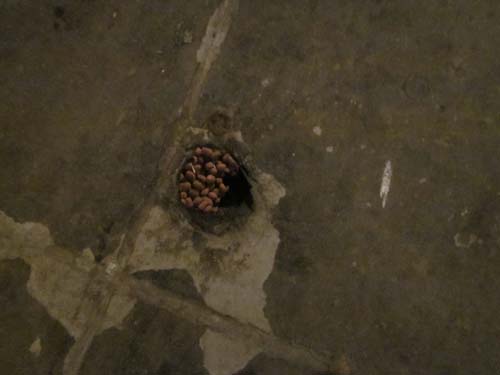
There’s a hole in the floor near the entrance of my building. I’ve been passing it several times a day since moving to L’viv. Once, to my astonishment, there was a light shining from within the hole. It was no ordinary pit.

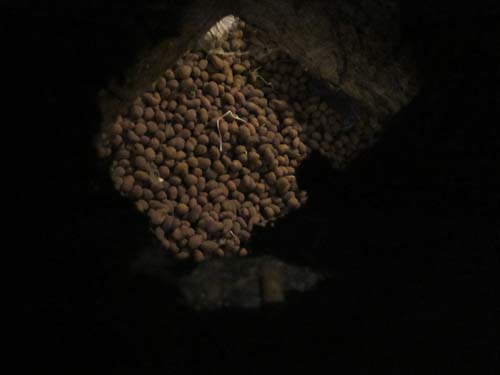
I looked inside and saw potatoes. I felt like a child discovering mysteries in the woods, like an explorer finding a lost civilization. I also felt tired, as it happened late and night. In the morning wasn’t completely certain whether I hadn’t dreamed the whole thing. I dutifully checked the pit every day from then on, but until a few days ago, it remained dark.

You can imagine my excitement when, almost as a New Year’s gift, the potatoes revealed themselves to me again. I sprinted up to my fourth floor kvartyra, and back down to produce this photographic proof:

t

Monument to Stalin destroyed in Zaporizhia on New Year’s Eve

Unidentified people blew up a monument to Stalin at around 2330 in Zaporizhia on the territory of the regional committee of the Communist Party of Ukraine.

The regional committee’s building was also damaged. The blast blew off the windows’ glass and facing, the main department of the regional branch of the Interior Ministry told Interfax-Ukraine.

Read more: http://www.kyivpost.com/news/nation/detail/93979/#ixzz19mefn4GF

The Ukrainian Language

I took Ukrainian lessons while in Kyiv. I’m still on the fence as to whether or not to resume them here in L’viv. I need to manage my time better.

In one sense (and only one sense) Ukrainian is easier than English. Unlike letters in English words, letters in Ukrainian always make the same sounds, regardless of how they’re arranged. On the other hand, word endings are a nightmare.

Ukrainian nouns have cases. They change depending on how they are referenced — subject, direct object, possessor. Latin has six cases; German has four; Finnish apparently has sixteen; Russian also has six cases. Ukrainian has the six cases of Russian plus an additional vocative case for when you’re calling someone or something, for example, “Ukraine, my darling” would begin “oo-kra-ee-nu . . .”

I’m completely charmed by seemingly endless gradient of diminutives in Ukrainian. For English speakers, think of how the name Michael can be reduced to Mikey. This is a diminutive. Ukrainian has one or more for every noun. I recently learned there is also the opposite of a diminutive. A noun can be a bigger, scarier version of itself by changing the ending.

Changing a word from noun to verb to adjective is also a simple matter of various twists and turns on the word’s endings.

The more I study, the more fascinated I become. Take the language’s tortured history.

According to one journalist friend of mine, there have been over 100 separate laws outlawing the Ukrainian in whole or in part. Stalin banished the letter ‘ґ’ — pronounced like the ‘g’ in gulag. The letter has returned from the archipelago, but you won’t see it very often. It doesn’t appear on my keyboard simulator. We can only guess what depravities it endured. The letter may never be the same again. Several phonetic combination were also banished.

Ukrainian has been Polinized in the West, Russified in much of the rest of the country — both coercive and voluntary forces have been at work.

There’s an emerging slang which mixes Ukrainian and Russian called суржик or “surzhyk.” The word surzhyk itself means a mixture of wheat and rye. Surzhyk varies greatly from town to town and even person to person.

In the diaspora, entirely new words emerged. I think my parents’ immigrant generation were so accustomed to protecting and preserving Ukrainian at all costs, they continued shielding the language after arriving in the US. We were scolded for transliterating “basketball” and instead were taught to say “koshekivka” — кошиківка — from the word кошик, or basket. In Ukraine, everybody says “basketball.”

Our word for exercise was руханка or “rukhanka” which means, simply, movement. I thought this was also a peculiarity of the diaspora, but I’ve since heard of it being used in parts of Western Ukraine, which makes sense. All WWII era refugees are from Western Ukraine — what had been Poland at the start of the war. (See Operation Keelhaul to learn how Allied forces forcibly returning millions of Soviet refugees to the loving embrace of Joseph Stalin.)

The Ukrainian term for exercise, meaning physical exercise, is фізичні вправи or “fizichni vpravy,” i.e. physical exercises.

Potato = картопля “kartoplia”, бараболя “barabolia” (which I grew up saying), or бульба “bul’ba”. Each betrays a regional identity.

My Ukrainian teacher laughed out loud when I said “zupa” for soup. In central Ukraine, they say it exactly as English speakers do — soup. Here in the west, “zupa” and soup seem equally common. I only knew “zupa” growing up, and suspect the more ardent preservers of the Ukrainian language would have seen “soup” as a betrayal of everything they stood for.

There is a very literary future tense by which you can bypass verbs like “going to” or “will.”

“Ia budu chytate” = I will read.

“Ia chytatemu” = I [will] read. (in the literary future tense)

The word for man is чоловік or “cholovik.” чоло means forehead. вік means age, mostly, but also wisdom. One lady, a very proud Ukrainian, used this example to tell me that Ukrainian teaches love and respect, even to those who don’t realize the roots of words.

Language is a hot issue here. Political careers live an die on emotions, not ideas. Hence, all over the world, politics is mostly identity politics. Here in Ukraine, this puts language issues center stage.

I wouldn’t tell anyone what language to learn, and I wouldn’t want anyone telling me. No doubt some ardent defenders of Ukrainian identity would feel threatened by this libertarian philosophy, but if you want to protect a language (or anything else) government should have as little to do with it as possible.

Much of the Ukrainian ethos swirls around the rather humiliating task of proving that we exist. In one of his poems, national figure Taras Shevchenko (1814-1861) repeatedly asks, what are the Muskovites looking for in our torn-open graves? Former Russian president Putin has said on more than one occasion “Ukraine is not even a nation.” It is usually followed by a deafening silence from Ukraine’s government.

When I was a grade school student in New York City, I remember my teacher telling me on heritage day that I wasn’t Ukrainian because there is no such country. At the time, my priority was getting along and I was happy to bow to her authority as ultimate arbiter of truth — relieved even. After all, what descendant of a former Soviet state doesn’t seek the approval of appointed authorities? I mean, there would be *anarchy* if we didn’t revere our leaders, genuflect before them, gloriously sacrifice ourselves for the privilege of inclusion in their genius visions for society’s future.

I’ve since felt the pressure of my inherited three-hundred year old longing. So I offer these bits of history as evidence that I am not a Russian with an identity crisis:

Ivan Kotlyarevsky’s epic poem Eneyida, 1798, is considered the first literary work in modern Ukrainian (http://en.wikipedia.org/wiki/Ivan_Kotlyarevsky).

Prior to him was the author Hryhorii Skovoroda whose language is apparently the subject of much debate. From wikipedia: “After an in depth study of Skovoroda’s written works the Slavic linguist George Shevelov was able to deduce that apart from Ukrainian it contained 7.8% Russian, 7.7% non-slavic, and 27.6% Church Slavonic vocabulary.” (http://en.wikipedia.org/wiki/Hryhorii_Skovoroda)

Looking back even earlier, we have hints about the language of the Zaporozhian Host and their divergence from Russian: “This linguistic divergence is confirmed by the need for translators during the mid 17th century negotiations for the Treaty of Pereyaslav, between Bohdan Khmelnytsky, ruler of the Zaporozhian Host, and the Russian state.” (http://en.wikipedia.org/wiki/Ruthenian_language)

From the same article: “Ruthenian can be seen as a predecessor of modern Belarusian, Rusyn and Ukrainian. Indeed all these languages, from Old East Slavic to Rusyn, have been labeled as Ruthenian.”

***

As the Austrian School economists repeatedly point out, commerce makes people peaceful. If we trade with one another, meaning, if we are allowed to trade with one another, we will be peaceful regardless of conflicting interpretations of history. Once we grow up and renounce the idea of an ultimate arbiter of truth, who uses force (taxes, public education, truancy laws, government museums, government historians) conflicting perspectives can co-exist. In a non coercive society, we would no longer need to obliterate rival perspectives for our own to survive. Such society is richer not only in material wealth, but in cultural diversity, intellectual rigor, and scope of possibility for every human being.

***

EDIT: Some transliterated diminutives, and giant-inutive.

Roman -> Romko, Romchik (what my aunt still calls me), Romanchik, Romeniatko, Romanochko.

Dog = “pes” -> pesyk, peseniatko, pesyshche (giant-inutive)

Granny = “baba” -> babucia, babtsia, babul’ku, babyshche (giant-intuive)

Girl = ‘divchena’ -> divchenka, divchenochka, divka (rude), divul’ia (sarcastic, scary)

The Ukrainian word for diminutive is пестливі (“pestlyvi”), which means endearment.

See also:
(follow up post about language among diaspora Ukrainians)
(Ukrainian words from my diaspora childhood which haven’t quite worked in Ukraine)

A month of Newspapers

Kyiv Post, Nov 10

Front Page Article: Ukraine Goes Offshore
“The proliferation of tax-minimization schemes, some of dubious legality, is costing the Ukrainian state budget billions of dollars each year in lost revenue. Yet officials show no inclination to crack down on these offshore havens.”

The article lists the biggest investors in Ukraine since independence:
1. Cyprus
2. Germany
3. Netherlands
4. Russia
5. Austria

The top recipients of Ukrainian foreign investment:
1. Cyprus
2. Russia
3. Latvia
4. Poland
5. Georgia

Cyprus’s prominence is due to its appeal as a tax haven.

[Here’s another article completely unrelated to the tax avoidance / evasion story entitled:]

Ukraine still stuck near bottom of world investment climate rankings “The report said Ukraine eased business start-up by substantially reducing the minimum capital requirement. It cut 9 out of 31 procedures to obtain construction permits and it eased tax compliance by continuing the implementation of voluntary electronic filing for value-added-tax returns. But Ukraine’s regulatory environment and tax system are still ranked amid the most complex and corrupt in the world, according to the World Bank ranking.”

***

Kyiv Post, Nov 19

Front page: Tax revolt gains steam on revolution’s anniversary “However, Vice Premier Sergiy Tigipko told Channel 5 TV that the tax hikes were necessary because of conditions imposed by the International Monetary Fund for $15 billion in new loans to Ukraine’s government. ‘Increases in utility rates and a hike to the minimum retirement age are necessary for Ukraine to receive more IMF credits,’ he said. ‘We are going to have to make unpopular reforms.'”

Gryshchenko: Democratic Ukraine is ‘moving forward’

***

Kyiv Post, Nov 26

Ukrainska Pravda exposes presidential estate scandal “President Viktor Yanukovych lives in a house surrounded by a milti-million dollar estate with its own bowling alley, enormous clubhouse, soon-to-be-built tennis court, a near-by hunting ground and shooting gallery. Yanukovych’s story – and he’s sticking to it – is that he only owns a house on the estate and a tiny patch of land around it. The president says he doesn’t know who owns the surrounding territory of 138 hectares, equal to 24 Shevchenko Parks – where massive construction and development is taking place.”

Trial date set for officers charged in student death The first judicial hearing in the May 18 police-custody death of university student Ihor Indylo starts on Dec 1 in Kyiv’s Desnyansky District Court . . . A Shevchenko District police inspector and an on-duty officer are being charged with excessive force and gross dereliction of duty. . . ”

Corporate Raiding: Top-level corruption, bureaucracy continue to stunt desperately needed foreign investment in Ukraine
“The problems are clearly deep when such prominent and respected Canadian investors as James Temerty, named this year by Ernst & Young as ‘Entrepreneur Of The Year’ in Ontario province, get bogged down in Ukraine’s muddy business environment.
     What did investing in Ukraine cost Temerty, a Canadian with Ukrainian roots? An estimated $100 million in losses, insiders say.
     Northland Power, Temerty’s Canadian energy group, leaped into Ukraine more than a decade ago. Through an investment venutre, it acquired a majority stake in Kyiv-based Darnytsia Heat and Power Plant. The simple plan was to modernize the plant, turning it into a leading and efficient player on the domestic market. But instead, Northland’s domestic subsidiary, UkrCanPower, spent much of the past decade defending its basic ownership rights over the investment.
     Norland eventually lost the battle to an influential domestic group. . . .
      . . . the pling of leading grain tranders such as Cergill, Tepfer International and Bunge, which have invest billions of dollars over the years into Ukraine’s promising yet far underdeveloped agriculture sector . . . Ukraine’s government first squeezed their business by restricting grain exports to keep domestic food prices low, then issued a disproportional grain export quotas to three domestic companies in a process deemed unfair and nontransparent. . . .
     While a select group of grain companies that received the lion’s share of export quotas will profit greatly amid record global grain prices, over, the quotas in place until June 30, 2011 will cause up to $2.6 billion damages to Ukraine’s agricultural sector, according to the Chamer. Moreever, the export restrictions utilized by Ukraine appear to violate World Trade Organization rules . . . .
     Yanukovych’s administration did nothing — until pressured by international energy companies — to stop obsccure companies from importing more than 1 million tons of oil and motor fuels free of duties and taxes through a nontransparent loophole. The suspect trade took place in recent months, accounting for 60 percent of all oil imported into the country and robbing the national budget of hundreds . . .”

In buying train tickets online, experts say customers may feed corruption “A shadowy company has made at least Hr 2 million from the online sale of train tickets and stands to make millions more as the scheme is rolled out on a larger scale.
     Express 2 takes a commission from all online ticket sales in a scheme dating back to March 2009 that requires the traveler to pick up a ticket ordered on the state railway website from the station. Since Nov. 15, tickets for certain routes can be printed directly from the Internet, a more convenient service that promises even larger profits for the firm.
     Experts said this looks like a common scheme used to pilfer profits from the state for the benefit of private, well-connected individuals.”

[I consider this typical government collusion — which is good to criticize, coupled with anti-capitalist overtones — which are bad.]

[Front page article about people who, as an experiment, tried living on Hr 907, or $155 a month, the national minimum wage. Ukraine’s minimum wage rhetoric is different from the US’s. In the US its about forcing employers to pay a salary to unskilled labor. In Ukraine, it’s more about pensions, student aid and other social benefits which are proportional to the minimum wage. Technically, Ukraine’s minimum wage also concerns itself with the salaries of unskilled labor, but it seems that all the small and medium companies are very good at operating in the shadows, and all the large companies are so well connected that few businesses if any are impacted by the minimum wage.]

Minimal wage means meat, medicines are luxuries
“‘All civilized countries have flexible taxation systems,’ said Oleksandr Okhrimenko, president of the Ukrainian Analytical Center. ‘The United States, for example, introduced some tax benefits to families who take care of their old relatives. That scheme basically enables people to take part in distribution of welfare.’
     European countries have a so called progressive taxation scale: the wealthier a person is, the mor taxes he or she pays. Income taxes in Germany very from zero percent for the poorest to 50 percent for the richest.
     The new draft of the Ukrainian tax code also contains this progressive approach, but its formula is not even close to the German one: the richest Ukrainian will have to pay 17 percent in income tax, while the rest of people will keep paying 15 percent as they have done before.”

Tax code protests intensify in nation “Ruslan Zorya, an entrepreneur and leader of the non-government Aktiv Cherkassy group, on Nov. 24 told reporters that only 10 of the 30 buses taking people to the tax code demonstration were allowed to make the trip. The other buses were turned back for various technical violations. He said.
     Cerkassy police responded that many of the bus drivers had not filed for permission to make the journey, as required by regulations.”

Visa-free travel to Europe rests on commitment to democracy
“And there are a lot of conditions. Among them:
– Adoption of legislation on preventing and fighting corruption and establishment of a single and independent anti-corruption agency; [HA!]
– Addressing external relations issues (including human rights and fundamental freedoms) linked to the movement of persons;
– Adoption of biometric international passports to reduce identity fraud;
– Establishment of training programs and adoption of ethical codes on anti-corruption involving public officials involved in issuing passports, border control and customs;
– Better border management to end Ukraine’s status as a transit point and source of illegal migrants to Europe;
– Preventing and fighting organized crime; and
– Adoption of a national strategy for prevention and fighting of money laundering.
     . . . . and, in return, [Ukraine] will get access to greater amounts of financing for its own domestic projects. . . .
     Given the financial difficulties of Ukraine, whoe government is dependent on a $15.5 billion line of credit from the International Monetary Fund, it is hard to see how it will come up with the money to meet EU conditions for visa-free travel and budget contributions to the 27-nation bloc.”

***

Kyiv Weekly, Nov 26-Dec 2

Jerusalem Syndrome “Ask the first person you meet on the street the name of the capital of Israel, you will hear Tel-Aviv 99% of the time. This is the most widespread fallacy at the expense of Jerusalem, which is the true capital of Israel. Tel-Aviv never was and could never be the capital of the ‘promised land’.”

[WTF???]

***

Kyiv Post, Dec 3

Import schemes in energy market cost state dearly “Since August, select companies have been exclusively granted permission to import goods into Ukraine absolutely tax-free. As a result, a torrent of imported crude oil and motor fuel has entered Ukraine, distorting competition and causing notable underpayments to the state budget of the country, all of which ruins the investment climate of Ukraine.
     Over four months, 1 million metric tons of motor fuel and 460,000 tons of crude oil have been imported under the preferential scheme, accounting for up to 60% of total fuel imports.”

***

Kyiv Post, Dec 10

Experts: Partial ban on indoor smoking in public places in ineffective remedy “The move to clean up Kyiv’s restaurants — most of which currently allow smoking — has been championed by public health advocates and non-smokers.
     But experts say that the measure falls short. Health officials say that only a complete ban on indoor smoking in public places can prevent the damage caused by inhaling second-hand smoke, a major cause of disease and premature death. . . .
     The new recommendation for separate smoking rooms in entirely optional, said Oleksandr Brihinets, head of the permanent commission of the Kyiv City Council on cultural and tourist issues and one of the initiators of the project.
     He suggested that no-smoking establishments use signs to advertise their policy, and said that they will be placed on an official list of tourist points. The owners of non-smoking places could also receive some benefits from the city authorities. For example, large neon signs would not be considered advertising, as they will be for other establishments starting next year, saving them thousands of hryvnias in payments to the authorities, Brihinets said. Other incentive [sic] are being considered.”

Tymoshenko wants IMF to probe Naftogaz, RosUkrEnergo spending

Moody’s: Ukraine banks still suffer from bad loands made before crisis “Non-performing loans in Ukraine’s banks are set to hit 40 percent of total loans by the end of 2010, accordin to a major report released this week by Moody’s Investors Service.
     Moody’s said the outlook for Ukrainian banks is negative because of this very high level of problem loans and banks low profitability. . . .
The depreciation of the hryvnia from around Hr 5 to the U.S. dollar to around Hr 8 also hit foreign-currency borrowers, which make up around 50 percent of all loans.”

Nation will start 2011 with two tax codes; transition expected to cause confusion “Ukrainians will wake up on Jan. 1 next year with double vision — not necessarily as a result of New Year parties, but because there’ll be two tax systems operating.
     The new tax code, adopted by parliament and signed into law by President Viktor Yanukovych this month, will come partially into force at the beginning of next year.
     Businesses will have three months to adjust to rules that take effect immediately, while several more months will be granted before other changes envisioned in the recently adopted tax code take effect.
     This all means that two tax systems will be working side-by-side for a while. This transitional period, experts say, could lead to confusion, which state tax administration officials could use to their advantage.
     ‘This will be a nightmare for accountants because during one calendar year, two laws will work, giving room for tax officials to abuse their powers,’ said Oleksandr Minin from KM Partners, a law firm. . . .
     The privilege tax breaks for small business have been left untouched. As a result, a variety of business activities performed by individuals will continue to be registered as individual business entities paying a small privileged tax rate. Their single tax will remain low — between Hr 20 to Hr 200.
     But there was one blow for small businesses. Big businesses will no longer be able to include the costs of goods and services, purchased from these private entrepreneurs and deduct the cost from their tax bills.
     The old tax system allowed medium and large enterprises not only to hire entrepreneurs to perform certain works or services, but also to take advantage of this system to reduce tax payments. Many companies employed a large number of full-tie staff this way. . . .
     ‘Now when payments to individuals registered under this system will not be tax deductible for corporate tax purposes, this will increase the cost of doing business with such entrepreneurs for companies,’ said Ron Barden, partner for tax and legal services at PricewaterhouseCoopers.’ . . .
     The tax introduces new tax rates on profits that will be reduced from the current 25 percent to 23 percent in 2011 and further to 16 percent in 2014. However, experts said the nominal tax rate does not reflect the so-called effective tax rate, which is considerably higher.
     While firms could artificially increase their gross costs, so as to declare a smaller profit to be taxed, tax authorities could at any time and for any reason disagree with the declared data.
     The tax code now provides for limited deductibility for a range of service payments to non-residents — up to 4 percent of prior year net revenues and a 4 percent limit on royalty payments to non-residents.
     ‘These two issues were of major concern for investors and the limits may still impact the overall cost of doing business, but not excessively, especially with the reduction in the corporate tax rate from 25 percent to 23 percent,’ Barden said. . . .
     Social payments on salaries . . . remain high. . . . As a result, many employers will in the near term continue to prevent employees from revealing their true salaries, keeping them in the shadows.
     ‘Currently every wage (up to an established cap) the employer pays triggers roughly at least 40 percent (or more, depending on the industry) of social contributions to the revenue. Add 15 percent personal income tax that the employer is liable to withhold from the salary and you will see how expensive it is to pay “white” wages,’ he added.
     This all makes it very expensive to pay wages legally, concluded Kotenko. . . .
     The relationship and powers of tax administration and taxpayers remains unchanged by the new tax bible.
     That’s hardly good news, given that the World Bank’s annual Doing Business report confirms that Ukraine’s tax environment is far from friendly. In 2001 Ukraine ranked 181 out of 183 countries for ease of its tax system.
     The world Bank counted 135 tax payments per year in Ukraine, which take up to 657 hours per year, almost 56 days. The total amount of taxes paid reach 55.5 percent of a business’s profit.”

Tax protests fizzle out, but organizers plan to launch new ones on Jan. 22 “Rallies against adoption of the new tax code fizzled out by Dec. 6, days after parliament passed an amended version of the bill which left the single flat tax in place that benefits millions of small entrepreneurs.
     The compromises represented a victory for small and medium-sized entrepreneurs who rallied nationwide to demand that President Viktor Yanukovych veto the bill.
     Yanukovych didn’t completely scrap the bill, as many protestors hoped. But after meeting with them, he sent the bill back to lawmakers on Nov. 30, urging parliament to adopt changes that preserve tax breaks for small businesses. The changes, including a reduction in the powers of tax authorities, were adopted on Dec. 2. One day later, police cordoned off Kyiv’s Independence Square and dismantled a half-dozen protest tents erected by demonstrators.
     Some protest organizers said [they] saw the developments as a victory. Others insisted protestors had been duped. . . .
     Vasyl Popik, head of the taxi drivers trade union with 50,000 members across Ukraine, said his group was satisfied with changes made to the tax code to ease the burden on small business.”

***

Ukraine extends $2 billion loan “Ukraine is extending by six months the term of a $2 billion loan from Russia’s VTB, a Ukrainian deputy finance minister said on Dec. 8.
     ‘We have extended the VTB loan under the same conditions,” Andriy Kravet told Reuters.
     Ukraine took the six-month bridge loan from the Russian state bank in June to help the government plug holes in the budget.”

Government extends grain export quotas “The government on Dec. 8 extended restrictions on the export of grain until the end of March and increased export quotas, the agriculture minister said Wednesday.”

Despite spending lots of money, government fails to solve serious problem of stray, dangerous dogs

Apartment owners band together to look after homes “Irina Myakota, a 47-year-old broker, lives in an old four-story building with columns on Gonchara Street in Kyiv. It has been seven years since dwellers of her house have lived without the dreaded “ZHEK,” and they are so much the better for it.
     ZHEK in Ukraine is the local residential utilities office, highly inefficient, which manages utilities and building upkeep in neighborhoods.
     Myakota and her neighbors rescued themselves from the clutches of ZHEK by becoming owners of their own house. In other words, they created a condominium and an association of the co-owners of the apartment building.
     Now they are responsible for everything that happens with the house, be it the changing of broken windows, painting of walls or the picking up of garbage. Myakota was not sure, however, that they did the right thing when they started.
     But it is turning out beautifully, in comparison to neighbors still held hostage by ZHEK. . . .
     Myakota, one of the activists of her condominium, is not completely satisfied. She would like to see support from the city for improvements such as the fixing of elevators or the cleaning of courtyards. “We are hardly surviving,” Myakota siad. “But it wasn’t better with the ZHEK. When we had a ZHEK, we had nothing at all.”
     But ZHEKS are on their way out within the next three years. According to the communal reform that will come into force by the end of 2014, Ukrainian citizens will have to create ownership associations — known by the Russian acronym OSMD — in about 70 percent of apartment buildings. . . .
     As of the beginning of 2011, Zuev’s companny will start managing three ZHEKs and 88 apartment buildings on the outskirts of Kyiv, in Vinogradar area.
     Privatizatino of apartments started in Ukraine right before the collapse of the Soviet Union. Most people then bought their paartments from the state for peanuts. In Soviet times, housing was state-owned and apartments could not be sold. Landings, staircase, roofs, cellars and courtyards remained state-owned. And all of this will soon change.
     From information supplied by the Ministry of Housing and Communal sector, so far Ukrainians have created OSMDs — or ownership associations — only in 15 percent of apartment buildings that are at least five-story high. . . .
     ‘There is enough money only for little things.’ The house face needs to be redone to keep the heat in, the roof needs repair and there are cracks in the walls.
     ‘This is why people who live in apartment blocks in sleeping areas are afraid to create [an association] — one needs to have money to maintain the house,” she said.
     This is where property management firms come in. Zuyev from ZhilKom said anything that eliminates ZHEKS will be an improvement. ‘Tenants will become customers of the managing company,’ Zuyev said. ‘They have the right to control the works and to change the managing company.'”

***

Kyiv Weekly Dec 10-16

Climate changes will kill millions every year “UN experts published the latest forecast of climate conditions on the planet. In their opinion, by the year 2030 climate changes will indirectly lead to the death of a million people each year and inflict damages to the economy to the tune of US $157 bn.”

***

The Ukrainian Weekly, Sun Nov 7, 2010

Ukraine Roundtable XI . . . “Washington was the venue on Oct 20-21 for the 11th annual convening of the “Ukraine’s Quest for Mature Nation Statehood” roundtable series.”

Siberian nationalists seek alliance with ethnic Ukrainians in Far East “A group of Siberian nationalists has called on ethnic Ukrainians living in the Far East — a community the Siberians note that currently has vewer opportunities to preserve its national culture than do the indigenous Siberian peoples — to join the Siberian nationalist movement.
     In an indication of seriousness, the Siberian Popular Assembly, fresh from its effort to have people east of the Urals declare ‘Siberian’ as their nationality in the just-completed Russian Federation census, has published an appeal to the Siberians of the Russian Far East and done so in the Siberian, Ukrainian and Russian languages.
     ‘Brother Ukrainian,s’ the appeal begins, ‘at this historic moment of the awakening of the Siberian nation, we Siberians extend to you the hand of friendship. There are scarcely any other peoples closer than we are by their historical fate,’ one of colonization, persecution, and Russification. . . .
     The Ukrainians of the Far East came into existence as a distinctive community at the end of the 19th century when the tsarist authorities provided free transportation and free land to Ukrainians suffering from famine. Several hundred thousand Ukrainians took advantage of that offer and called teh land they settled in “Zelenyi Klyn,” or Green Triangle. . . .
     Indeed, one of the causes of the defeat of the Russian White Movement [during the Russian Civil War] in the Far East was the opposition of its leaders to any concessioins to the non-Russians and especially to the Ukrainians, who most of the White leaders refused to acknoledge were a separate and distinct nation.
     The Bolsheviks exploited that and promised the Ukrainians in the Far East native language schools and broad cultural autonomy. But, having defeated teh hites, the Soviet government reneged and promoted the thorough-going Russianization and Russification of the ethnic Ukrainians.”

***

The Ukrainian Weekly, Nov 21

Odesa-Brody pipeline gets another chance “Using the Odesa-Brody oil pipeline as originally intended, south-north, is under active consideration again –– this time, by the governments of Ukraine and
Belarus. The pipeline has been used since 2004 in reverse, north-south, by Russian oil companies for exports out of Odesa. Such reverse-use blocks the access of non-Russian oil into the Odesa-Brody pipeline for supplying Ukraine and other countries in the region. These countries have sought unsuccessfully to correct the situation during the intervening years. Four recent developments are spurring the same countries to re-open the issue:
     1. Russia has imposed a steep price hike through export duties on crude oil to Belarus, compounded by taxation of Belarusian exports of oil products refined from Russian crude. This has compelled Belarus to seek non-Russian supplies for its massive oil-processing industry, so as to maintain operations and avert a Russian takeover of the assets.
     2. The growing volumes of Venezuelan oil are potentially available for delivery at Ukrainian Black Sea and Baltic ports and onward transportation to land-locked Belarus. While the cost-effectiveness of existing transportation by railroad is questionable, the Odesa-Brody pipeline would alleviate this problem if used northward to Brody as originally intend-ed.
     3. Russian oil transit through the Druzhba pipelines via Belarus and, espe-cially, via Ukraine to Europe is expected to decline in the years ahead, as Russia re-directs export volumes toward its own Baltic Pipeline System. . . .”

Chernovetskyi relieved of some duties “Kyiv Mayor Leonid Chernovetskyi has lost part of his authori-ty in Ukraine’s capital city. Via a presiden-tial decree he was dismissed from his post as head of the Kyiv City State Administration, which he held concurrent-ly with his office as mayor. Now the exec-utive branch in Kyiv will be chaired by a representative of the Party of Regions, Oleksander Popov.”

Mandatory dubbing of films abolished “KYIV – A decree obliging film distrib-utors to dub or subtitle foreign films dis-tributed in Ukraine has been abolished, Culture and Tourism Minister Mykhailo Kuliniak said at a press conference on October 29.”

[Several stories about visa agreements which would allow Ukrainians to travel more easily. “Arbitrary restriction” in my opinion.]

***

The Ukrainian Weekly, Nov 28

Two-thirds say they are patriots “KYIV – The vast majority of Ukrainians – 76 percent – consider them-selves patriots, reads a report by the Rating sociological group. The main sub-ject of pride for the Ukrainians is the place where they were born and raised (33 per-cent) and the land on which they live (31 percent). According to the survey, the results of which were reported on November 17, only one in 10 admitted that they have no patriotism. In addition, as it turned out, the residents of Ukrainian cities are less patriotic than villagers. Youth is least patriotic, and older people are most patriotic. The survey revealed that Ukrainians are proud of the great men of their nationality (28 percent), the state in which they live (25 percent), spiritual qualities of the people (20 percent), the national language (17 percent), literature and art (9 percent), and military power of the country (3 percent). They are also proud of their hard work and ability to manage a household (21 percent), national songs, festivals and customs (20 percent), faith and religion of the people (17 per-cent). In addition, for 9 percent of Ukrainians a subject of pride in their coun-try is the state flag, emblem and anthem, and for 12 percent the victories of their country’s athletes. A total of 45 percent of Ukrainians think that true patriotism is manifested in respect for traditions, and 36 percent in strengthening families and rais-ing children. The study was conducted in September. (Ukrinform)”

***

The Ukrainian Weekly, Dec 5

Peres advises Ukrainians to forget history “KYIV – President Shimon Peres of Israel, speaking in Kyiv on November 25 during in a public lecture on “Political and Economic Challenges in the Era of Globalization,” said he advises Ukrainians not to focus on history and to leave history to scholars. “If I were asked what to advise Ukraine, I would say: forget about history, history is not at all important… You won’t be able to not repeat the mistakes of the past, you will simply make new ones,” he said (according to a Ukrainian translation of his remarks as reported by the BBC). ”

Ukrainians gain visa-free travel to Israel “KYIV – Ukrainians will be able to visit Israel without visas beginning on February 9, RFE/RL’s Ukrainian Service reported on November 23. Ukrainian Foreign Affairs Ministry spokesman Oleksander Dikusarov told journalists that all citizens with passports will be able to visit Israel for 90 days without a visa. Israelis will enjoy the same visa-free travel privileges to Ukraine.”

6.6 million have left Ukraine “KYIV – According to the World Bank, Ukraine ranks fifth in the world among countries with the highest migration rates, the newspaper Segodnia reported on November 11. Living overseas are 6.6 mil-lion Ukrainians who emigrated in various years – nearly 15 percent of Ukraine’s total population. Running ahead of Ukraine in terms of the number of emigrants are Mexico (11.9 million), India (11.4 million), Russia (11.1 million) and China (8.3 mil-lion). According to the World Bank, Ukraine is losing not only potential laborers, but also graduates. Thus, working overseas are 3.5 percent of the total number of the Ukrainians who have a higher education.”

U.S. policy may lead to inflation in Ukraine “KYIV – The United States has turned on the printing presses, which could result in an increase in petrol prices in Ukraine and a rise in the price of some goods imported from Europe, Ukrinform reported on November 17, citing Focus magazine, which conducted a survey of experts. The victory over competitors from other coun-tries through a reduction in the price of goods is the ultimate goal of all currency wars in the world. Ukraine also contributed to exchange rate wars by collapsing the hryvnia in 2008, which allowed domestic steel and chemical exports to survive the economic crisis, the publication writes. However, the rest of the public had a hard time, as food prices soared and wages pegged to the dollar exchange rate plum-meted. This time things could be more com-plicated, especially if the dollars that are being printed by Washington are sent to for-eign markets, including to Ukraine. “America can impose another loan on Ukraine from certain international institu-tions, bringing the country to national default,” believes Yurii Havrylechko, an expert from the Foundation for Safe Society. . . . The president of the Association of Ukrainian Banks,Oleksander Suhoniako, proposed that the Ukrainian financial market be closed for “hot” dollars. “Speculators who will buy securities in Ukraine will inject a few billion dollars into the market, which is a lot by our standards. In order to buy out such an amount of dollars, the National Bank of Ukraine will have to print hryvni. As a result, there could be inflationary pressure on the national currency,” the expert said. The world will start to feel the first effect from printed U.S. dollars in the next few weeks, when the first tranche of new dollars will be put into circulation. Then the echo of currency battles will come to Ukraine. (Ukrinform)”

***

The Ukrainian Weekly, Dec 12

Kyiv Mohyla Academy reports new government restrictions “KYIV – Ukraine’s Ministry of Education and Science, led by the controversial Dmytro Tabachnyk, has begun a campaign to restrict the autonomy of the National University of Kyiv Mohyla Academy and halt its progressive reforms in higher educa-tion, the university’s president, Serhiy Kvit, said at a December 9 press conference.The ministry wants to eliminate the uni-versity’s English language requirement, its pioneering Ph.D. programs, and unique admission standards for its master’s degree programs, which require passing five exams, he said. Minister Tabachnyk even seeks to forbid students from freely attend-ing lectures. “The minister wants to cancel in our stat-utes and rights precisely that which in Western Europe is the foundation of the Bologna Process and the European Higher Education Area (EHEA),” Dr. Kvit stated.”

Tax protesters face charges “KYIV – Police in Kyiv have launched an investigation into the alleged destruc-tion of city property by protesters, RFE/RL’s Ukrainian Service reported on December 6. Thousands of small and medium-sized business owners and opposition activists protested on Kyiv’s Independence Square from November 22 until December 3, with many of them camping on the square. They were chal-lenging Ukraine’s new tax code, which was adopted by the parliament in mid-November. The protesters set up a tent camp on the square, which was forcibly closed by police on December 3. Police say that when the tents were removed they discovered that protesters had ham-mered iron spikes into the paving stones and caused significant damage. Kyiv’s city administration is currently calculat-ing the damages, with a preliminary fig-ure of some $25,000 being mentioned. An investigation was officially launched into the “premeditated destruction of city property.” One of the coordinators of the demonstration, Oleksander Danyliuk, was summoned to police and questioned about the damage.”

Ukraine to ban cigarette advertising

***

The Ukrainian Weekly, Dec 19

Ukraine’s judiciary most corrupt “KYIV – The Global Corruption Barometer 2010 published by Transparency International shows that corruption is on the rise worldwide, and Ukraine scores among the worst in the former Soviet Union. Furthermore, its judiciary system is the most corrupt in the world, according to the Berlin-based organization. In the report, almost 92,000 respondents in 86 countries were asked to evaluate the state of corrup-tion in their home countries.”

Yanukovych decrees major reorganization of governmentWikileaks spotlight Ukraine’s power struggles and corruption ““Much of the skepticism about former Prime Minister Yulia Tymoshenko that was voiced by her critics repeatedly sur-faced in the U.S. diplomatic cables exposed by Wikileaks, including her alleged lust for power, her populist politics and close relations with Prime Minister Vladimir Putin.
     The most embarrassing cable surfaced on December 15; it was authored by U.S. diplomats in Kyiv and sent to the State Department by former U.S. Ambassador William Taylor Jr. in December 2009.Ms. Tymoshenko’s presidential cam-paign was based on a “populist economic policy,” they reported, which would enhance the role of the state” in national-izing private enterprises as part of the for-mer prime minister’s two-faced approach to Ukraine’s oligarchs,U.S. diplomats criticized Ms. Tymoshenko for an “obvious lack of ele-mentary knowledge of economic funda-mentals,” the cable reported. She didn’t conduct significant reforms during her term, instead focusing on her battle with former President Viktor Yushchenko, which harmed the economy as a result.About 70 percent of her government’s expenses were done without holding ten-ders for the work, and almost 25 percent of the costs of government contracts were stolen, the cables alleged.
     U.S. diplomats were concerned about a “Putinist chain of command” regardless of who won the 2010 presidential vote – Ms. Tymoshenko or Mr. Yanukovych.
     Another cable leaked on December 2 reported sharp criticism of Ms. Tymoshenko offered by a close advisor, as reported by the German magazine Der Spiegel to be her former finance minister, Viktor Pynzenyk.The former prime minister “wasted the opportunity for implementing economic reform that came with the financial crisis. . . .
     Mr. Firtash [Gas Oligarch] acknowledged his interac-tions with Russian Jewish mafia boss Semion Mogilevich, admitting that he needed “his approval to get into business in the first place,” the report said, reveal-ing the important role that Mr. Mogilevich played in the Russian government.
     Mr. Firtash claimed he was forced into dealing with organized crime members, including Mr. Mogilevich, or he would never have been able to build a business. If he needed a government permit, for example, he needed permission from the appropriate “businessman” who worked with the official who issued that particular permit, Wikileaks revealed. . . .
     Another of Ukraine’s most powerful oligarchs, Rinat Akhmetov, didn’t figure as prominently in Wikileaks. Most notably, however, former U.S. Ambassador John Herbst referred to him as “the godfather of the Donetsk clan” in a February 2006 cable dispatched to Damon Wilson, who served at the time as senior director for European affairs at the National Security Council.
     The Wikileaks cables confirmed that Mr. Akhmetov hired the K Street political lobbying firm Davis, Manafort & Freedman for an “extreme makeover” of the Party of Regions following Mr. Yanukovych’s 2004 election defeat.They were “working to change its image from that of a haven for mobsters into that of a legitimate political party,” former U.S. Ambassador Herbst reported in March 2006.””

Civil servants to be cut by 30% “KYIV – The Cabinet on December 14 resolved to reduce the number of civil ser-vants working at central executive bodies and territorial authorities subordinate to them by no less than 30 percent in compli-ance with the president’s decree of December 9 “On Optimization of the Central Executive Bodies System.” (Ukrinform)’

[See! It’s not all bad news!]

***

The Ukrainian Weekly, Dec 26

Yanukovych administration intensifies campaign against opposition “The administration of President Viktor Yanukovych has intensified its cam-paign against opposition leader Yulia Tymoshenko in recent weeks, filing criminal charges against the former prime minister and employing both violent methods to intimidate her allies.
     The conflict turned bloody when about 40 national deputies of the Party of Regions staged a December 16 attack in the Verkhovna Rada against deputies loyal to Ms. Tymoshenko, who were blocking the parliamentary rostrum and tribune in protest against the criminal charges filed against their leader.
     To add insult to injury, the Procurator General of Ukraine filed criminal charges against the attacked deputies – not those who threw the punches and flung chairs. The Yanukovych administration is prosecuting the misdemeanors of its opponents while ignoring its own . . . .
     The same day charges were brought, prosecutors also denied Ms. Tymoshenko the right to leave Ukraine. They changed her sta-tus from suspected of criminal activity to accused on December 20.”

University rector’s wife beaten “DONETSK, Ukraine – Authorities in Donetsk have launched an investigation into the beating of the wife of the local universi-ty’s de facto rector, Yurii Lysenko, RFE/RL’s Ukrainian Service reported on December 20. . . . Ms. Lev suffered a concussion and is recuperating at home. Her husband, Mr. Lysenko, was elected uni-versity rector by faculty members earlier this month. The Education Ministry, which had proposed its own candidate, has refused to confirm Mr. Lysenko in that post.”

L’viv Journal

I think it was sunny for my first two days in L’viv, just over a month ago, but since then L’viv’s narrow cobblestone streets have been perpetually wet or frozen. We had snow then rain then snow again and an overcast sky ever since with occasional flurries.

I’ve been spending a lot of time with various distant relatives. On Sunday, I spent the night in Konopnytsia. I watched UFC fights with my 15-year-old nephew who trains in kickboxing thrice a week.

His grandfather recalled asking his mother why she is crying and why she won’t stop hugging the stranger who just arrived by foot. “This is my brother,” she said. My grandfather jad just returned from Bereza Kartushka . The Polish guards abandoned it when Poland was invaded, and the remaining prisoners walked home.

I didn’t understand what my nephew meant when he told me his grandfather had made him a pear in the garage. “Pear” is what they call a punching bag. It was a potato sack stuffed with rags and taped.

I’m very impressed with the young man for his entrepreneurship. He sells flowers, raspberries from the garden (which is hauntingly similar to the garden my own grandfather tended in New York’s Catskill Mountains), homemade soap (he showed me a glossy catalog with a soap making machine he wants to buy), and pagan Ukrainian rain callers / chasers away called “doshchevitsias” — imagine a long hollowed out stick filled sealed at both end, filled with small, hard seeds. He gave me one as a gift.

He asked me (not vice versa) whether I’d heard of Robert Kiosaki and his book “Rich Dad Poor Dad.” As you might imagine, we had a lot to talk about: tariffs, taxes, paper money, gold, silver manipulation.

Despite my rain dances with the doshchevitsia, the cloudy weather continues. It penetrated my windows, chich I’ve begun sealing with masking tape, but not my morale. Every day is an endless parade of challenges, adventures and curiosities. I struggle (and fail miserably) to keep up with my ambitions. You may have notice I have yet to begin those book reviews I promised.

One lady told me L’viv is in a depression and has lower atmospheric pressure, which is why people need to drink coffee — hence L’viv’s coffee culture. There is indeed a coffee culture here. Not so sure about the theory though.

***

More about the weather: One older man I recently visited with said that during his excile to a Japanese Island, almost all the Russian prisoners died while hea nd his fellow seminary students accustomed to L’viv’s dampness lived on.

He said that in 45 when their “liberators” arrived they immediately ruined (his word) all the priests, but were utterly perplexed as to what to do with the students. Eventually they wrote to Stalin who himself had once been a seminary student. The man described in detail how Stalin lit his pipe and deliberated, which made me think his story is partly the imagined events surrounding the facts of his life.

Apparently they decided to send them to a Japanese Island in the hopes the American’s atomic bomb would kill them, but first they were put in soldier uniforms and sent to Iran because, he said, Stalin wanted to show the Iranians how cultured the Soviets were. He said that from the time the Iranians learned his group consisted of Ukrainians from L’viv, they treated them very warmly, unlike the other Soviet soldiers.

He actually opened with Iran upon meeting me. “I heard you’ve been to Iraq. I was in Iran, you know.” And I thought I was in for a confused, endless recollection of his half-forgotten life, but he was lucid enough and interesting enough that I enjoyed the visit and will likely seek another to test some opinions I’ve heard on various Ukrainian historical figures.

After several months in Iran, they were taken about a dozen timezones eastward. The young and old died along the road, he said. Six years after that, an extremely fat Soviet General or Admiral who tested the tires of any car he sat in, and whose name my host was astonished that I did not recognize, apparently told them they’d only be released if their wives had three children in their absence. That hung over their heads for a while, then they were released anyway. He returned to L’viv. “So many had vanished,” he said, shaking his head.

He is a professor and a writer and claimed so many titles on such a variety of subjects that I can’t help but feel suspicious. He said there are two big organizations of Ukrainian writers. The National Union of Writers of Ukraine, which is claims is runs by former communists and whose Taras Shevchenko Award is fixed and corrupt and already planned out ten years in advance, and the Association of Writers of Ukraine, which used to give not literary awards but general ones to distinguished individuals. If I understood correctly, they grew disillusioned after giving an award to former Ukrainian President Victor Yushchenko and haven’t given one since.

***

Still more about weather:

After the first snow, it wasn’t uncommon to see parents pulling children along the sidewalk on tethered sleds, made possible by the almost non-existent snow removal. On one street, I did see a half-dozen people in reflective vests shoveling snow onto the back of a truck which drove forward several meters at a time, but for the most part, snow gets trampled down by thousands of feet and car tires, sprinkled here and there with a little sand (most of which seems to find its way up four stories and onto the floor of my apartment), and left to the forces of nature.

After much searching, I bought a pair of boots for 600 UAH ($75). They’re rather uncomfortable.

***

I joined a gym, thinking I wouldn’t be doing any grappling here, but I’ve since gotten a lead about some guys who either practice or are interested in Brazilian Jiu Jitsu. Nevertheless, so far, I’ve been going regularly to Euro-sport, a very well-mainted gym full of expensive looking people with a pool and a “zone relax” which I think is a spa.

Contrary to her claims, the nice young lady who gave the tour during my initial visit did not speak very good English, but after several frustrating obfuscations, I joined. They take their “zone relax” seriously. A six-month restricted hours membership costs about $490. If instead of unlimited visits to the “zone relax” I restrict myself to a meager 4 per month, the cost is $300. I went for the latter.

On my first swim I was told three times by three different people that swim trunks are forbidden. Either they take this policy very seriously, or a lot of old, hairy Ukrainian men want to see me in Speedo-like bikini bottoms.

***

Who heard of the Khazars?

With regards to Ukrainian history, as I’ve written before, things only get more complicated the closer you look. There’s no end to this, even in Ukraine’s ancient history.

A man told me his ideas about the Mongols who sacked Kiev-Rus, and the Khazars who, according to him, sought revenge for their defeat by Kiev-Rus. I’ve found no hint of the revenge narrative in my casual internet inquiries, but there was lots of information about the Khazars, whom I’d never heard of before despite their civilization having once been the largest in Europe, existing east of Kiev-Rus and having an intertwined history.

Read about the Khazars on wikipedia.

Oleg of Novogorod expelled the Khazars from Kiev near 880. Sviatoslave I of Kiev went to war with the Khazars and destroyed their civilization.

There seems to be much historical controversy surrounding the conversion of Khazars to Judiasm and the question of whether Khazars are the ancestors of Ashkenazi Jews. Perhaps the controversy has made their study taboo. In 2008 Shlomo Sand, Professor of History at Tel Aviv University published the controversial book, The Invention of the Jewish People about the Khazars.

I’m sure there’s more to be said about this, and, like the rest of Ukrainian history, the closer we look the more complicated it will get.

As interesting as this history is, I’m going to back to property rights. To paraphrase Mises, commerce forces us all to be peaceful, whether we like each other or not. :)

BJJ in Rivne

12 December 2010

I’m on the train writing in the elephant adorned notebook I just bought. The train isn’t moving yet. I’m still a little drunk from our post-workout beers. There’s a specific beer made in Rivne named Bergshloz. It’s very good, particularly the dark. The train is now moving.

A BJJ friend invited me to Rivne. I learned that he not a painter of houses, as I had previously believed, but a painter of art. He quit his job as a lawyer to do something closer to his passion. He paints and draws for advertisements including what sounded like high-end perfume ads in magazines. He also showed me a woman’s shirt on which he had painted some wonderful Irises. I was very impressed with his old portraits, his subject of choice. He hasn’t painted them in a long time.

He met me at the train station yesterday (Saturday) and we walked through town to a fantastic pizzeria. The cooks apparently learned their craft in Italy. Having been born and raised in NYC, nourished largely on parlor pizza, I believe I know my stuff. Trust me, Pich Na Drovakh is worth visiting, for the food, the ambiance and the river view.

We trained in the evening. I taught, by invitation, and had a wonderful time. They’ve only been practicing BJJ regularly for 2 months, but do so four times a week, most recently that morning with Ilya. They also do Akido three times a week.

As in Kyiv, they don’t stop for water breaks at all. This was difficult for me at first, but I’ve gotten used to it.

I taught three techniques for escaping mount — trap & roll, shrimping out, and pulling one leg into half-guard. There were about five or six kids there and I only slowed down for them a little. Then, because Ilya had mentioned my sneaky chokes during his introduction, I showed them how to do a baseball choke to someone passing your guard, how to defeat it, and that quick lapel choke from guard where from a loose cross grip, you raise your arm under their chin and weave the other over the back of the head and under your elbow.

After training, we went for some post-workout beers. I asked about the main industries in Rivne. After much though, people named Amber mining & works, granite mining a fertilizer plant, a linen factory, and the fact that many frogs and snails eaten in France come from the woods surrounding Rivne.

A little information about people’s family histories was offered to me without my asking. Perhaps its partly my imagination, but it seemed to speak to a time when societies and lives were broken and scattered to the winds. Ancestors were from Poland, Russia and other parts of Ukraine. Few seemed to have very deep roots in Rivne itself.

My guidebook says Rivne was the capital of Nazi Ukraine, and was consequently obliterated. I did not ask any questions, but I know what the Soviet liberators did in other parts of Ukraine. All Rivne’s construction is in a square, practical, repetitive Soviet style with wide roads and prominent monuments. In the central square, poet and national figure Taras Shevchenko has replaced Lenin, and the church is once again a church, shared by the Kyiv and Moscow patriarchs of the Orthodox Faith. During Soviet times, it had been the city’s “Museum of atheism” with displays about the Soviet space program.

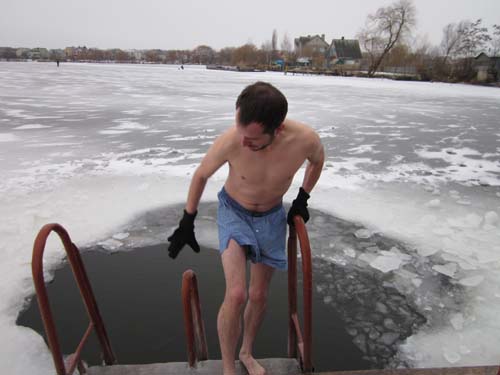
I slept at my friend’s. Before breakfast, we went to bathe in the frozen lake. (Pictures below.) It was very exciting and fun. I don’t think I’d ever walked barefoot on ice before. Getting dressed afterward was the worst part, but only for my hands. One of my pinkie fingers is still a bit numb.

Then we ate and went to train no-gi. I told them I was very impressed with them, given they’d only been training two months. I suggested they work on on being tighter in their movements and transitions, relying more on body weight and positions instead of arm strength to control their opponents.

I showed them Pedro’s drill of switching sides in side control, replacing guard from side control, sit-out from sprawl position, rolling to replace guard after a sit-out, the spinning drill where someone holds your feet, and basic armbars and triangles. The my friend showed the lock-down from half guard and some half guard sweeps and escapes, including Eddie Bravo’s twister into a calf splicer or back mount.

Then we had after-workout beers. They gave me a Rivne mug as a gift and I hurried to the train , buying this notebook from a shop along the way.,