
R.I.P. forgotten millions.
Author Archives: RomanInUkraine
Mijja — Recordable, Interactive Children’s Books
This has been taking much of my energy lately. We just a few days from launching our first two stories.
New technology. Old fashioned story telling. :)

Capitalist Art
Emotion Media Factory Laserland (EMF) has completed Europe’s biggest floating multimedia fountain system in the Ukrainian city of Vinnytsa by order of Roshen Confectionery Corporation.
Bitcoins & Mises’s Regression Theorem (in Kyiv!)
The name Skaskiw
Skaskiw (or Skaskiv) is a somewhat rare name. Amazingly, I’ve met six or so Skaskiws besides my immediate relatives.
There’s also partisan leader Yaroslav Skaskiw whom I read about on Wikipedia.
The name seems to come from the village Bozhykiv (also transliterated as Bojekiv).
The name means God-village. God was banned in the Soviet Union, so it’s name was “Pryvitne” which means welcoming, until the collapse of the Soviet Union.
I’ve been to Bozhykiv a couple times. It was a really touching visit the first time. I remembered my dad’s story about visiting in 1974 (on his honeymoon) and sneaking away from the Intourist tour to arrange a car for a visit to the village. He ran up the hill and enjoyed the panorama he hadn’t seen in thirty years, but just briefly. He hurried back to the car, lest the authorities
The neighbor’s remembered my grandparents (whom I’ve never met). They recalled how they used to be invited over when my grandparents received letters from my father in America.
As I understand it, my grandparent’s house was sold to them shortly before my grandmother died, because they had no heirs other than my dad who was in America. Their two-room house is now a woodshop. I was touched almost to tears when they offered to give me the property, should I want to live there.
I estimate that 20% of the tombstones in Bozhykiv’s cemetery had the name ‘Skaskiv.’ It’s a small village. A few hundred houses. This past year, some guy wrote a big book about the village history. I was shown a .pdf, but it’s in Ukrainian, which I read very slowly. The .pdf had 340 pages, and it’s setup so one .pdf page equals two book pages. I need to read this book some time, or have it translated.
***
See also, UPA organizer Halyna Skaskiw: http://romaninukraine.com/halyna-skaskiw-head-of-youth-department-of-ukrainian-insurgent-army-berejany-region-ternopil-oblast/
Ukraine’s New Hundai Trains
So, I recently took a trip on them, Kyiv to Lviv. Five hours instead of over-night.
I like that you’re not forced in a strange union, sitting on bunk beds with strangers in a private cabin. I love the free electricity, the comfort, the modernity — sliding class doors, nice seats that face forward, windows that you can look through without having to lean awkwardly.
These new trains are over staffed compared to European ones. Of course, it’s impossible to tell who is doing it correctly without a more competitive free market for transportation, but I suspect that like most of Ukraine’s government endeavors, the trains have way too many employees. There’s someone assigned to each car. There are two people taking a cart of snacks through the train (which I love). There’s another lady whose only job seems to be passing through and collecting garbage twice during the five hour trip.
In other rail news, they’ve been requiring identification both for purchase of tickets and for boarding which slows things down a lot and increases the level of stupidity. Sadly, most Ukrainians aren’t very good at standing in line, and government institutions will never, ever think to invest in any sort of crowd control. So boarding a train is even more of a mob scene than usual because the gate keeper has to check everybody’s id.
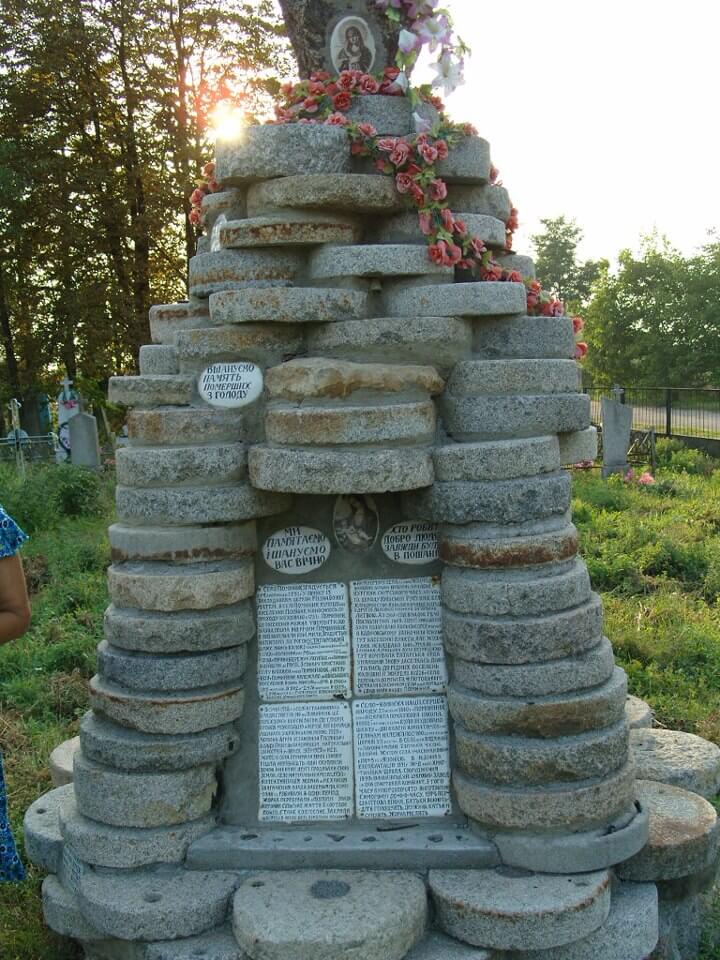
Holodomor Monument in Cherkasy Oblast
—
Цей пам’ятник зробив житель села Вікторівка, що на Черкащині. Він зібрав усі жорна з дворів, в яких всі померли під час голодомору. Влада не дозволила поставити його в селі, тому ця людина встановила його у себе в городі. До цього пам’ятника ніколи не заростала стежина і завжди лежать живі квіти. Прислала цю фотографію уродженка села Наталія Володіміровна Била
—
This monument was build by a villager from Viktorivka in Cherkasy. He collected all the millstones of households in which everybody died during the famine. The government doesn’t allow it in the village, so this man has set it in his garden. The path to this monument is never overgrown, and there are always fresh flowers. A lady from the village sent this photograph.
More signs of Spring in Ukraine
Of course, Ukraine’s folkloric White Storks returning to their enormous nests:


L’viv streets teeming with visitors, street vendors of all sorts, musicians and beautiful people:


Signs of Spring in Ukraine

The sidewalk ice softens enough to chop through.

(The town of Коломия)
Potholes blossom like wild flower.

And cafes begin putting up outdoor patios.
What I learned in Ternopil
The ice fishermen are smarter than me. :)


Prague

Friends in Prague, March 2013.
Short Fiction: Для загального добра
It’s nice to see that not all Ukrainian writers from the early part of the previous century were calling for socialism. It’s a shame that those who were, most notably Ivan Franko and Lesia Ukraiinka, now have monuments to them all over the place and appear on Ukraine’s money.
The only reason they haven’t passed into the dustbin of Ukrainian literary history is that they wanted a separate Ukrainian socialism instead of joining the greater workers’ paradise. That is the lone criteria for being a hero to Ukrainian nationalists.
Anyway, here’s a writer with a better understanding of how the world works:
http://ukrlit.org/Kotsiubynskyi_Mykhailo_Mykhailovych/Dlia_zahalnoho_dobra/
Soviet Video about the battle for Ternopil
Things people have told me about this battle:
1) Hitler declared the city some sort of official secure place — No retreat allowed.
2) The city was almost completely destroyed during the fighting.
3) The Soviets attacked the city nine separate times before finally succeeding.
4) Soviet generals had, at one point, announced all the way up their chain of command (all the way to Stalin), that the city was captured. When they realized they were mistaken, they were in an absolute panic and rather than report their failure, resorted to massive bombardment of the city and another attack.
5) After Ternopil, the retreating Nazi army didn’t have to organize a defense around Lviv. (I also heard the Soviets wanted to preserve the value of Lviv and purposely hurried.) I know there was a little fighting at the railway station in Horodok, 30km past L’viv.
The KGB-stka who lives above the restaurant
The owner tells me she denounces him every week. Writes to the city council. The denouncements don’t have the power they used. There is no firing squad or cattle train to Siberia, but they’ve entangled him in legal nonsense with the city.
Across the Siberian Wastes by Jim Rogers (late 1990s)
Jim Rogers spoke recently in Kyiv. He has also turned cautiously optimistic about Russia:
Rogers, who last year joined the Russian state-controlled investment bank VTB Capital as an advisor after being negative on Russia for 46 years, also said he is bullish on the ruble.
Nevertheless, his essay, Across the Siberian Wastes, written in the late 90s is one of the best portrayals of post Soviet society I have read.
Here are my excerpts:
As I see it, that’s the big news out here: Very little that’s important to Moscow matters in Krasnoyarsk. Back when Moscow held dominion over the largest contiguous empire the world has ever known, back when a sea of goods and money streamed in from Poland, East Germany, the Ukraine, and other parts of the empire, there was money for the space program, the world’s best chess team, intercontinental missiles, and millions of well-armed soldiers. Today all that has changed. Like Chechnya, Dagestan will split off from Russia and so will dozens of other tribal and ethnic areas across what is now Russia but which will come to be a continent-wide checkerboard of new nations.
Since I came through here nine years ago a lot has changed. Back then there were no stores, no kiosks, no shops, and long queues for the few available goods. Today there are lots of shops and wonder of wonders, lots of goods—albeit often only locally produced and of poor quality. These new merchants must be selling a lot or they wouldn’t be in business, even if all they offer are shoddy goods. Compared to my last trip there are a lot more cars, and indeed here in a city of a million people there are nearly 5,000 Mercedes.
As befits a region much like our wild west, everywhere we see security. It’s not only usual to see police in bulletproof vests and AK-47s at highway checkpoints, but guards in stores are as formidably outfitted.
Every place we’ve been across Siberia—from Vladivostok to Khabarovsk, Svobodnyy, Chita, Ulan Ude, Ulaanbaatar in Mongolia, and Irkutsh to here in Krasnoyarsk—we find Russia falling apart. In every town, city, and village there are weeds, dust, mud, rust, peeling paint, and crumbling cement. Their balconies about to fall off, many buildings that in any second- or first-world country would be declared derelict by building officials are still in use.
. . . .
Hopelessness leads to drunkenness, and both lead to deaths in their late 50s for the average Russian man.
. . . .
As in many Russian cities, in Krasnoyarsk there are cheap restaurants and expensive restaurants, the expensive ones as usual filled by “New Russians.” This is the Russian breed of vulture capitalist who feasted off the collapse of the Soviet Union, who back home we’d call nouveau riche or rich trash. Indeed, the largest house built here in over 100 years has just been completed by a local politician, a house that would be impressive even in the U.S. All the New Russians are building big private houses that could not have been built after the Revolution.
How did these New Russians become so rich? Simple—for the most part they were the managers of state-owned enterprises under communism, and as the USSR collapsed, they grabbed the factories, inventories, and stockpiles of raw materials they controlled and used these assets for their own benefit. During the first years after the collapse, hundreds of billions of dollars in commodities were sold to the West in a gigantic fire sale, the proceeds of much of which stayed in the West in Swiss bank accounts. With their authority enforced by the bodyguards and troops they hired, these former managers ran their old enterprises as they saw fit and proclaimed themselves their emperors, and who was there to contradict them?
. . . .
We have visited several of these snatched plants–indeed there are no other kind. One was an aluminum smelter, and another a vodka factory, which despite its monopoly and the extraordinary demand for its product runs only one shift. Like so many factories here, the vodka factory was poorly laid out and inefficient. Certainly the demand for its product is here: we see drunks at night, drunks in the afternoon, and drunks in the morning.
We also visited a fur-coat factory, where coats are cut and sewn. Like other enterprises, it was owned by the group who ran it for the communists. The building reminded me of the old loft buildings in New York that turned out piece goods forty, fifty, eighty years ago; today no American owner could afford to move his raw materials and half-finished goods through his factory by means of inefficient elevators and narrow stairs.
As with all goods here, the quality of these coats is poor and the price amazingly low. Back in the old Soviet Union, quality didn’t matter. It was enough to produce the product. If the boots were poorly stitched or the bucket had a hole in it, a Russian or a Pole would make it do. That mentality is still here, and that attitude will cripple Russia’s attempts to capture a share of the world’s markets for decades to come.
In fact, we see business opportunities everywhere. A Western competitor to the vodka factory or the fur-coat factory would do wonderfully well—until his business was taxed away, inflated away, or simply taken away–or he was shot dead, a fate which has befallen hundreds of domestic and foreign businessmen. Here they don’t fight over cattle and horses as in our Old West, but over franchises and business territories; all the same it’s a frontier mentality, the only law being that of the AK-47. Investing here’s like the cockroach motel; you can put your money in, all right, but how do you get yourself and your money out?
. . . .
To give another example, we sailed from Japan to Vladivostok via FESCO, the Far Eastern Shipping Company, a Russian transport company. FESCO was once owned by the communists. After the collapse its managers grabbed it and have run it reasonably well, although a Western competitor would run circles around them. In fact a Western investor has even bought into the company. However, he has now been approached by the government of eastern Siberia for a piece of the action, to be given, say, a fifth of his holdings, a fate he is resisting. However, if he is not careful the government—that is to say the governor of the far-east region—will simply take the company away by means of some ruse.
. . . .
It’s hard enough to call out from your hotel room here, and forget e-mail. Indeed, often the only way we can communicate with our folks back home is via e-mail—but it means we have to pay a physical, not a virtual, visit to the local Internet Service Provider.
It turns out that every decent-sized town in Russia today has an ISP, a battered office jammed with half-a-dozen aging computers and half-a-dozen roughly dressed youths staring into their screens. (I’ve never been able to fathomed exactly what they stare at for so long.) We descend on them, and they’re shocked and delighted to see visitors from the exotic west.
“How much to plug into your lines?” we ask, brandishing our laptops. It’s clear when they say a dollar an hour they think they’re wildly overcharging us, but we’re overjoyed to download and transmit our e-mail.
. . . .
Even in the fanciest hotels there’s rarely soap, towels, or toilet paper—and just as it was nine years ago, there are no toilet seats. In fact, we have our own toilet seat which we carry in our trunk. I don’t know what Russians do with the seats from their public toilets, but I don’t think there’s a single seat left from one end of this 7,000-mile-wide country to the other.
. . . .
Here in Krasnoyarsk the Russians complain that the Chinese have stolen everything from them. What they mean is that the Chinese have crossed the border, spied opportunities, bought low-priced goods to sell abroad, and opened businesses, to which they bring their usual long hours and business acumen. To me this is a natural trade-off, for basically the Chinese need natural resources and a market, while the Russians need people to work their abundant resources. Indeed, in many cities we find a “Chinese” market, that is, a market of mainly Chinese merchants and their goods, selling to the Russians.
. . . .
In 1990 it looked to me that the pressures from so many different ethnic groups would cause the USSR to split into dozens of parts as the post-communist era unfolded. The USSR indeed split into 15 states, and the same fate awaits Russia. I know it’s hard to imagine, but if the U. S. Federal government were to collapse, isn’t it plausible that the Latin citizens of Miami might declare themselves a state and run their region to suit themselves? Well, with varying degrees of speed that’s what’s happening all over Russia.
Further east the Buriat Mongols are a major ethnic group. While they certainly aren’t ready to secede from Russia, the local newspapers keep mentioning that the Russians took their province in the not-so-distant past, making sure no one forgets that their province wasn’t always a part of Russia. Ghengis Kahn, a Mongol, is often cited as the greatest emperor of his time, a ruler whose regime covered more peoples and countries than any other of his era.
The Chinese who are pouring into the vacuum developing in Siberia constantly remind everyone that the area north of the Amur was historically China until the 19th century. Lake Baikal was settled by the Chinese before there was a Russia. In fact, the name Baikal originated with two Chinese characters—bai and kal—which mean ‘holy lake’ in Chinese.
Vladivostok was only settled at the end of the 19th century by Russians trying to consolidate their new possessions. The name Vladivostok literally means ‘to secure the east’–clearly against the Chinese who were being thrown out and the Japanese who wanted in.
. . . .
The western stereotype of Siberian prisons seemed true. The prisoners had less hope in their faces than any people I’ve seen in all my travels. Their cheekbones were sunken, their faces apathetic and lifeless, and their eyes hollow.
. . . .
All the tractors we passed were aging models, held together by baling wire, left over from the communist years, which of course yield little productivity. Factories are often so neglected that we cannot tell whether they are even producing goods.
. . . .
The mayor [of Moscow] is spending an estimated US$1.0 billion rebuilding the Cathedral of Christ the Savior although the books are secret. He spent US$12 million on icons, but no one has ever seen the icons.
. . . .
This, of course, assumes there will be a Russia. As we’ve come west we’ve found more and more signs of eventual disintegration. All the Moslems still in Russia want out. Mosques are being built everywhere. The Bashkirs around Ufa want their own government. The leader of Tatarstan is determined to take his region out of Russia, which would certainly be ironic. Why? In the sixteenth century, after centuries of warfare, the Russians finally defeated the Tartars. Over the next three centuries this victory led to the Russian conquest of the south and east as far as the Pacific Ocean. So it would be fitting and ironic if the empire’s disintegration was speeded up by a reversal from the Tartars, the Russians’ antagonists of several hundred years ago.
. . . .
Putin and the old KGB have quietly taken over from Yeltsin to try to stop all the public theft and prevent the country from spiraling further out of control. They are doing this undercover, to make the coup appear as if it’s Russian post-communism democracy as usual, because they still want Western money. I suspect their plan is then to get rid of Yeltsin in some way, both to avoid elections and to put themselves in power “legitimately.” As an indication, Putin just appointed a minister to deal with the media. That minister’s first statement was, “The press is a greater threat to the state than the state is to the press,” and he immediately started putting on the clamps. I do not expect any of this to succeed—rather the manipulation of the media will contribute to the downward spiral and to yet another collapse.
We’ve encountered two dishonest policemen so far, and we’re told we’re lucky to have encountered only two. Perhaps unwisely, we decided to report them to officialdom partly to see how seriously our charges would be taken, hoping to learn something. We found no official who would even accept our report about GAI 21-0269 and DPS MK 3438, the badge numbers of the two crooked cops. Every official instructed us to file our report some place else. Muscovites to whom we tell this story are richly amused that we even tried.
Every business has to pay for its “roof,” that is, its protection from the rain or some other more human catastrophe—whatever. We have also found that every business has to pay the police, too. Even a place like the high-profile, five-star Hotel Baltschug Kempinski in Moscow apparently is beholden to the police because it is afraid to rile them.
Economic Advice for the Ukrainian State:
From my friend and teacher, Patrick Barron:
Here’s the bottom line: there is no benefit that a country can derive from EU membership that it cannot derive more cheaply and with no loss of sovereignty by simply adopting unilateral free trade.
(thanks, Ed)
ps- A case can be made that EU membership puts downward pressure on local corruption. That seems to have been the case in Romania and Poland, but I don’t think it’s worth the price of sovereignty and the official, legal corruption from Brussels.
Христина Соловей: ‘Горе долом’
[youtube]iOBN0vJyHT4[/youtube]
Unwarranted Pessimism & the Reason for Ukraine’s Bureaucracy
Thank you for the condolences I received on my previous post. I’m concerned, however, that this blog tends unfairly toward pessimism.
Ayn Rand wrote that the government makes us all criminals because criminals are easier to control. In the U.S., the federal tax code alone is more than 24 megabytes in length, and contains more than 3.4 million words; printed 60 lines to the page, it would fill more than 7500 letter-size pages. (The often cited figure of 80,000 pages seems to be an exaggeration.)
In any case, the vast quantity of laws, regulations and codes leaves every entrepreneur scared that he might have violated one of them. There’s no way to be sure. Hence, success should be enjoyed quietly. Entrepreneurs have good incentive to hide any triumph over bureaucracy. Failure doesn’t invite a bureaucrat’s scrutiny the way success does.
***
I’ve alluded to this before. I think I’ve come to understand thee reason for Ukraine’s psychopathic bureaucracy. Where western bureaucracies were created from nothing in pursuit of a goal — education, food safety, building safety. Perhaps the worst you could say, they were created with this public goal, while the private goal was the establishment of monopoly privilege. They had to at least appear to be working. Ukrainian bureaucracy is an *imitation* of these failed systems of the west built atop the lingering habits and moral depravity of Socialism.
There was no lustration as happened in central Europe. Ukraine inherited more Soviet bureaucrats and bureaucracies than did other post-Soviet states.
Days like today make me miss America
So for the past couple weeks, a friend of mine who works in a municipal level gov’t position has been telling me that everything’s fine, that he’ll call tomorrow and tell me when I can pick up documents I’ve been waiting for. His help has been completely selfless. I’m grateful, and want to be polite, even when he never calls. I kept waiting TWO days, giving him a chance to live up to his promise, and then calling him, and receiving the same reassurance.
When I called him yesterday, he finally said everything was ready. “Travel to the regional office and pick up your stuff.”
Public transportation in Ukraine kicks my ass. I’ve written about train stations before. Same goes for bus stations: the only way I’m able to figure out when a bus is going somewhere is to travel to the station, stand in line, and then ask the clerk.
Yesterday evening, I enlisted the help of a native Ukrainian. She made an inquiry online. She said there was a bus from L’viv to the regional office at 15:00. That didn’t sound right and I decided to take a marshutka first thing in the morning to find out when the buses travel.
I take the #10 Marshutka to the bus station. I just googled the distance and see that it’s about 10.5 kilometers. The fact that a ten kilometer trip takes 45 minutes is one of the miracles of L’viv’s public transportation system. It’s a little cartel. Marshutky are filty, slow, and even more crowded than the NYC subways I grew up riding. There are never enough.
It turned out my Ukrainian friend was wrong. One bus leaves at 8:30 in the morning. I learned this at 8:45. The next one at 13:00. I waited in a nearby restaurant for almost four hours.
I eventually took the bus to the region where my paperwork was being prepared. During the two-and-a-half hour ride at a snails pace to avoid pot holes, I telephoned a cousin and asked him to meet me. We went together to the office where everything was supposedly ready. Nothing was ready.
I couldn’t even pay the 26 uah fee (about $3). I was told the following week not to return there, but to go to the Oblast center to get my documents, and then later to the regional office to pay the three bucks.
It would have been a foolish, rookie mistake to try and figure out why I’d been asked to go there in the first place when apparently I had to first picking up the documents in the Oblast center. The fact that the question didn’t even occur to me until much later is a sign of my maturing to the reality of Ukrainian bureaucracy. It has no logic, no center. It is idiocy for the sake of idiocy. It is a cruel joke without a punchline. It just keeps stumbling along, but without ever actually getting anywhere.
I waited another two hours for the bus back to L’viv.
Here’s what really made today special:
I had intended to take Marshutka #10 back toward my apartment. I thought I saw a #10, and moved to secure my place in the crush of people. (There are never enough Marshutky.) It turned out that it was #40. I zoned out for what I expected to be a 45 minute, 10 kilometer trip, and didn’t realize my mistake until I was in a little town beyond the municipal boundary of the city. My cell phone battery died.
I was able to take a different Marshutka back to the bus station, and arrived just in time to see the last bus departing toward the city center. Of course, I didn’t realize it was the last bus until after a good twenty minutes of sitting on the cold bench.
I started walking home, and found a big crowd of people at a different Marshutka stop. I waited with them for quite a while, but felt reassured by their number. Thirty one. I counted. I took that Marshutka. One lady told me it was the last of the evening. After a half-hour ride, it may or may not have gotten me closer to my home. Not sure. I exited and walked across what seemed like half the city, climbing piles of snow and wading through ankle deep slush.
It was after midnight when I returned home.
My day has been as smart and efficient as a bag of hammers.
Why Would Putin Condemn Cyprus Bankster Theft?
The story:
Russia condemns ‘unfair’ Cyprus bank levy as bailout fears grow
On one hand, the economy of a government is their “sphere of exploitation” (to use Hoppe’s term from Austrian vs. Marxist Class Analysis). So why would Putin not welcome this action, which punishes those who dare escape his sphere of exploitation, and will likely discourage others from escaping?
Two reason:
1) Russia wants to improve itself by attraction rich, capable entrepreneurs from the west, like the Frenchman Depardieu.
2) In the twisted, counter intuitive world of post-Soviet economies, the exploiters are often trying to escape their own prison. I suspect most politicians of post-Soviet countries had money in Cyprus.

