
Category Archives: History
Notes on Kolakowski’s “My Correct Views on Everything”
I love the intellectual life in L’viv.
I recently went to a coffee shop to hear L’viv author, historian, and university professor Iaroslav Hrytsak discuss a new collection of Kolakowski. I read a translation of one of Kolakowski’s essays which was discussed at the coffee shop. Here are some notes:
My Correct Views on Everything is a correspondence by Polish philosopher Leszek Kołakowski.
Wikipedia: “He came to believe that the totalitarian cruelty of Stalinism was not an aberration, but instead a logical end product of Marxism, whose genealogy he examined in his monumental Main Currents of Marxism, his major work published in 1976-1978.”
1) Kolakowski has a wonderful sense of humor, and offers a devastating demonstration of the hypocrisy and stupidity of Marxists using empirical evidence. I enjoyed reading it, though I feel like I missed a lot without first knowing Mr. Thomspon’s essays. This essay is 1/2 of a conversation.
2) If you want a deep philosophical analysis, start with the fact that Kolakowski is an empiricist. There is an ancient debate among philosophers over where knowledge comes from. Empiricism vs Rationalism. For the lay person, this is a boring debate, but it has huge implications, especially in the field of economics.
Some background on the debate:
http://www.dummies.com/how-to/content/philosophical-battles-empiricism-versus-rationalis.html
Hoppe spends the first 30-minutes of this lecture making the case for rationalism in economics and discussing the history of the debate. If you watch this video, know that “Positivists” are Empiricists. https://www.youtube.com/watch?v=hiXcO3pcR8I
Here’s an essay about Hoppe’s essay about Rationalism: http://www.stephankinsella.com/2011/06/hoppe-on-falsificationism-empiricism-and-apriorism-and-protophysics/
The first (and most difficult) part of Mises’ most famous book, Human Action, establishes the argument that economics is a rational science, not an empirical one. Here’s a free copy of the gigantic book: http://mises.org/document/3250
Here’s the simplest way to make the argument that I can think of: Humans learn. Therefore, every human event is unique and un-repeatable. Therefore, the study of human action is unsuitable for empiricism.
Okay, back to Kolakowski.
Most of his essay offers evidence of the brutality of socialism. “X happened, therefore socialism doesn’t work.” He always stops short of making absolute statements about the nature of human action. Empiricists fall into the trap that every situation is unique and requires experiment. If Utopian socialism doesn’t work, we can try Marxist-Leninist socialism. If that fails, we combine Rousseau and Marx and try to create an agrarian based communist society (as Cambodia attempted).
I think Kolakowski’s rejection of socialism is so strong and visceral, he would reject most forms of socialism, but his empiricism prevents him from making absolute statements.
You can do a search for “empiric” to see how often Kolakowski uses the term. Here are a few examples:
“These narrow empiricists and egoists [from Eastern Europe] extrapolate a poor few decades of their petty personal experience. . . .
and find in it pretexts to cast doubts on the radiant socialist future elaborated on the best Marxist-Leninist grounds by ideologists of the New Left for the Western countries.”
I think in this one he admits he is an empiricist:
“Only in such a loose sense that the same statement would be equally true when I substitute for “Marxist” or “Christian”, “sceptical”, “empiricist”. . . . I do not deny my debt to Marxism, to Christianity, to sceptical philosophy, to empiricist thought and to a
few other traditions ”
3) Kolakowski believes in the existence of a state (as 99.9% of people do). He criticizes a lack of a sort of “national liberty” just as much as he criticizes a lack of real liberty which is individual liberty.
“in that all key sectors of our life, including the army, foreign policy, foreign trade, important industries and ideology, are under tight control of a foreign empire which exerts its power with a considerable meticulousness (e.g. preventing specific books from being published or specific information from being divulged, not to speak of more serious matters). Still, we appreciate immensely our margins of freedom when we compare our position with that of entirely liberated countries like the Ukraine or Lithuania which, as far as their right to self-government is concerned, are in a much worse situation than the old colonies of the British empire were.”
He slips into Mr. Thompson’s paradign of socialist “systems” vs non-socialist “systems”. I would instead point out that these are not crimes of capitalism, but crimes of governments which have somewhat capitalistic economies:
“all negative facts to be found in the nonsocialist world-apartheid in South Africa, torture in Brazil, hunger in Nigeria or inadequate health service in Britain-are to be imputed to the “system”, while similar facts occurring within the socialist world have to be accounted for by the “system” as well, yet not socialist, but the same capitalist system (survival of old society; impact of encirclement etc.)”
4) He remains suspicious of capitalism:
[see above quote]
“consumer captialism has a logic of its own.”
“total freedom means anarchy and anarchy results in the domination of the physically strongest, i.e. total freedom turns into its opposite; efficiency as a supreme value calls again for despotism and despotism is economically inefficient above a certain level of technology.”
“I share without restrictions your (and Marx’s, and Shakespeare’s, and many others’) analysis to the effect that it is very deplorable that people’s minds are occupied with the endless pursuit of money, that needs have a magic power of infinite growth, and that the profit motive, instead of use-value, is ruling production. Your superiority consists in that you know exactly how to get rid of all this and I do not.”
5) The criticism which is most logical, and, in my opinion, best, is here:
“the “new alternative society” have shown very convincingly that the only universal medicine these people have for social evils-state ownership of the means of production-is not only perfectly compatible with all disasters of the capitalist world, with exploitation, imperialism, pollution, misery, economic waste, national hatred and national oppression, but that it adds to them a series of disasters of its own: inefficiency, lack of economic incentives and, above all, the unrestricted role of the omnipotent bureaucracy, a concentration of power never known before in human history. . . . We want a society with a large autonomy of small communities, do we not? And we want central planning in the economy. Let us try to think now how both work together. We want technical progress and we want perfect security for people; let us look closer how both could be combined.”
also here:
“And socialism is defined within this “system-thinking” as total or nearly total state ownership of the means of production; you obviously cannot define socialism in terms of the abolition of hired labour, since you know that if empirical socialism differs in this respect from capitalism, this is only in restoring direct slave labour for prisoners, half-slave labour for workers (abolition of the freedom to change one’s place of work) and the mediaeval glebae adrcriptio for peasants.”
He also approaches it here, though stops himself:
“Still, I think that many important tenets of Marx’s doctrine are either false or meaningless or else true only in a very restricted sense. I think that the labour theory of value is a normative device without any explanatory power whatsoever; that none of the well known general formulae of the historical materialism to be found in Marx’s writings is admissible and that this doctrine is valid only in a strongly qualified sense; that his theory of class consciousness is false and that most of his predictions proved to be erroneous (this is admittedly a general description of what I feel, I am not trying to justify here my conclusions).”
6) Side note: “Fascist” as slander.
On pages 10-11, he jokes about how the accusation of “fascism” was used as propaganda against anyone who opposed socialism. I think we Western Ukrainians can relate to that.
7) I’m really curious how Marx influenced Kolakowski, and which aspects of Marx Kolakowski accepts. He writes:
“If I admit nevertheless to keep thinking, in historical (yet not in philosophical) matters, in terms inherited in part from the Marxian legacy, do I accept an allegiance to the Marxist tradition? Only in such a loose sense that the same statement would be equally true when I substitute for “Marxist” or “Christian”, “sceptical”, “empiricist”. Without belonging to any political party or sect, to any Church, to any philosophical school, I do not deny my debt to Marxism, to Christianity, to sceptical philosophy, to empiricist thought and to a few other traditions ”
“I readily admit that without Marx our thinking about history would be different and in many respects worse than it is”
I hope he is speaking of Marx’s idea that history properly told is the history of class struggle. The first Hoppe essay I ever read was “Marxist and Austrian Class Analysis”. Hoppe details the surprising overlap between Marxism and the Austrian School. Basically, he arguing that Marxists interpret history correctly, but mis-identify the exploiters. The exploiters are not the businessmen, but those you use violence to seize wealth (criminals and politicians).
Audio: http://www.youtube.com/watch?v=1DIFVvrczXs
Text: http://mises.org/community/blogs/ayrnieu/archive/2008/07/17/marxist-and-austrian-class-analysis.aspx
PDF: http://mises.org/journals/jls/9_2/9_2_5.pdf
***
Polish vs Ukrainian villages in Galicia
I enjoyed fascinating discussions yesterday in many regards. I enjoyed them in L’viv style too — sitting in a coffee shop, then in another, then in another.
Here’s one detail:
In Galicia, originally Ukrainian villages are visibly different from originally Polish ones. The Ukrainian ones arose earlier. Many were build during a time of Tartar and Turkish raiders. Consequently, they are often hidden in valleys and ravines. They are also rounder with many little streets — for security, community, or both. Polish villages mostly came into existence during the time of a strong Polish state. They were built along single roads or intersections in places with good land for farming.
For my An-Cap friends, these reflect eras of mobile bandits versus stationary ones (whose longer time preference causes them to be more slightly more humane).
Arguing with Soviet Patriots — USA vs USSR
I occasionally encounter a Soviet patriots who defends the USSR by comparing their crimes favorably to the United States, and grossly exaggerating Soviet military and economic power.
I am thrilled to have found this video which is so perfect a reply to their arguments that I feel relieved of the responsibility of making one myself.
[youtube]b3OZeiBdXx8[/youtube]
Note: I originally wrote Soviet “Nationalists” but I’m beginning to reserve that term to relate to ethnicity as opposed to political union.
Vanquished Aristocracy
Thanks to my great friend Curt Doolittle for helping me understand Ukraine a little better. I am delighted by his visit and hope he stays.
***
The story of Ukraine is the story of vanquished aristocracy, annihilated first by the Mongols and second by the Bolsheviks.
Much of what remains waits for their ancient kings to return. A cult awaiting leaders. Predictably, only false profits, lairs, manipulators and the most brutal thugs aspire to the helm. History will not be rewritten. The dead will not return.
Ukrainian aristocracy survives only in the blood of Ukrainians. The aristocratic class needs to be reconstituted. The best genes, those of the ancient kings, perhaps, can only rise amid liberty, in a system of voluntary exchange and property rights where the masses don’t assault the friuts of success with a million rusty knives, each entitled idiot tearing off a piece for himself. Furthermore, t can only arise amid institution like family and fatherhood. Voluntary segregation forces the irresponsible to face the consequences of their irresponsibility.
***
Curt:
A country where the men stand around, watch what’s going on, direct the women as if they are somehow adding value to the obvious, and the women humor the men, mollify them sufficiently as if they’re afraid of being beaten, and then do all the work as if the men weren’t there anyway.
. . . .
Men are what mothers breed, and make them. While they have innate tendencies that are very different from those of women, most of what we call civilization is creating rules and incentives that direct men’s energies to the pursuit of status and behavior that is beneficial for all.
So who is to blame for the behavior of men here?
They have not abandoned their wealth of violence. That’s obvious. Neither domestically, politically, economically or socially. And for that I admire them. HOwever, without chivalry, they have no means of directing their energies to service of others.
And without mothers who understand chivalry, they have no one to teach them.
***
The remembering of past glory seems to be the predominant theme in much Ukrainian poetry. See Shevchenko’s Розрита могила .
Also, in paintings of the iconic Kozak Mamay:
.jpg)
The Kozaks were many things, including the warrior culture of the steppe that proceeded the annihilation of Kyiv-Rus at the hands of the Mongols in the 13th century.
I imagine him singing about how there was once a great kingdom here. Tragically, much ancient Ukrainian literature, including unique original texts were destroyed by the Soviet Union.
Ukraine Writing 24,000 yrs old Kamyana Mohyla
[youtube]Tju4coNCP_U[/youtube]
Memos show US hushed up Soviet crime
The American POWs sent secret coded messages to Washington with news of a Soviet atrocity: In 1943 they saw rows of corpses in an advanced state of decay in the Katyn forest, on the western edge of Russia, proof that the killers could not have been the Nazis who had only recently occupied the area.
The testimony about the infamous massacre of Polish officers might have lessened the tragic fate that befell Poland under the Soviets, some scholars believe. Instead, it mysteriously vanished into the heart of American power. The long-held suspicion is that President Franklin Delano Roosevelt didn’t want to anger Josef Stalin, an ally whom the Americans were counting on to defeat Germany and Japan during World War II.
Documents released Monday and seen in advance by The Associated Press lend weight to the belief that suppression within the highest levels of the U.S. government helped cover up Soviet guilt in the killing of some 22,000 Polish officers and other prisoners in the Katyn forest and other locations in 1940.
The evidence is among about 1,000 pages of newly declassified documents that the United States National Archives released and is putting online. Ohio Rep. Marcy Kaptur, who helped lead a recent push for the release of the documents, called the effort’s success Monday a “momentous occasion” in an attempt to “make history whole.” (Read more)
Meet the Ukrainian Michelangelo
 “Pinzel was a mysterious baroque sculpture of XVIII century, often compared to the great Gian Lorenzo Bernini and even to Michelangelo di Lodovico Buonarroti. Although some meticulous art connoisseurs tend to treat the latter as an exaggeration, there’s nevertheless no doubt that Pinzel had a unique technique and original view on baroque plastic arts, especially visible in his wooden artworks.
Unfortunately the information on Pinzel’s life and art is very scarce and extremely limited. And you will not be able to find much of it in the museum.
Researchers divide between attributing Pinzel Bavarian, Bohemian, Silesian, Italian or Ukrainian origins. Some even believe he could have escaped from Europe to run away from his past and start a new life in Western Ukraine incognito. And he successfully did. Under the patronage and financial support of Kanev headman Mykola Pototskiy, Pinzel and his long-term partner, architect Bernard Meretyn, have created and decorated lots of sacral houses in Western Ukraine.
There are very few of the Pinsel’s masterpieces that were found and identified so far, and many of them are collected in Lviv Sacral Baroque Sculpture Museum.” Read more: http://www.tripadvisor.com/ShowUserReviews-g295377-d1466009-r128570105-Johann_Georg_Pinzel_museum_of_Lviv_Sacral_Baroque_Sculpture-Lviv_Lviv_Oblast.html
Scythians and Sarmatians of ancient Ukraine (7 BC – 4 AD)
[youtube]jkeWai9hzog[/youtube]
From the Youtube Video:
“Scythians and Sarmatians were Iranic speaking tribes from ancient Ukraine (7 BC – 4 AD). They inhabited mainly southern Ukraine (Ukrainian steppe, Crimean peninsula, basins of Dniester and Dnieper valleys). Initially nomadic tribes, in later period some settled. The direct offsprings of them are Jassic (Jasz, Jaszsag) people of north Hungary (from Jazygia), ancient Croats of west Ukraine (of upper and middle Dniester) have also absorbed some Sarmatian groups. Ossetians (Republic of Ossetia-Alania in the north Caucasus) are descendents of western Sarmatian tribes and still speak Iranic language there. Jasses (Jazygs) got assimilated by Hungarians and lost their Iranic tongue. The usage of “h” instead of “g” in Ukrainian is also Scytho-Sarmatian remnant. The city of Jassy in Romania comes from Jasses (Jazygs), a big Sarmatian tribe. Even name Scotland comes from Scyths, as legend says Scots migrated from Scythia, that is Ukraine.”
Ronald Regan Square in Krakow

Reagan tells Soviet jokes
[youtube]mN3z3eSVG7A[/youtube]
Happy May 1st – Victims of Communism Day.
R.I.P. forgotten millions….

The thing is, in a free society, people can voluntarily create communes. They can pool their resources and elect a chairman to direct the use of those resources. I wish all these red-banner waving idiots would try that.
The madness lies in that communists don’t want to pool their resources voluntarily. They want to pool everybody’s resources BY FORCE.
It doesn’t work the other way. You can create voluntary communist organizations within a free society, but you can’t create free organizations within a communist society.
A eulogy for John Demjanjuk
The newspaper headline reads, “Nazi dies, avoiding jail time.” By any measure, John Demjanjuk was not a Nazi.
By his worst accusers he was a prisoner of war forced to work in a Nazi concentration camp. The article concludes: “Demjanjuk was the first man in Germany to be convicted for serving as a guard at a death camp – but without evidence of being involved in any specific murders.” How consistent! Over 36 years there was never any evidence.
Following his May 11 German conviction and sentence, the German government placed him in a nursing home. The court lifted the warrant of arrest stating that further incarceration would be unlawful pending the appeal and that John would not be a flight risk because of age, illness and the lack of a passport. They were simply waiting for him to die. In any event, under German law, a defendant is not considered convicted until all avenues of appeal have been exhausted. Demjanjuk died before his appeal was heard.
Yet another example of the facts not supporting the headlines!
But then this was the nature of Demjanjuk’s 36-year ordeal. The facts never did fit the accusations either. Demjanjuk was an enigma for his accusers. The accusations simply did not stick despite fraud, perjury, cover-up and incessant pressure.
Over the summer, my son who was entering high school was assigned to read “Night” by Eliezer Wiesel, an overwhelmingly moving memoir of Wiesel, a Jewish inmate at the notorious Auschwitz concentration camp. Wiesel was brought to Auschwitz from Romania. He wrote of unspeakable horrors including one where a Jewish acquaintance who was deemed fit for work, was forced to work in the crematorium and pushed his own father into the oven.
Wiesel suffered at German concentration camps from May 1944 until January 1945 at Auschwitz and then at another camp until early April 1945 when the Americans liberated him, a total of some 11 months.
I knew about the notorious Auschwitz camp from my father who was a Ukrainian prisoner there from December 1941 until January 1945. My father suffered at German concentration camps for more than three years.
Demjanjuk was a Red Army soldier, essentially Stalin’s fodder at the battlefront, considered by his commander-in-chief less important than munitions. He was captured and endured life as a German prisoner of war.
The end of the war brought little respite since being from the USSR, John had to evade repatriation to the USSR, a nefarious scheme of the Yalta conference where the Allies became complicit in Stalin’s crimes.
Finally, he managed to emigrate to America and lived there generally peacefully until that peace was disturbed in 1976. What followed was 36 years of persecution by new tormentors, including Jews and Americans, and old ones, Russians and Germans.
I knew Demjanjuk and his family. I met him several times. He always impressed me as being warm, good-natured and of remarkable hopefulness. I met him last in the Munich prison in November 2009 on the eve of his trial.
Frankly, neither he, nor his son, nor his German attorney nor I fully understood the charges against him. I suspect that the entire legal world marveled when the verdict came down against him. Similar charges had not been leveled against any human being.
In fact, ethnic German had been amnestied from similar prosecution by the German government in the 1960s. Here was a case that flew in the face of basic tenets of jurisprudence – selective prosecution, unequal treatment before the law, etc.
I am not suggesting that John Demjanjuk was a saint, after all he was a human being and, I am sure had faults.
I do consider him a martyr. He was a victim of German cruelty, Russian perjury, American irresponsibility at the very least and possibly criminality, and the immorality of the Jewish-Holocaust industry. Certainly he has gone to a better place where the judge is not beholden to anyone, where therefore justice is even-handed, and Demjanjuk should be rewarded for his egregious suffering.
I am proud to have known him.
Read more: http://www.kyivpost.com/news/opinion/op_ed/detail/124728/#ixzz1tc8Ue9n2
Cossack Film Series, Spring 2012
Save Ludwig v. Mises’ Heritage in Lviv/Lwow/Lemberg
Seems some L’viv bureaucrats are looking for bribes by threatening to tear down the recently erected plaque.
Ukrainian language article: http://galinfo.com.ua/news/97796.html
Facebook group to save the plaque: https://www.facebook.com/pages/Save-Ludwig-v-Mises-Heritage-in-LvivLwowLemberg/141546405945727
Finding the Birthplace of Ludwig von Mises
by Mykola Bunyk and Roman Skaskiw
The problem of determining the house in which the famous economist and liberal thinker was born acquired urgency several months ago with an initiative by Ukraine’s small Austrolibertarian community to unveil a memorial plaque this September for the 130th anniversary of Ludwig von Mises’s birth.
The initial relevant information about the Mises family concerned Ludwig’s great-grandfather Ludwig Mayer Rachmiel Mises. According to the website of the Center for Urban History of East Central Europe in Lviv, Ludwig’s great grandfather Mayer Rachmiel owned buildings on Market Square 18 and Old Jewish Street 7 (Rynok Square 18 and Starojevreis’ka 7), two prominent addresses in the center of Lviv connected by a courtyard.
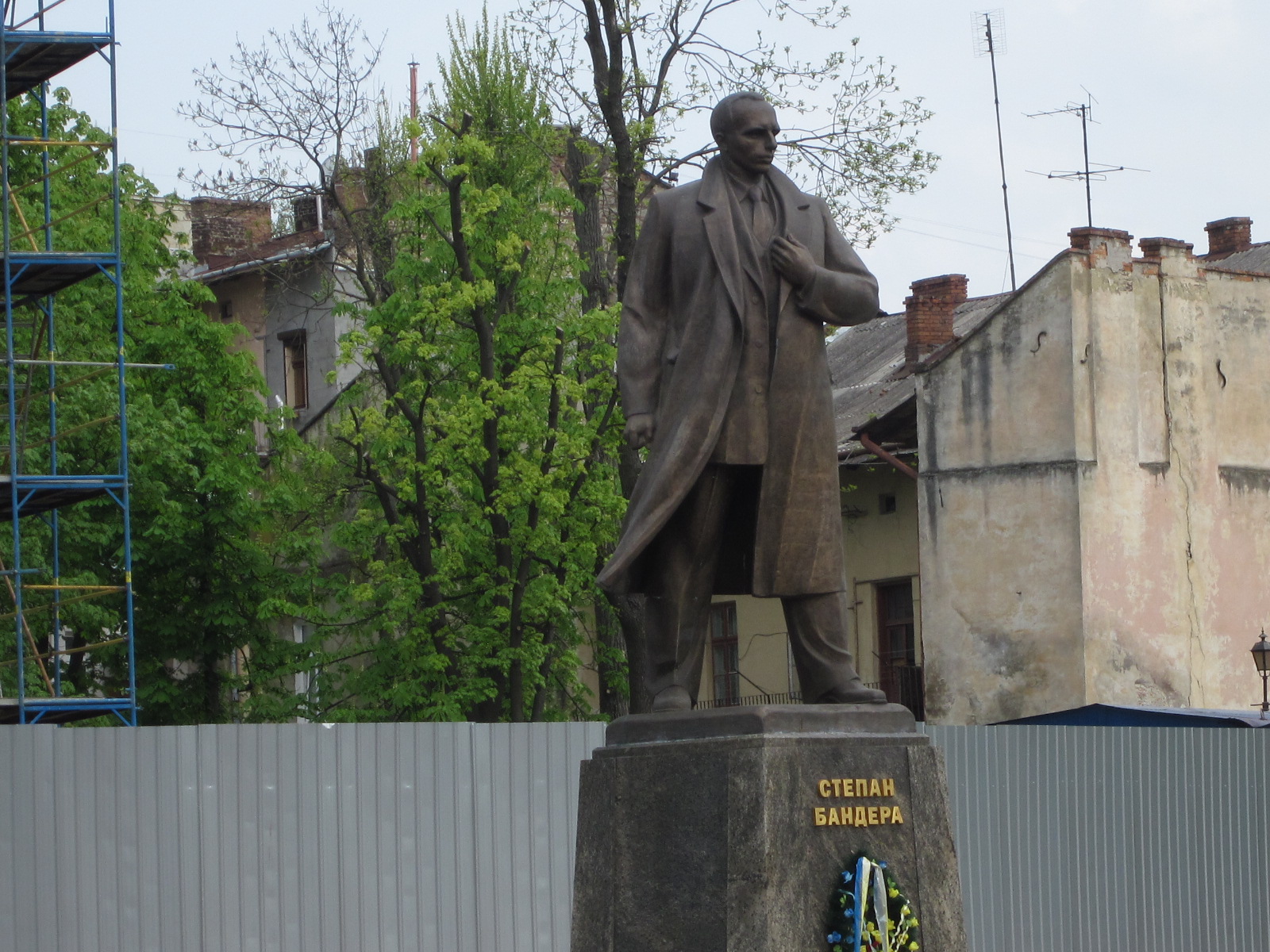
Statue of Bandera
In L’viv, a statue of Stephan Bandera is guarded 24/7. In other parts of Ukraine statues of Lenin are guarded 24/7. The state should not be the arbiter of history.

Two Little Stories from Easter
1) Lost Bells
She knew it was St. Mykola’s Church whose bell-ringing reached us faintly in the wind because it was just a bell. The Church of Blahovishchennia (how would I translate that?) and Saint Sofia’s both had several bells.
The three bells of St. Mykola’s were buried during the war when the Germans began taking church bells for the metal. No one remembers where they are buried.
2) The Fishy Discount
During Easter, I was told by my 2n’d cousin’s husband Vitalik and his friend that they took the marshutka to L’viv to buy fish.
The price was 23 hryvnias per kilogram. The weight of the fish selected was 950 grams.
The lady told them the price was 22.50, but she’d discount it to 22.00.
During the marshutka ride on the way back, they did the arithmetic.
I asked whether they couldn’t get fish in Horodok, wondering if this wasn’t another business opportunity. They said yes, but in L’viv it was cheaper and better. His mother-in-law, by contract, told me they just wanted an excuse to travel to L’viv.
Property Rights and Ukrainian Identity
I gave this lecture on April 19th, 2011.

Property Rights and Ukrainian Identity:
http://romaninukraine.com/Stuff/RomanSkaskiw_PropertyRightsNUkrainianIdentity.mp3
– In the lecture I make the case against coercive means to support the Ukrainian culture and language. I made two points afterwards which strengthened and elaborated on my case. Firstly, that coercive institution can easily be turned against Ukrainian culture and language. This is already happened through the policies of Ukraine’s Russophile education minister. Secondly, that people interested in supporting the Ukrainian culture and language should do as I do, and voluntarily donate money to cultural organizations. Even more importantly, people should vote with their wallets, and buy embroideries, museum and theater tickets, they should patronize nightclubs which play the type of music they like, and so on — your patronage supports exactly the aspects of Ukrainian culture which you find important.
– I also made a reference to two forces likely supporting the hryvnias peg to the U.S. dollar, but I only mentioned one, the IMF. The second is the power and influence of the country’s biggest oligarchs, who are all exporters. Exporters benefit in the short run from a weakening currency, as I discuss in this essay.
– I misspoke. On the wall hung Taras Shevchenko’s portrait, not photo.
Q & A:
http://romaninukraine.com/Stuff/RomanSkaskiw_PropertyRightsNUkrainianIdentity-QnA.mp3
– If my goal was to convince conference attendees that a more libertarian respect for property rights ensures a better future for all, then perhaps I committed a tactical mistake. I should have stuck to the more conventional position of advocating more regional autonomy and local self-governance, but I was asked what system I support. I mentioned privatizing security and with that, we all jumped head first into the deep end of the anarcho-capitalist swimming pool. I did the best I could, working from memory.
– I misspoke at one point, saying Iowa instead of Hawaii. The political scientist who calculated that over 100 million people (172 million, actually) were killed by their own governments during peace time, was the University of Hawaii’s Rudolph Rummel. There is also the KGB admission during Glasnost that 43 million Soviet citizens were killed, another estimate that 60 million Soviet citizens were killed, and Little Black Book of Communism which calculates that over 100 million people were killed by Socialist governments.
The Ghostly Bandurist of Desyatynna Street
During my recent visit to Kyiv, I veered off the touristy Andriivs’kyi Descent, and walked down Desyatynna Street, hoping to find the Bandurist I had once seen playing there. Desyatynna is a very unspectacular street. The sounds of the merchants at their tourist shops on Andriivs’kyi fades as you walk. It is residential. From an apartment of one building hung a sign protesting the construction of additional units on the roof. The street gets more interesting when it dead-ends into the parking lot of the imposing, Soviet-style Ministry of Foreign Affairs, not far from St. Michael’s Golden-Domed Monastery, but I only walked to where I had once seen the ancient Kobzar. As on my previous four or five attempts, there was no sign of him.
I’d seen him only once, and now wonder if he wasn’t a ghost. There are many more ghosts wandering over Ukraine’s black earth than over the U.S. I don’t know how to describe it to my American friends. Perhaps it can be understood by Southerners and Indians, by the losers of wars. Those ghosts, half in the wind, half in your blood, press you with that lonely urgency. You sense some critical knowledge which nobody’s telling you, as if you missed a day of school and are now condemned to stumble on in confusion.
It is a rare thing when one of them speaks to you.
I saw him in November. Small, sharp drops of cold rain had just begun falling through the wind. I actually walked past him, coming within several steps without noticing him. Then I heard a tinkling in the wind, bells you might associate with angels or the souls of babies. I turned and saw the ancient man.
His sun-baked cheeks were sunken, and eyes half shut. He looked so emaciated, my first thought concerned whether or not I should seek medical attention for him. The grey ends of his mustache curled off his face, and blew in the wind beneath his chin as I wondered what to do. His fingers were gnarled like roots, with thick, brown finger nails. They seemed to barely move over the strings of his bandura, perhaps having learning efficiency over several lifetimes of practice. I saw all this before I heard him, as he played very quietly.
The street was empty except for us. I would have liked a second opinion, a verification of sorts. Some magic in the sounds he produced held me frozen in place.
The wood of his instrument was blackened where his fingers gripped it, and the strings too were black with grime except for where he plucked them. There, the strings shone as brightly as the domes of St. Michael’s Monastery. He wore a great wool hat, and an over-sized coat. I felt so absorbed by this strange apparition that it was his ragged velcro sneakers which seemed anachronistic, rather than the man himself. A melodic groan blew from his skinny neck, and I stepped still closer.
Between breaths he opened his eyes slightly and seemed to take me in without giving anything back, never interrupting his ancient song. I leaned even closer, tilting my good ear toward him. It seemed he sung of a young girl whose lover will not return from war, children begging for bread, and a solemn line of horsemen and the grasses of the endless steppe opening then closing behind them like water. The sounds unwinding from his strings contained the rocking of slave ships on the Black Sea, devastated cities, and a mother whose children are condemned to work foreign lands. There were Scythian Mounds, torn open graves, betrayal and forgotten glory. There were people hiding in their gardens with the wagon cars outside, and the ashes of a library.
If I could only have listened longer, taken a seat at his torn, velcro sneakers and listened, I might have learned that missing bit of knowledge for which I’ve been so hungry, that elusive clarity. The movements of his long-practiced fingers to retell the stories and glories consumed by fire, reignite the lights vanished by darkness. It was all there, but I woke up. I startled awake, as if from a dream.
The ghost had vanished in the wind. I stood over the withered Kobzar. He played on, but my usual reality crept back into my thoughts, crowding him away. Some important obligation — I don’t remember what — compelled me to move on. I made a mental note to return to that spot, thinking, idiotically, that I could capture all the loneliness and history with my digital camera and post it on this blog.
Regardless of how futile it would be, I’ve returned five or six time now with no luck. If I do come across the ghost again, I hope I’ll find the courage to sit at his feet and listen.

