Category Archives: Mostly Tourism

Relatives Skyping w/ Mom

Relatives visited me a few Sundays ago. Here’s a picture of some of us Skyping with my mother in NYC.

I’m proud myself for hosting so many people, though I think I may have committed a faux pas by serving a meat other than fish (kobasa and salami) on a Sunday during lent.

One of the most culturally interesting moments came when I was gathering dishes. Two of my nieces ages 10 and 12 not only insisted on clearing the table themselves, but washed them all despite my telling them not to. Later, after some coffee and desert, my third niece, perhaps feeling jealous of the thanks I offered her sister and cousin, did it herself, then asked me where I kept the broom.

“I’ve lived here five months and I haven’t seen a broom,” I told her. She found one anyway and swept the kitchen.

Holy moly!

River Cruises along the Dnieper River

Here’s the flier for a trip I’m interested in taking. Perhaps in June:

Favorite Sights Along the Dnieper River

The Dnieper River offers an abundance of wonderful sights, many of which have enamored
tourists for hundreds of years. The area along the river is rich in history that can spark your
imagination with images of times long passed. The combination of its historical significance
and its natural beauty make the Dnieper River one of the most exciting trips that you can take in
Europe. When you visit, make sure that you set aside time to see some of the favorite spots along
the river.

Sights of Kiev From the Dnieper River

Kiev’s origins stretch all the way back to 482 CE, making it one of the oldest cities in Europe.
Over hundreds of years, the city has grown into a thriving metropolis with more than 2,000,000
residents.

While floating down the Dnieper River, you can enjoy some special views of Kiev’s historic
landmarks. The illuminated bridges connecting the river’s coasts are a relaxing sight that evokes
the tranquility of Ukraine’s peaceful times (the Nicholas Chain Bridge is particularly delightful).
Kiev, however, has been maintained through struggle against numerous opposition forces. The
Mother Motherland Statue honors those lost in the German-Soviet War. Its statue’s figure stands
above the city with a shield and sword lifted to the sky. Even those without Ukrainian roots may
feel inspired by this statue.

View the Countryside from the Dnieper River

Travelers floating down the Dnieper River will pass several important cities, including Kaniv,
Nikopol, and Kherson. All of these cities offer their own unique views. Some of the most
wonderful sights, however, come from the countryside that stretches between these cities.

The Ukraine has a reputation for its stark, industrial cities. The rural areas, however, are the
exact opposite. Spring is a wonderful time to visit. On your trip down the river, you can view
fields of wildflowers and trees in bloom. During summer, you will feel honored by the river’s
lush greenery that shields the water from outside forces. The fall, of course, offers its own
beauties as the tree’s leaves start to turn.

It is difficult for many cruise ships to navigate the Dnieper River during winter. The frozen
ice makes certain areas troublesome. As the ice begins to thaw in spring, though, travelers are
treated to a miraculous site.

Consider reading several reviews of Viking River Cruises to help you determine what season you would like to explore the Dnieper River. Having more information about specific cruise options will help you choose the one that fits your particular interests.

Traveling on the Dnieper River

Regardless of whether you are interested in spotting remarkable pieces of art, magnificent
buildings, or stunning views of nature, the Dnieper River can give you a vacation that will
encourage you to return time and time again. To truly experience the area, you might consider
booking a cruise that allows you to visit notable cities along the journey. That way, you can stop
to visit the historic sites and museums in person. Seeing them from afar and up close is the best
way to truly appreciate the beauty of this region.

Kharkiv

I recently had the opportunity to visit the eastern city of Kharkiv, once the capital of Soviet Ukraine. My friend, an American historian studying there, provided a wonderful tour.

I found the city’s Soviet legacy a little creepy — there are monuments of Lenin and a neighborhood named after Felix Dzerzhinsky.

I liked the exotic feel of the city. There are certainly many foreigners there — mostly students at their many universities — but they are Arabs, Asians and Africans. There are few westerners, which was strangely exciting.

The presence of the oligarchs / mafia felt greater in Kharkiv — it was the first thing several of the people I met talked about. Also, we passed a store which had been burned few months ago. I also encountered stories like: “My mother sold her home in the 90s for $1500. The guy never paid her, but my mother didn’t do anything because he’s connected.” There’s also the specific bad reputation of some prominent local politicians, $600 Metro benches and more.

On the other hand, some people tell me L’viv is more corrupt. I’m not going to do a careful analysis, nor will I dissect the meaning of the word “corrupt” right now.

Pictures of Kharkiv. Look through them to read the many captions.

The owner of an apartment gave me permission to photograph it. He said it’s typical late 80’s Soviet upper “class” decor. Class bears quotation marks, because the Soviet Union was officially a classless society. This is the type of apartment enjoyed by higher level government workers — military officers, KGB, etc.

Soviet Kitsch:

I’m planning to make a separate post about the Parkhomivka Art Museum which we managed to visit during this trip. It’s probably the unlikeliest art museum in the world.

A brief stop in Kyiv

Face Control Sign A warning to travelers. If you phone Kyiv’s Arena Dance Club and ask them the cover price, then show up to enter, you’ll discover that you’ve been lied you, by those dirty lying liars. In Ukraine, you have to tolerate a lot of abuse (and staggering indifference) from businesses. Not that big a deal, but I’m getting tired of it. My contribution toward better business practices in Ukraine is publicizing the injustice here.

The place turned out to be rather dead, even though it was Saturday night, though the music was pretty good, and the fact of it being empty made it easier to get drinks — always a challenge in Ukraine.

***

The river-walk in the Obolon neighborhood was beautiful.

***

Spontaneous Cooperation in Transportation

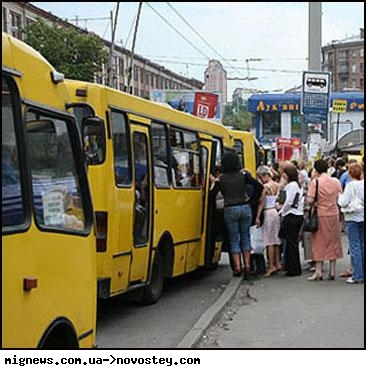
Marshutka i.e. bus In the two small examples I am about to present, I see yet another rebuttal to the Hobbesian notion that without a supreme authority, the natural state of man is a war of all against all.

By U.S. standards, one might say there is a shortage of traffic lights in Ukrainian cities. Instead, there are designated cross-walks. The dynamics of them are interesting. The exact behaviors they cause aren’t perfect, but are much closer to ideal than the brute legal force of traffic lights.

A lone pedestrian, unless he or she is in a big hurry, will usually wait until several others accumulate to form a critical mass before they cross. But the pedestrians won’t go if there are just a few more cars. In that case, they’ll wait until there is room. These spontaneous behaviors all seems to be astonishingly mature.

They are also consistent with the experiences of a British town which saw a several-fold improvement in commute times after they shut off all their traffic lights. That’s right. They shut off all their traffic lights. There was no decrease in safety either.

[youtube]vi0meiActlU[/youtube]

***

The second example of spontaneous cooperate is a compliment to Ukrainians and a counter-example to this country’s ubiquitous corruption.

The marshutky (semi-private busses) in the city of L’viv are the most crowded public transportation I’ve ever encountered — as a child of the NYC subways, I do not make this claim idly. Imagine the impossibly crowded buses. How does everyone have room to pay the driver?

They don’t.

People pass money back and forth. You’ll be standing awkwardly, barely reaching the overhead railing for balance, and someone will pass you a 10 hryvnia note. “For two,” he’ll say. (The price is usually 1.5 to 2.5 hryvnias, i.e. 12 to 20 cents, depending on the route.)

Money gets passed forward, and change is passed back. Astonishing. Sometimes I spend the better part of my trip passing money back and forth, but this isn’t even the most impressive part.

There are no automatic machines like in NYC busses. The driver is responsible for all the financial transactions, making change, etc. How does he do it?

He doesn’t.

Once, it was I who found myself closest to the driver — I tried to avoid the spot, but couldn’t overcome the movements of the crowd. I was handed a 5 hryvnia note. “For one,” said the lady with the gigantic fur hat.

There was no one else between me and the panel beside the driver — no one to whom I could pass the money and responsibility. I looked above the windshield. A note read “1.75 hryvnias.”

I dropped the five onto a panel beside the driver which had money and change all over it. I gathered 3.25 hryvnias and put it back in the lady’s waiting hand. More money came my way, and still more. I dusted off my arithmetic and spend most of the trip making change. Money flew all over the place. A couple times, the driver reached over and organized some of the bills. I was too busy providing quick, accurate change.

***

I am reminded of anarchist Peter Kropotkin’s late-in-life observation about cooperation: “I failed to find,” he wrote, “although I was eagerly looking for it — that bitter struggle for the means of existence, among animals belonging to the same species, which was considered by most Darwinists (though not always by Darwin himself) as the dominant characteristic of struggle for life and the main factor of evolution.” What he saw instead was “Mutual Aid and Mutual Support carried on to an extent which made me suspect in it a feature of the greatest importance for the maintenance of life, the preservation of each species, and its further evolution.”

He concluded that

life in societies enables the feeblest animals, the feeblest birds, and the feeblest mammals to resist, or to protect themselves from the most terrible birds and beasts of prey; it permits longevity; it enables the species to rear its progeny with the least waste of energy and to maintain its numbers albeit a very slow birth-rate; it enables the gregarious animals to migrate in search of new abodes. Therefore, while fully admitting that force, swiftness, protective colors, cunningness, and endurance to hunger and cold, which are mentioned by Darwin and Wallace, are so many qualities making the individual or the species the fittest under certain circumstances, we maintain that under any circumstances sociability is the greatest advantage in the struggle for life. Those species which willingly abandon it are doomed to decay; while those animals which know best how to combine have the greatest chance of survival and of further evolution, although they may be inferior to others in each of the faculties enumerated by Darwin and Wallace, except the intellectual faculty.

Skiing in Bukovel

What interested me most about my recent visit to Bukovel, Ukraine’s only major ski resort, was the rapid, uneven development of the resort and the region. Bukovel is located 240 km from L’viv, where I lived during my 2010-2011 Fulbright Scholarship.

Before dawn on Saturday, we went to the statue of Mykhailo Hrushevski where a private bus picked up all the skiers. Many L’viv residents make day trips, leaving at 4am and returning at 10 in the evening.

At about 8:30, we passed our hotel near Bukovel and asked the bus driver to drop us off. Four and a half hours is a long time to travel 240 km, and a testament to the state of Ukaine’s roads. For much of the trip, the bus weaved from the adjacent shoulder, across the lane of oncoming traffic and into the opposite shoulder to avoid potholes. The gross corruption and incompetence of the Ukrainian government is universally blamed for the pathetic condition of the roads (among many other things). Ukrainians are all holding their breaths for Euro Cup 2012, some with fear of national humiliation, others with childlike anticipation of calamity.

(Read more at GoNomad.com)

The Snoring from my Hallway

The word bum, in English, is an Americanism and a shortening from the word bummer. Strangely, the Ukrainian word is бомж or bomj, which sounds the same (plus an additional letter), means the same thing (though I don’t think it’s derogatory), but happens to be an acronym.

БОМЖ = Без Определённого Места Жительства = Without a Permanent Place of Residence

L’viv is a city of about 750,000 and I see fewer homeless people than in my native Iowa City. One can speculate as to why: perhaps family ties are stronger here. Nevertheless, I’ve been hearing one lately.

My kvartyra (apartment) is on the highest floor. The stairs go up farther though and there’s a small landing with a perpetually locked metal door. When the weather is cold, a bomj sleeps there and snores so loudly that I can hear him inside in apartment. This is the case right now. :)

The Ghostly Bandurist of Desyatynna Street

During my recent visit to Kyiv, I veered off the touristy Andriivs’kyi Descent, and walked down Desyatynna Street, hoping to find the Bandurist I had once seen playing there. Desyatynna is a very unspectacular street. The sounds of the merchants at their tourist shops on Andriivs’kyi fades as you walk. It is residential. From an apartment of one building hung a sign protesting the construction of additional units on the roof. The street gets more interesting when it dead-ends into the parking lot of the imposing, Soviet-style Ministry of Foreign Affairs, not far from St. Michael’s Golden-Domed Monastery, but I only walked to where I had once seen the ancient Kobzar. As on my previous four or five attempts, there was no sign of him.

I’d seen him only once, and now wonder if he wasn’t a ghost. There are many more ghosts wandering over Ukraine’s black earth than over the U.S. I don’t know how to describe it to my American friends. Perhaps it can be understood by Southerners and Indians, by the losers of wars. Those ghosts, half in the wind, half in your blood, press you with that lonely urgency. You sense some critical knowledge which nobody’s telling you, as if you missed a day of school and are now condemned to stumble on in confusion.

It is a rare thing when one of them speaks to you.

I saw him in November. Small, sharp drops of cold rain had just begun falling through the wind. I actually walked past him, coming within several steps without noticing him. Then I heard a tinkling in the wind, bells you might associate with angels or the souls of babies. I turned and saw the ancient man.

His sun-baked cheeks were sunken, and eyes half shut. He looked so emaciated, my first thought concerned whether or not I should seek medical attention for him. The grey ends of his mustache curled off his face, and blew in the wind beneath his chin as I wondered what to do. His fingers were gnarled like roots, with thick, brown finger nails. They seemed to barely move over the strings of his bandura, perhaps having learning efficiency over several lifetimes of practice. I saw all this before I heard him, as he played very quietly.

The street was empty except for us. I would have liked a second opinion, a verification of sorts. Some magic in the sounds he produced held me frozen in place.

The wood of his instrument was blackened where his fingers gripped it, and the strings too were black with grime except for where he plucked them. There, the strings shone as brightly as the domes of St. Michael’s Monastery. He wore a great wool hat, and an over-sized coat. I felt so absorbed by this strange apparition that it was his ragged velcro sneakers which seemed anachronistic, rather than the man himself. A melodic groan blew from his skinny neck, and I stepped still closer.

Between breaths he opened his eyes slightly and seemed to take me in without giving anything back, never interrupting his ancient song. I leaned even closer, tilting my good ear toward him. It seemed he sung of a young girl whose lover will not return from war, children begging for bread, and a solemn line of horsemen and the grasses of the endless steppe opening then closing behind them like water. The sounds unwinding from his strings contained the rocking of slave ships on the Black Sea, devastated cities, and a mother whose children are condemned to work foreign lands. There were Scythian Mounds, torn open graves, betrayal and forgotten glory. There were people hiding in their gardens with the wagon cars outside, and the ashes of a library.

If I could only have listened longer, taken a seat at his torn, velcro sneakers and listened, I might have learned that missing bit of knowledge for which I’ve been so hungry, that elusive clarity. The movements of his long-practiced fingers to retell the stories and glories consumed by fire, reignite the lights vanished by darkness. It was all there, but I woke up. I startled awake, as if from a dream.

The ghost had vanished in the wind. I stood over the withered Kobzar. He played on, but my usual reality crept back into my thoughts, crowding him away. Some important obligation — I don’t remember what — compelled me to move on. I made a mental note to return to that spot, thinking, idiotically, that I could capture all the loneliness and history with my digital camera and post it on this blog.

Regardless of how futile it would be, I’ve returned five or six time now with no luck. If I do come across the ghost again, I hope I’ll find the courage to sit at his feet and listen.

Fraud Detection

My credit card was blocked. When I called, the fraud department told me it was because of a charge of over $1000 to an online store which sells Plus Size Women’s Clothing, Lingerie, Accessories, and wide width shoes.

Wasn’t me, I swear!

“Hot Topic” in Ukraine

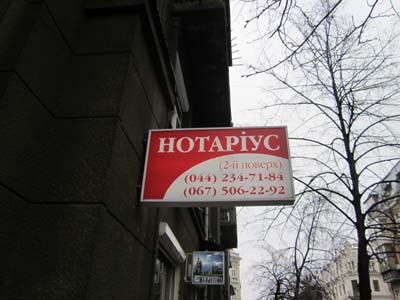
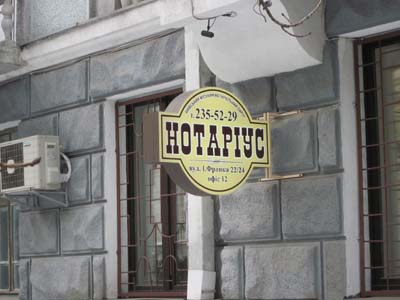
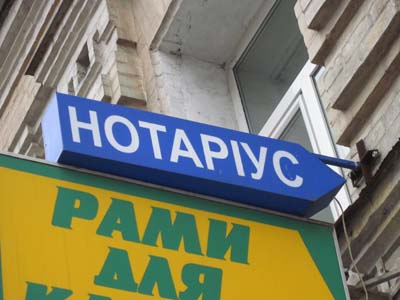
New visitors to Ukraine may be surprised by the ubiquitousness of Hot Topic stores (more so in Kyiv than L’viv it seems to me). With at least one, sometimes several, on every street, novice travelers might easily conclude the American retail chain specializing in music and punk/rock culture-related clothing and accessories has a strangle hold on the Ukrainian market.

But wait! Upon closer inspection, travelers semi-competent with Cyrillic letters may realize the signs are actually “Нотаріус” (No-ta-ree-us) which is Ukrainian for notary. Sorry, novelty T-shirt lovers. The abundance of notaries speaks to one of the most popular, activities of Ukrainians: getting things stamped.

Notary Sign in Ukraine - Notarius

Notary Sign in Ukraine - Notarius

Notary Sign in Ukraine - Notarius

Notary Sign in Ukraine - Notarius

Notary Sign in Ukraine - Notarius

Notary Sign in Ukraine - Notarius

Ukraine Tourism

My neighbor from Iowa came to visit me. Took the opportunity to be a tourist. Here are pics from the L’viv Opera, a late 19th Century Mansion is disrepair (the guard dog’s ferocity didn’t live up to the warning sign), a place called Stilsko where there existed a city in the 10th century — descended of present day Croatians according to our guide, and a nearby ski area called Slavs’ke. We took the chair lift up into the cold. There’s a surprising little commercial area on top of the mountain. We ate verenyky and kabobs to warm up from the cold chairlift ride.

Rizdvo (Christmas) in Ukraine

Ukrainians, including all the variants of Orthodoxy and Eastern Rite — a.k.a. “Greek” — Catholics (my peeps), celebrate Christmas Eve on January 6th.

I personally just celebrated Christmas Eve on the 6th, Christmas on the 7th, Maria’s Day on the 8th, and Stepan’s Day on the 9th.

Some Ukrainians begin celebrating on Roman’s Day, which is December 1st and I expect all my friends to remember that! And I know which of you have read this BECAUSE I BACKTRACED IT!

They continue with only a minor lull through St. Mykola’s Days on December 19th, which is when gifts are exchanged, to New Years, which is when gifts have been exchanged since Soviet Times — I think (The holiday seems to have adopted many of the atheist customs associated with western Christmas, including Christmas trees. A friend didn’t believe me when I told her American’s don’t exchange gifts on New Years.) through Christmas and the aforementioned holidays connected to it, on to Old Calendar New Year on the 13th/14th (there’s a blurb here which relates it to Slavic stubbornness, and finally to Yurdan (spelling?), which I thought was January 17th, but Ukrainian Wikipedia says it’s the 19th.

It celebrates the Christening, and I just spent 15 frustrating minutes failing to find an English-language reference to it. here‘s the translated Wikipedia page.

There’s a funny saying in Ukraine “From Romana to Yurdana is Ukrainian Ramadan,” meaning not that people fast or anything, but that they celebrate for a very long time.

Okay, I thought this was going to be a five-line blog post — a sweeping overview of sites and sounds. Obviously, I’m wrong.

I feel I ought to say something about the schism between Catholic, Protestant Christmas (December 25th) and Orthodox, Greek Catholic Christmas (January 7th).

Almost every time I write about this, I wander all over the internet getting the vocabulary straight, then send my email and instantly forgetting everything. No more, at least not tonight. It’s 1 am. I’m tired and hung over. (There is NO DAMN REASON for pounding shots with breakfast . . . and coffee, and lunch . . . ).

My dear fellow Ukrainians, you probably wouldn’t need to know 1001 home remedies if so many of you didn’t drink from breakfast onward. I’m going to go out on a limb and guess that the characteristically weak immune systems I so often hear Ukrainians mentioning and attributing to Chernobyl might have more to do with the ol’ fire water. I’m being harsh. Today was a holiday. A very special holiday. The Day of Stepan. Whoever that was.

So I’m not going to do my homework for this blog post. I’m going to keep sipping water, write this blog, maybe another 5-liner, a couple emails, then go to bed. I invite my readers to look up the Great Schism, the Julian, Revised Julian, and Gregorian calendars, movable feasts, dual dating, and whatever else Wikipedia might lead you to.

Okay, so finally, what I wanted to write from the start before getting tangled in history and tradition, is a brief overview of my Christmas, which was great, and could certainly have been worse:

Eating, drinking.
Going to the cemetery to put pine branches on the graves of relatives and freezing my hands trying to light candles.
Kneeling to pray before Christmas Eve dinner.
Eating, drinking at another table, and another, and another
Gold teeth, swollen hands, and fingernails thick as oyster shells.
America, diaspora, I speak so well, family, family, why aren’t I married yet — maybe you’ll find a Ukrainian girl, hehehehehehehehehehehehehehehehe.
Sledding on a sled, sledding on a bag.
Snowball fight.
A neice indifferent to her accent as she read the Green Eggs and Ham, my gift.
Cards.
Taking the nieces to carol under lit windows in their town.
Little devils, kings and kozaks wandering through town.
Nieces insisting my accompanying them was worth a cut, though I didn’t sing.
Me hiding the cash (45 UAH) in Green Eggs and Ham.
Them finding it and hiding it in my jacket.
A four day-long argument with the women over whether or not I could eat more.
A four day-long argument with the men over whether or not I could drink more.
Barely making it to the toilet in time at 3am of my first night.
A miserable hour of keeping myself standing in church, dizzy, dehydrated, exhausted, freezing, back and knees aching, cotton-mouthed sinning with my angry, impatient thoughts.
Holding my plate at arms length from the table because I really, truly, honestly, definitely could not eat any more, delicious though it was and it was.
Not resisting my new Kindle’s free 3g browsing and trying not to feel extravegant explaining it to cousins.
Meats, fats, pickled things from the garden (or the woods, in the case of the mushrooms), salads and vodka cognac wine.
Busting out the old back-wash-into-the-chaser trick so that I wouldn’t die.
The legendary pork jello.
Totally impressing the nieces with my mad Super Mario Brothers skillz (I knew that rigorous childhood training regime would eventually pay off.)
Kung Fu Panda dubbed into Ukrainian.
Stories about my grandfather and his sibling. (maybe I’ll share later.)
Insisting I had to go, finally, and telling them I haven’t seen this horse yet, the one I drink to as a parting kick in the balls from every table. Where is he? Okay, to that fucking horse.

***

Edit: I didn’t mean to imply I found myself in the company of drunks. They all seemed to hold their alcohol extremely well. There are lots of drunks in Ukraine, but not at the tables I joined.

15 Observations about Ukraine and Ukrainians

(FYI, I am one.)

1. They hate making change. If you offer a 100 or 200 UAH note, retailers will almost always ask if you smaller notes. Often they tell you they can’t make change. Sometimes, I think cabbies are just trying to get more money from me. Recently, a grocer will discounted the price because she couldn’t make change, and when I offered a tram driver a 10 UAH note for four 1 UAH tickets, she told me she couldn’t make change. She asked if we were making the return trip and suggested I buy eight tickets instead. Ridiculous. You’re in business, people.

2. They fear drafts. Even young men tell me, for example, which way I should lie in the train car to avoid a draft from the window. I think there’s a larger health fear in Ukraine. Some Ukrainians believe Chernobyl has weakened their immune systems.

3. They feed guests.

4. They think the worst of themselves. I’ve heard rude bureaucrats, poor customer service, unpredictable business culture, government failures all blamed on inherent flaws in the Ukrainian character. This is false. I’d attribute poor customer service, and business culture on the fact that the market has only been at work for twenty years and remains mutilated, the bureaucrats and government failure on the nature of coercive enterprises.

5. Emotionally tough. They can take disappointments much better than Americans.

6. Practical. This goes hand-in-hand with #5.

7. They know many home remedies for every ailment you’ve ever heard of, and most of the ones you haven’t.

8. Drinking customs. You clink glasses with every drink, not just the first. You don’t take your drink alone. When you see one person holding their glass, quiet down and hold yours. There is a preference toward having three (or six, or nine, or twelve, or fifteen) drinks — honoring the holy trinity, I think.

9. Embarrassed by their bathrooms. This goes back to #4.

10. Know how to cook.

11. Know how to tend gardens, livestock. (Good because it gives Ukrainians a fall back plan during economic crises. Bad because it lowers the division of labor.)

12. Religious. Especially in Western Ukraine.

13. In restaurants, you have to ask for the bill. When it comes, sometimes you’re expected to pay right away.

14. In business and even shopping for expensive items, personal relationships and recommendations carry even greater weight than they do in the U.S.

15. They want to know how they and their country are perceived (hence I started maintaining a list).

Also,

– often gawdy in popular expressions of art & decoration

– insufficiently skeptical of television commercials

– too often attribute west’s wealth to benevolent governments and effective welfare programs

– light switches in bad places.

Secret Potatoes

Happy New Year, everybody.

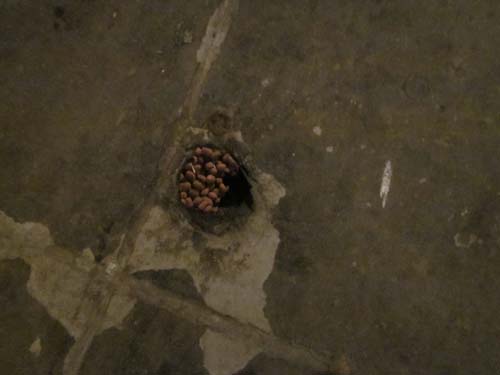
There’s a hole in the floor near the entrance of my building. I’ve been passing it several times a day since moving to L’viv. Once, to my astonishment, there was a light shining from within the hole. It was no ordinary pit.

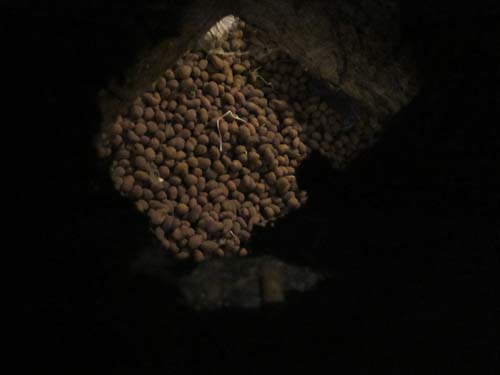
I looked inside and saw potatoes. I felt like a child discovering mysteries in the woods, like an explorer finding a lost civilization. I also felt tired, as it happened late and night. In the morning wasn’t completely certain whether I hadn’t dreamed the whole thing. I dutifully checked the pit every day from then on, but until a few days ago, it remained dark.

You can imagine my excitement when, almost as a New Year’s gift, the potatoes revealed themselves to me again. I sprinted up to my fourth floor kvartyra, and back down to produce this photographic proof:

t