My landlord slipped a note under my door. It came from the Post Office. I had received a package. I had been expecting one — a French Press — a personal gift from a dear friend in Prague.
I carried the note to the main post office where they told me to go to my local post office, number 18 or something.
The next day, I walked to a post office near my apartment. They directed me to yet another one near the bazaar. At that post office, they told me packages are handled in the adjacent building, but they only worked until three pm. It was almost four.
I left and made a mental note of the adjacent door, which had no sign or distinguishing markings. It did not seem like a post office, but it was the only thing even remotely matching the clerk’s directions. I returned the next day.
The door opened into a small chamber which could have been foyer or waiting room. There was a table with one tall stack of papers leaning heavily against the adjacent cabinet.
One of two chairs was occupied by a middle-aged woman who ignored me. I sensed her fanatical indifference to the world. She seemed capable of ignoring a locomotive, should one ever come crashing through the wall of that chamber. If indifference was a religion, she’d be a high priest.
I felt very much the outsider in a world loathe to acknowledge me. Perhaps it was my own insecurity, but I felt like Alice who initially struggled for the attention of Wonderland’s denizens. They ignored her as another uninteresting fixture.
“Is this the post office?” I asked, breaking the silence. I had the suspicion the lady would look right through me without seeing me. For some reason, I felt started by the fact of her reaction.
She said nothing, but waved her hand to a door opposite the entrance. I tested it. Its bolting mechanism was sufficiently ill fit that the door gave a centimeter or so before the bolt banged against the latch hole.
Immediately, I felt guilty of something, though I wasn’t sure what. The noise of the deadbolt had echoed in the chamber announcing my effort. Perhaps the noise condemned me as a sinner in this wonderland, guilty of desiring some outcome and working purposefully toward it.
The lady’s indifference remained. One might think of a Buddhist monk, but without any hope of reaching of Nirvana. Hers was a more perfect harmony, without hope and without fear. If you ever find yourself by the bazaar, please find this door and peak inside. I suspect she’ll still be there.
It occurred to me that I might not have sufficiently twisted the doorknob. Surely, anyone inside in the room would have heard the clatter. Should I test the door again?
I waited, hoping for some sign of sentient existence beyond the portal. Nothing.
I grabbed the door knob again, with both hands this time, twisted with all my strength. I clearly heard a latch-bolt retract, but when I pulled the door, again, what must have been a deadbolt pounded loudly against the latch hole.
I felt glad for my second try. Though it didn’t represent progress toward to my goal, I helped me understand the situation. I felt confidence of two things:
1) The door was indeed locked.
2) The second chamber was almost certainly uninhabited, because any occupant would certainly have reacted to my noisy appeal.
Though the outcome was unfavorable, I the issue’s resolution filled me with an albeit miniscule sense of accomplishment. I had tried exhaustively, but failed. Now it was time to move on. Perhaps this wasn’t the adjacent building they’d told me of. I would ask a local friend for help. Now it was time to move onto the next task.
Perhaps the pleasant thought of leaving wonderland, of returning to civilization is what inspired a playful feeling in me. I flippantly rapped the door with my knuckles before turning contently. I walked half way across the room before the sound of an opening deadbolt froze me in place.
I felt the hairs standing up on the back of my neck. Did I really hear it? Surely, a human would not have waited for me to knock. Surely, a human would have understood the meaning of clattering deadbolt in a public building during business hours. I turned slowly to the door, bracing for whatever demon or alien life form might hurl itself toward me.
I felt my heart pounding. Looking at the door, I adjusted my stance, braced to move quickly, to dodge or to flee. Nothing. There was only silence. The door did not budge. Only it’s deadbolt had been pushed open by someone, or someTHING. Was this an invitation? Was it a dare?
The woman did not return my gaze. I felt lost. I did not know the rules of this world and reminded myself that I had once been a paratrooper, that I was a three time combat veteran, a warrior and leader of men.
I turned the knob and the door opened with a squeak. An office. Definitely an office. Perhaps a Post Office. Two desks. A woman at one of them. She doesn’t notice me.
I had reassured soldiers en route to Afghanistan that things are much less scary up close. This certainly seemed to be the case here. I closed the door noisily. There was nothing to fear, but much to puzzle over.
I surveyed the room. The strongest hint of a postal vocation was the cubby shelving on the wall. Other than that, it could have been any sort of office: Cabinets, two chaotic desks, one with an old Cathode Ray Tube monitor atop it. There was no sign of a computer. The strangest thing seemed to be the woman scribbling busily at one of the desks and not acknowledging me whatsoever.
I imagined her ignoring the pounding of the deadbolt. I imagined her, annoyed by my interruption, eventually rising from her desk, slamming open the bolt and returning to her place. I stood in utter awe of her capacity to ignore me, and didn’t even think to say anything until she finally looked up from her work and said something so quickly that I understood nothing beyond the irritated tone of her voice.
I did not react to her impatience, though, as my sensibilities had not yet adjusted to this strange world. I would have felt no less baffled had I discovered a troop of Kozaks sipping coffee in my kitchen one morning, their horses drinking from my toilet.
She spoke again, pointing the scrap of paper which I had forgotten I was holding, the paper my landlord slipped under my door. For the first time since entering her office, I felt I was interacting with a human.
My wonderment ended, and I stepped toward her, offering the paper. She responded angrily, indicating that she did not want the paper handed to her, but placed on the desk. Clearly, these were self-evident rules in this wonderland, and I, very much the clumsy, bothersome tourist. I placed it on the desk, and she immediately snatched it up.
With surprising animation, she shuffled through some papers and boxes in one part of the room, then in another. She found my package, much to my delight, then placed in on the table and asked to see my passport. I signed two or three slips of paper, and she returned to her previous posture, huddled over her desk, scribbling.
“Is that it?” I asked.
“Yes, yes,” she said impatiently. “That’s it.”
“Thank you,” I said.
It seemed she no longer heard me, or saw me, but I was happy. I left, gently shutting the door behind me. The woman in the first room also seemed oblivious to my passing.












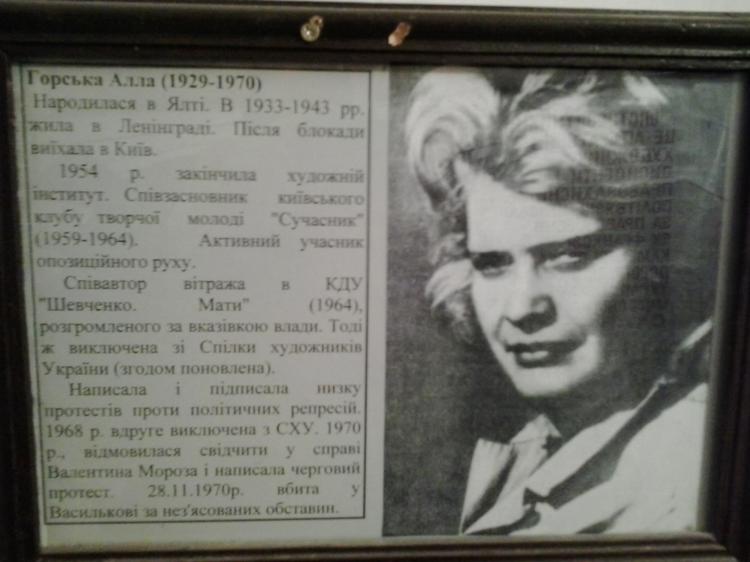





 “Соціалізм — це найчесніший людський лад. І він мусить виростати на чистій, на природній людській основі чесності, справедливості і взаємодопомоги людей, а не підтримуватись зграєю платних шпигунів, поліцейських, донощиків, кар’єристів, чиє ім’я — людська безликість. І за такий соціалізм варто боротися до скону.”
