http://arsenale2012.com/home/?lang=eng
Artists from all over the world.

http://arsenale2012.com/home/?lang=eng
Artists from all over the world.
Before I returned to Ukraine, a American who’s lived here for almost a decade advised that it’s not for everyone. “The toilet paper is definitely softer in America,” he said.
He was talking about all the little things which are more difficult in Ukraine. These are no big deal in my opinion, but they are interesting.
First, some reasons I prefer Ukraine . . . for now:
All in all, I feel safer in Ukraine than in the US, especially from violent crime.
Toilets work. (The privately owned ones, that is.) For an expose on American toilets see Jeffrey Tucker’s, The Relentless Misery of 1.6 Gallons.
The markets are much less developed. Opportunities abound. I walk around everyday and imagine various enterprises. I think: “this could work. That could work.”
Although there are real, devoted advocates of economic Marxism here, everyone considers them ridiculous. I think they’re mostly devoted to the sacrificed their ancestors made to the red banner and hammer and sickle. As I’ve written before, when an endeavor is sprinkled with the blood of good people, it becomes its own justification, regardless of whether or not is a moral and economic abomination. In the U.S. Marxism is treated like a good idea that hasn’t yet been properly implemented.
There is less cultural Marxism here. It is okay for women to be beautiful and men to be manly and people to be successful.
There is less of a slave mentality (maybe). Although the U.S. still has the hottest entrepreneurial talent in the world, by far, I feel like most Americans now have a slave mentality. They want to be caged and taken care of by the state. Perhaps it’s because government in Ukraine is such an obvious and spectacular disappointment, that most people (excluding pensioners) don’t expect anything from them.
Now, the bad:
1. Opening a door. There seems to be a 50/50 chance that the door will bump into another door, or a closet, or a person standing by the sink of a restaurant’s bathroom. Things aren’t designed as well in Ukraine.
2. Turning on a light. In most apartments that majority of light switches are centrally located. It’s as if the home’s commissar, following in the great socialist tradition, wanted a commanding height from which to bestow the blessing of light upon his subjects who are obviously too stupid to do it themselves. The result — I spend frustrating seconds switching lights on and off until I see, through the cracks of a door at the end of the hallway, that the proper switch has been flipped.
In renovated apartments, the light switches are no longer centrally located, but they are poorly placed. You have to reach around a door, for example, to flip the switch.
3. Unplugging something. If you’re not careful, the plastic socket casing will come out of the wall pulling guts and wiring with it.
4. Browsing the internet. It has to do with how IP addresses are assigned. When I unplug one laptop and switch the ethernet cable to the other, I have to wait for 30 minutes before I can use it. (This was solved when I got WIFI.) Also, if you misspell your password just once on a Ukrainian website, you’re immediately confronted with a Captcha verification. No second chance.
5. Showering. Hot water is unreliable, even in my gym. It’s getting much more reliable, though! Some building have gigantic water heaters beside them — again the Soviet lust from centralized control — but little by little, people are installing private water heaters in their homes. Many bathrooms are small and crowded, and many showers are handheld, with the fixture for fastening the nozzle above you broken. I’m learning to wash single-handed.
6. Going to a restaurant. There is the generally poor customer service which I’ve written about before. There seems to be a common practice of labeling every table “reserved” on certain nights. A place will be half empty, but every seat and table will be marked “reserved,” and you’ll get scolded for sitting there. (What the fuck?) You’d think they’d welcome your money. They don’t even offer to sell you a reserved table. Perhaps it’s up to me to offer them money. I don’t understand this system.
7. Shopping. A store may be locked during normal business hours with no explanation. Or, the main door may be locked and you’ll never realize that only the side, alley-way door is open. When you point it out, the lady behind the counter will have no idea why you’re bothering her with such trivialities.
Also, in Soviet times, shops were run by the government. The clerk, much like the clerks Americans interact with at the Department of Motor Vehicles, is a government employee who enjoys a monopoly on the “service” they offer. They were rude as hell, and asserted their authority by abusing customers. The legacy of this is that some retail people assert their authority by being rude. This is changing slowly. The free market takes time. Businesses with bad customer service has to go bankrupt or change. The best ones will slowly increase their market share. The further a market is from free, the slower this process. Also, you have to pay for your bag and bag your items yourself.
8. Finding your way around. Street signs are not located at intersections. They are *sometimes* located on little placards on buildings. I’ve walked a quarter mile trying to figure out the name of the street I had turned onto.
Address numbering is weird. It can still be in the single digits on one side of the street, while on the other they’re reaching the thirties. Some addresses are inside courtyards accessible only by alleyways.
Also, major roads in Kyiv (and in some other cities) are crossed by going through underground passageways. They are often filled with shops and it’s impossible to go the direction you think you need to go.
9. Checking a movie listing. Once while walking through Kyiv, sounding out the names of stores, I noticed a ‘kinoteater,’ a theater. There was no brightly lit sign depicting movie listings as one may find in the US, so I went inside. I studied the various posters and announcements above the ticket booths, but found no listings until a crowd off to one side attracted my attention. They peered over each other’s shoulders to study an 8 1/2 by 11 sheet of paper taped to the wall below eye level on which the listings were printed in black & white. Hunger Games was not playing.
10. Water deliveries. Despite repeated promises, they don’t arrive. (Ukraine’s tap water is non-potable.)
11. Calling a cab. The operator of a cab company hung up on me suddenly and without explanation as soon as we began to have difficulty understanding each other. When I called back the first time, the same lady answered. She recognized my voice and hung up instantly. I called back a third time, got a different operator and ordered my cab. I still use them, because they’re inexpensive and tell you the price beforehand. When no cabs are available, sometimes you’ll get a text message telling you. Sometimes they just leave you waiting.
12. When it rains neither umbrellas nor taxis seems to be available.
13. Interpersonal space. Ukrainians sometimes have a strange sense of it. Example #1: When the metro leaves a station, it is not usual to be tapped on the shoulder immediately and asked whether you’re getting off at the next station, simply because you’re standing between another person and the door. They expect to switch spaces with you even if it’s too crowded to switch spaces, even if you’re the only person between them and the door, and even if you’re a nice person who always gets out of the way for people.
Example #2: I went to eat at an inexpensive local buffet style restaurant called Puzata Xata. There were many free tables, but beside the windows, there was only one. A small table. It had a blue folder on it. I didn’t see anyone nearby, so I sat there and began to eat. A middle aged woman put her tray down opposite me and sat down. She rummaged through her purse. “Was this table taken?” I asked in Ukrainian, ready to move elsewhere if it was. She seemed not to hear me. I asked again, a little louder. She didn’t react in the slightest, and I wondered if she was deaf. “Excuse me,” I said in English. Again, no reaction. She pulled a cell phone from her purse, and then I knew she wasn’t deaf. She was ignoring me. “Was this table taken?” I asked again in Ukrainian, determined to get an answer. She looked at me angrily and said “Well sit. It’s a common area. Sit and eat. What do you want?” We both ate our food, sitting just a few feet apart facing one another. Both of us took phone calls during our meal. I left when I finished.
14. Boorish behavior. The lady behind me in line at the supermarket kept tapping my bag, accidentally, I thought. I was in a good mood and felt more shocked and amused than irritated. She seemed to be with her husband or lover. He was whispering softly to her in Russian. I guess her tapping was supposed to be a hint that I didn’t grasp. Eventually, she shoved me from behind. I turned around, shocked. She raised her chin defiantly. The man immediately grabbed her and moved himself between us. He scolded in in the same gentle, lover’s voice. The line was unusually long and slow — late night rush. Eventually, she shoved me again. I think she felt frustrated that I wasn’t crowding the person in front of me. I turned around and again the man put himself between us, and lectured her. I did too. I told her I was a foreigner. That in America people don’t push each other. She waved her hand dismissively and said something like “move along America.” Her man continued to gently berate her in a lover’s voice. He said something like “this man came all the way from America to visit us and his is how you’re treating him.”
Pretty pathetic behavior from an adult. I was on my way home from Brazilian Jiu Jitsu and therefor in a good mood. I was more stunned than anything else.
15. Banking. This is related to the interpersonal space issue. When I go to a bank, to inquire about my account, withdraw money, or the like, the people behind me in line are right up in my shit. Their noses are on my shoulder. They watch closely as I fill out forms, count money. Sometimes they pretend I’m not there and begin conversations with the teller while she’s in the middle of helping me.
16. Leaving your apartment. You need a key, sometimes two. This is a fire hazard catastrophe waiting to happen.
17. Toilets in public places. You have to pay an attendant. Despite that, they are filthy. Often, they are squat toilet. Often, they are filthy squat toilets. Filthy, pay squat toilets.
18. Old ladies closing the windows on public transportation. Okay, so most public transportation is crowded, a little dirty, uncomfortable, etc. Ukraine’s public transport has the added feature of, old women who sincerely believe that drafts (as opposed to germs) cause disease. It’ll be miserably hot, steamy and smelly on a public bus, and some idiotic, sweater-clad babushka will insist that the windows be shut. She’ll insist as if her life depends on it, because she believes it does.
19. Removing a price tag, especially from a cup or dish. They don’t have the ones that come off smoothly like in America. These bastards are sticky and fall apart. Once you’re done picking off the paper — one torn bit at a time, you have to use a scouring pad to remove the glue from your new dishes.
(I’ll likely be expanding this post as more things occur to me.)
I like to describe Ukraine as not quite designed for humans . . . yet. Socialism is not designed for humans, and Ukraine, given the perversion and distortion that characterizes it’s two decades of lurching away from the Soviet system, is recovering slowly.
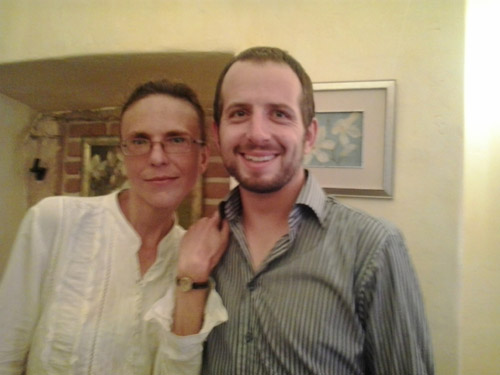
The opening of my cousin’s art exhibit in L’viv. :)


I’m afraid I didn’t take any pictures the city itself or its defining characteristic: the wide, shallow river running through the city center, in which fisherman stand from dawn to dusk.
Here are a few other pics:


Obolon district. Kyiv.
The lady behind me in line at the supermarket kept tapping my bag, accidentally, I thought.
I was in a good mood and felt more shocked and amused than irritated. She seemed to be with her husband or lover. He was whispering softly to her in Russian. I guess her tapping was supposed to be a hint that I didn’t grasp. Eventually, she shoved me from behind.
I turned around, shocked. She raised her chin defiantly. The man immediately grabbed her and moved himself between us. He scolded in in the same gentle, lover’s voice.
The line was unusually long and slow — late night rush. Eventually, she shoved me again. I think she felt frustrated that I wasn’t crowding the person in front of me.
I turned around and again the man put himself between us, and lectured her. I did too. I told her I was a foreigner. That in America people don’t push each other. She waved her hand dismissively and said something like “move along America.” Her man continued to gently berate her in a lover’s voice. He said something like “this man came all the way from America to visit us and his is how you’re treating him.”
Pretty pathetic behavior from an adult. I was on my way home from Brazilian Jiu Jitsu and therefor in a good mood. I was more stunned than anything else.
Euro 2012 is almost over. Italy plays Spain on July 1st for the Championship.
I was happy to watch Ukraine overcome Sweden at a bar with friends, and to watch one albeit unimportant game in the Kyiv Stadium (Sweden v. France after both their fates had already been settled).
The long-anticipated event seems to have more-less gone off without any major problems. All the tourists I spoke with were very impressed. That’s the surface.
Behind the surface was, as is characteristic of tax-funded endeavors, massive, massive corruption. It’s highlighted in this ̶U̶k̶r̶a̶i̶n̶i̶a̶n̶ Russian-language video:
[youtube]3SxOso5tbjI[/youtube]
“Even as the Euro 2012 soccer championships kick off Friday, it’s already clear there will be big losers in host countries Poland and Ukraine.
The first former Soviet-bloc nations to host the quadrennial tournament have spent almost $39 billion getting ready, including $25 billion in Poland and $14 billion in Ukraine. Besides accommodating an expected 1 million soccer fans, the two countries are betting that new stadiums, roads, and other infrastructure will help give a nice boost to their economies and local companies.
So far, it hasn’t worked out that way. Three of Poland’s biggest construction companies have declared bankruptcy in recent weeks after running up hundreds of millions in losses on Euro 2012 projects. ” (Read more from businessweek.com)
Here are some pics I took through the experience:


First training in Ukraine! The new BJJ club is right near my place. Also, beside a grocery. Now I’m eating my bodyweight in fresh cherries.


Every since I paid an outrageous 250 UAH for my first trip from Kyiv Borispol Airport, I’ve been ignoring the cabbies.
They seem to accept my body language, and no longer even try to take me for a ride. I call one of two taxi companies who quote a price over the phone. It’s nice, though they are sometime rude. The girls will hang up on you if they don’t understand you, and hang up again when you call back.
Anyway, the price is usually 130 UAH.
Recently, just out of curiosity, I approached the official looking black and yellow taxi booth in Terminal B.
“How much to the center?” I asked.
“What street?”
I told her.
Without consulting any computer or chart, she thought for a moment and said 260 UAH. I laughed out loud.
I expect many soccer fans to get cheated during Euro Cup 2012.
There were a bunch of transactions on it in Moscow.
4th time I had my debit/credit card stolen. 2nd time they resulted in ATM withdrawals in Moscow.
ffffffffuuuuuuuuuuuuuuuuuu!
Anybody know how this happens? What should I do differently?
Here is a map of where it was used in Moscow:

The orange marker shows the ATM where 4 transactions were made. The other markers show “Victoria” supermarkets. At one of them, a $300 transaction was made.
I’m pretty sure my info was stolen when I made an ATM withdrawal in Kyiv at Mezhyhirs’ka street 54.
I was carrying a plastic bag in addition to my shoulder bag, so I think that helped me look Ukrainian. As is becoming my routine, I worked till 6:30 in the morning, then went to the gym, then went to eat. Mafia, a Japanese & Italian food franchise with good wifi wasn’t opening for another 10 minutes, so I went to the Videnski Bulochky (Viennese Buns) next door. I ordered in Ukrainian and the lady asked me something extensive in Russian.
“I’m sorry, I don’t understand very well,” I said in Ukrainian.
She cocked her head and looked at me like I was teasing her. “You don’t speak Russian?” She asked, eyeing my clothes. I probably looked too modern for her guess that I’d just arrived from some village.
I would like to speak Russian. I studied it for two years in high school, but remember very little. I’m sure I’ll get better the more time I spend in Kyiv. People describe the Ukrainian – Russian divide as a west-east divide, and it is, generally, but it’s just as much a country-city divide. When I visited the Parkhomivka Art Museum in the countryside near Kharkiv, people spoke Ukrainian.
“No,” I said.
“You speak Ukrainian, but don’t understand Russian?”
“Yes,” I said, then, to assuage any belief that I might be teasing her, I added: “I’m from America.”
“You’re from America and you don’t speak Russian, but you speak Ukrainian?” she asked, now smiling.
“Yes.”
“I’ve before met anyone from America who speaks Ukrainian, but not Russian.” She confirmed that I wanted the omelet breakfast and asked if I wanted tea or coffee, green or black tea, then lemon or honey.
Good wifi here. :)
Here’s a story posted with permission from a friend of mine. Remember, the conversion rate is 1 dollar to 8 hryvnas. So 100 Hryvna is about $12:
So my roommate goes to a clinic that is right around here, its
actually a clinic for the employees of the Ukrainian river transport.
The employees get treated for free. Public clinics are also free but
very shitty, they are also based on your address. The doctor that
would be considered my doctor at the neighborhood clinic is a horrible
bitch on wheels. And when I say free, I mean technically free but you
should give then like 20-50 hryvna or a chocolate bar if you don’t wan
them spitting in your blood samples.
So I didn’t think I could go to the clinic for the river transport
employees, because its technically private, but its not, as long as
you give the doc like 150 hryvna that he just pockets. you don’t make
an appointment through the main office cuz they will ask for your
registration card # which you don’t have. But you call the doctor
directly and see him. He even gave me a discount of 30 hryvnas because
my roommate refereed me. So 120 is a pretty good price for a
consultation, its usually 200-380. + and here is the kicker, I was
sent for an ultrasound of the abdomen and that thing where they shove
a tube with a camera through the esophagus into the stomach. Can you
Imagine how much that would cost in the states? and even here, here
ultrasound is like 300-500 hryvna.
So he gives me the # of his doctor friend at the private hospital for
river transport employees, I call her, go over there, she personally
takes me over to the ultrasound department, vouches for me as if I’m
her patient, then takes me over to the other department and does the
same thing. She tells me to give each lab 100 hryvna and that’s that,
the lab technicians just pocket the money. in all, that’s like 50$ for
something that in the states with no insurance would be like 1000$,
and even with insurance, there is still usually a copay of 10-30$ no
matter where you go.
Also unlike in the states, they tell you the results as soon as they
do the procedure, none of that “we will send it to your doctor in 2
weeks and you should make an appointment with him to talk about this
test in a month”. And the results of the blood work get sent to your
email in less then 24 hours.
I thought you would like that.
It had no hot water (at least not on my first visit) but it did have a four-lane bowling alley partially seperated from the weight room.
Also, hand-written membership cards too big for any wallet.
Such little things make every day interesting in Ukraine.
August 12, 2010, morning:


August 5, 2011, 8pm:

On Thursday night, I rented a car, loaded it to eye level with my three enormous pieces of luggage from Ukraine plus some of the boxes of my old thing which my other had, then, too restless to sleep, decided to drive right away.
I napped twice during the trip for thirty minutes each — once at six am in a McDonalds parking lot where I put sneakers over the parking break and seat belt buckle to soften them, and second time on the should of a highway off ramp where I pulled in front of a big rig whose driver, I imagine, did the same as me. There, I slept seated and I woke when the car became hot at about 10:30am.
I detoured to visit a friend at Notre Dame University. We had lunch instead of dinner because I made great time and would get a discount for returning my rental car within 24 hours. He gave me a tour and a Time Magazine with an article entitled Five Myths About the Economy. One of the myths was “the free market can fix it,” another “entrepreneurs drive the economy.”
I got snagged in horrible Chicago traffic, where I wondered about the innovative and courageous bureaucrats tasked with managing the transportation system.
Hard, intermittent rains fell for the last hour of my trip in Iowa, as the glow of the sun shown behind clouds before me. I arrived at my condo in the cool, damp evening and remembered the combination to my garage door. It opened on my first attempt, as if I had been there just yesterday. All my belongs looked clean and intact and the only smell was that of mothballs. A small, year-long worry vanished.
There were three racoons in the dumpster. I left the lid open.
I unpacked my car and hurried to the Cedar Rapids Airport, dropped off the car, $398 instead of $582 since it was just a single day. I have no idea why the cost of one-way rentals has skyrocketed. Then, excited by the turns of my life unfolding before me and feeling awake and alert, waited for my friend Regina to pick me up.
I think this will be a big year for me.
I review my finances monthly. At the end of July, I noticed an ATM withdrawal on the 15th of that month for $178.63 from an ATM in St. Petersburg Russia (ATM W/D 0317, 00888519 LENTA ST).
I’ve never been to Russia. I’d been back in the U.S. for three weeks when the suspect withdrawal happened. Either they knew my balance, or guessed really well, because my account only had about $200.
My bank, Hills Bank, was really nice about it. I filled out a form and they sent it to their investigator who contacted me. There’d been another withdrawal from another St. Petersburg ATM in May (ATM W/D 0338, 00069616 RBA ATM 19881). That one for $354.33 when my account had just a little over $400.
Clever patient criminals.
She said ATM fraud is rare, because they need to either counterfeiter the card or do something else I didn’t quite understand. The day of that May fraud was the day I gave three lectures at Donetsk University of Economics and Law, so I’m certain I didn’t make any ATM withdrawals, and certainly not in Russia.
In any case, Hills Bank is taking care of me.
I think I did good following the Fulbright office’s advice, though when I heard it, I thought it excessively cautions. I sheltered my main banking account by opening a checking account at a separate bank and used it for month-to-month expenses and ATM withdrawals.
Anyway, this is the second financial fraud I experienced from my trip.
The first was stopped before the transaction went through. The criminals did get some money from this one, but I was reimbursed without too much difficulty.
The biggest losers are Ukrainians (not to mention Russians), because this type of stuff keeps investors away from their desperately under-developed economies.
[youtube]FGHzI2apBBM[/youtube]
From arbroath.blogspot.com: Zoo officials say the Albino California Kingsnake has two heads that think, react and eat separately, though one is more passive than the other.
The head of the zoo said that the two heads sometimes compete with each other for food.
Because of that, zoo workers have to put a barrier between the heads when feeding the snake. The zoo said two-headed snakes are extremely rare, appearing once in every 50 years.
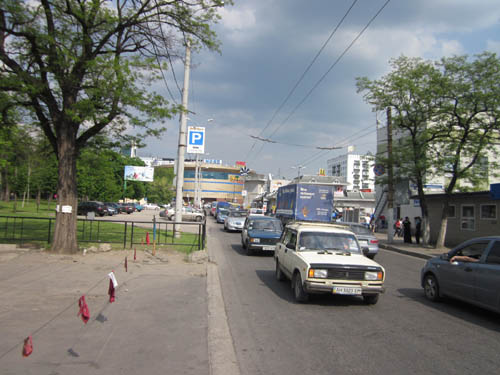
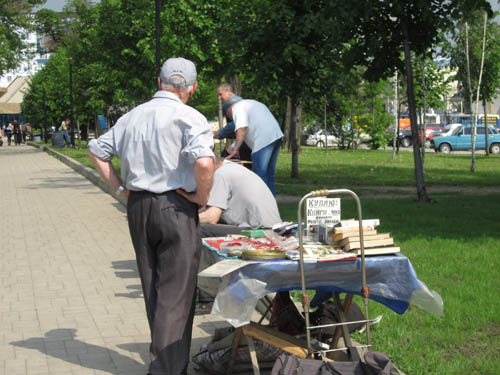
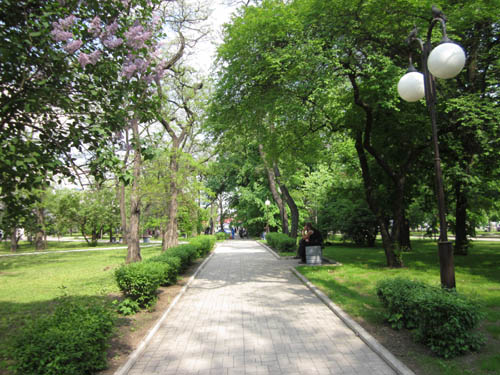
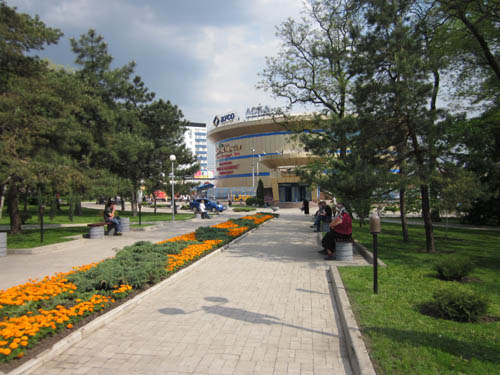
I expected Donetsk to be a gray, industrial place. This wasn’t the case at all. There is an extraordinary number of trees. I was told the city was recognize by UNESCO in 1970 as one of the greenest industrial cities in the world.
They are known for steel production, coal mining and roses.
I was struck by how the public areas — parks, roads, sidewalks — are so much better maintained in Donetsk than in other parts of Ukraine. Feel free to speculate as to why.
I gave five lectures in two days and will post the two that I recorded soon.
Two law students and I went out for coffee. They talked about the impossibility of starting a business in Donetsk without the right connections.
There were foreigners in the streets, but Arabs, Chinese and Africans — few westerners, just like in Kharkiv.
My hosts were very gracious. They offered me a wonderful tour of the city and worried like two mothers when I told them that I’d walk around a bit on my own in the evening. One made repeated calls to my mobile to make sure I was okay.
One lady I spoke with said “there isn’t much here, but we like our city.” Many Ukrainians seem to think the worst. I feel like Donetsk has quite a bit to offer. She also said “we speak mostly Russian here, but we are Ukrainian too,” and she seconded her Ukrainian credentials by telling me her husband is descendent from one of Bohdan Khmelnytski’s Atamans (generals).
One law school student asked me about national socialism in L’viv. I told them it is mostly the politicians, and that the people I speak with who have a national socialist inclination are mostly just scared about losing their language and culture. I said that commerce can make anybody peaceful. It forces people to cooperate.
I also spoke with one entrepreneur who endured a grueling two-year fight against corporate raiders and, amazingly, prevailed. “If I hadn’t generated so much publicity,” he said, “they would have killed me for sure.”


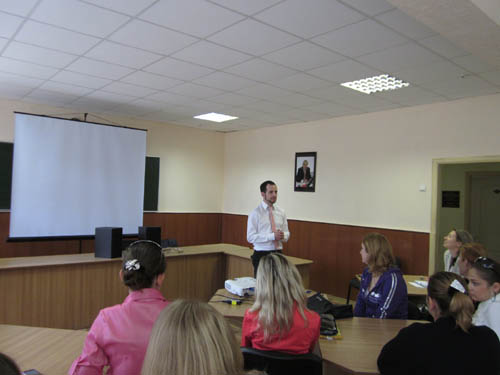
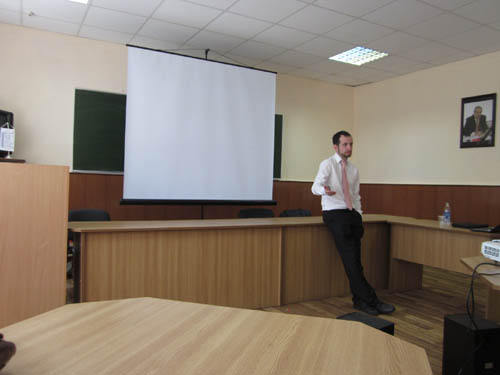
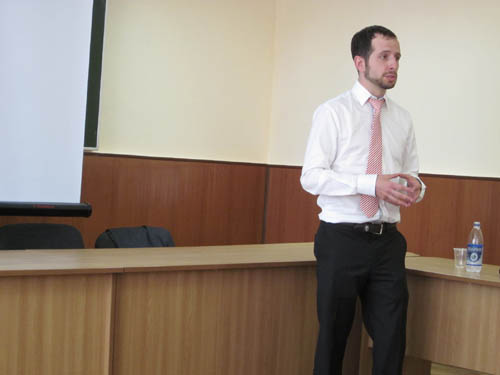
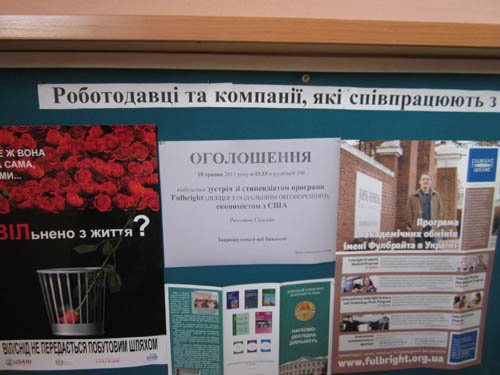
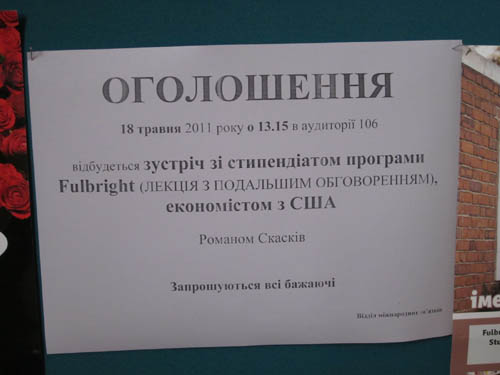
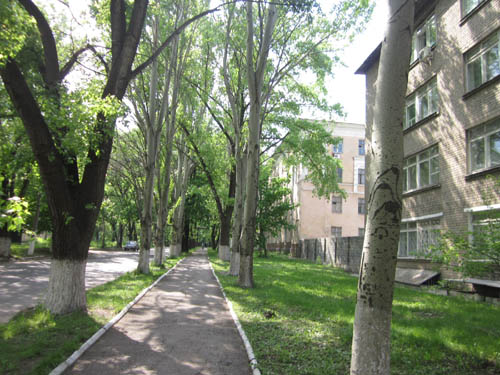



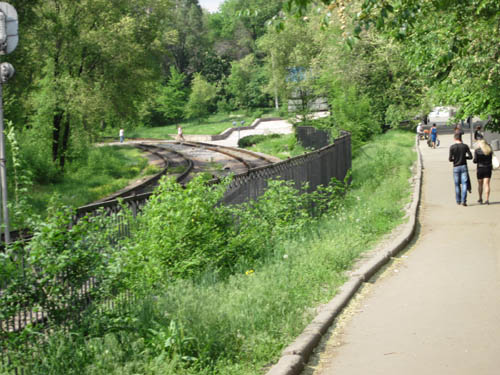
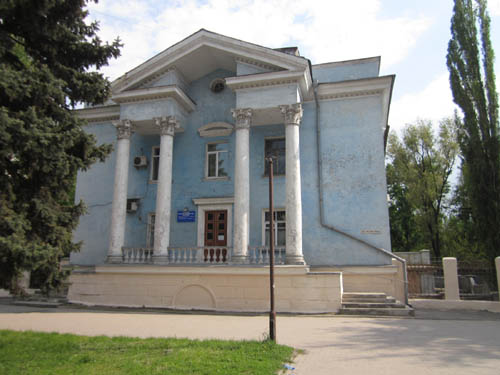
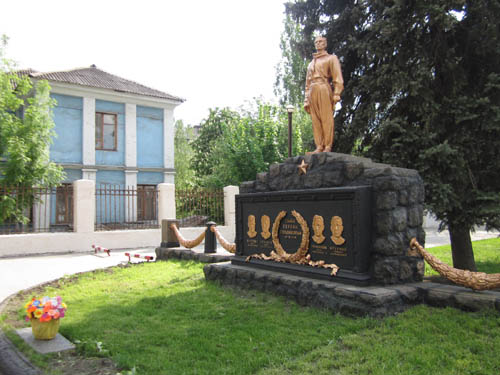
Shakhtar, Champion! Shakhtar, Champion! Shakhtar, Champion!
I miss walking around and imagining history, including the specific history of my ancestors during the insanity of the previous century. It’s a burden, that weight of history, but I miss it now that it’s gone. It’s also a tether to help me understand who I am. I also miss the coffee culture, my uniqueness as a Ukrainian-speaking American, and the endless interesting places to visit.
I miss being in a place that is not politically correct, the universal cynicism about government, and the excitement of a market economy that hasn’t even reached its 21st birthday.
As of a few days ago, I’m back in the United States, western North Carolina to be more precise.
America’s wealth is immediately apparent: the wide, smooth roads, big houses, even for poor people, store after store after store selling cheap, high quality goods.
I made a few trips in my mother’s car to buy a coax cable, brackets and other supplies for some minor repairs in her new house. I was struck by the monumental investment in commerce. Huge tracts of land dedicated to making my patronage as convenient as possible. I imagined all the people hoping I’d stop at their store to buy home furnishings, groceries, lunch, tax advice, mobile phone service, paintings, building materials, pet supplies, discount clothing, electronics.
I paid $2.40 for twenty five feet of RG 6 coax cable. How do these places stay in business with such low prices? I had to explain what I wanted and wait for a while as they made it. At Lowes, the same cables was available for $10, ready made and hanging abundantly on their shelf. A higher price for more convenience? I love choices.
For a while everything seemed possible. Everything seemed to be at my finger tips. For my every desire, it seemed some merchant was desperately trying to provide at a price I could afford. I tried imagining my second cousin’s visit to Toronto in 1990. She was startled by the question “what type of tea would you like?” never before realizing more than one type existed.
I was reminded of the power and ingenuity of the human spirit as it once existed in the United States, unhindered by populist claims of social responsibility by which everybody puts their fingers in everybody else’s pocket. As William Faulkner expressed it:
that man’s inalienable right [to pursue happiness] was the peace and freedom in which, by his own efforts and sweat, he could gain dignity and independence, owing nothing to any man.
OWING NOTHING TO ANY MAN! Do you hear that, leftists??? I want my country back!
Faulkner went on:
the enemy of our freedom now has changed his shirt, his coat, his face.
He no longer threatens us from across an international boundary, let alone across an ocean. He faces us now from beneath the eagle-perched domes of our capitals and from behind the alphabetical splatters on the doors of welfare and other bureaus of economic or industrial regimentation. . . .
His artillery is a debased and respectless currency which has emasculated the initiative for independence by robbing initiative of the only mutual scale it knew to measure independence by. . . .
to believe this, that man’s crime against his freedom is that there are too many of him, is to believe that man’s sufferance on the face of the earth is threatened, not by his environment, but by himself: that he cannot hope to cope with his environment and its evils, because he cannot even cope with his own mass. . . .
Which is exactly what those who misuse and betray the mass of him for their own aggrandizement and power and tenure of office, believe: that man is incapable of responsibility and freedom, of fidelity and endurance and courage, that he not only cannot choose good from evil, he cannot even distinguish it, let alone practice the choice. And to believe that, you have already written off the hope of man, as they who have reft him of his inalienable right to be responsible have done, and you might as well quit now and let man stew on in peace in his own recordless and oblivious juice, to his deserved and ungrieved doom. . . .
What we need is not fewer people, but more room between them, where those who would stand on their own feet, could, and those who won’t, might have to. Then the welfare, the relief, the compensation, instead of being nationally sponsored cash prizes for idleness and ineptitude, could go where the old independent uncompromising fathers themselves would have intended it and blessed it.
Let’s hope that after the collapse of the dollar, America regains its lost liberty, and more importantly, its lost spirit of self reliance and responsibility.
I made of list of impressions as they came to me, writing them on a notepad on my pocket:
* Wealth. The amount of wealth accumulated in the United States is mind boggling.
* Polite customer service — this excludes TSA workers.
* Obese people.
* The stewardess is required to teach Americans how to put on their seat belts. Home of the brave, baby!
* People dress much more casually.
* At stores, I get accurate change every time and without question. (In Ukraine, they’ll bother you for exact change, or other small bills and coins to reduce the volume of change.)
* Standing in lines is much more ruly. There’s no consuming fear of losing one’s spot. Perhaps this is because the United States has known famine and mass shortages (except during FDR’s New Deal).
* Money looks different.
* Lawns instead of gardens. My first thought concerned all the wasted fertility, all the vegetables and chickens which might be raised, but then I thought: No! Division of labor. Specialization.
* No more adapters for my laptop power cords.
* Much more processed food.
Stay tuned. I will blog about Donetsk next and post my lectures.

